

The Public Reading of Scripture
In our study of worship, we left off considering the various parts or elements of worship. So far, we’ve looked at preaching, giving, and prayers. Next, let’s consider the public reading of Scripture.
I would argue that the most important reform of the Protestant Reformation was the return to the Bible as our sole authority. The reformers moved the table for the Lord’s Supper to the side of the sanctuary and placed the pulpit front and center, not to diminish the Supper, but to emphasize that the Bible and its preaching must come first. Without the Bible, without God speaking to us, we have no authority to practice the Lord’s Supper. We would not even know how to observe it. The same is true for all of worship and the entire Christian life. We must recognize the authority of Scripture and reflect that in all we do as the church.
This includes not only preaching but also the public reading of Scripture.
Listen to what the Apostle Paul tells Timothy in 1 Timothy 4:11–16:
Command and teach these things. Let no one despise you for your youth, but set the believers an example in speech, in conduct, in love, in faith, in purity. Until I come, devote yourself to the public reading of Scripture, to exhortation, to teaching. Do not neglect the gift you have, which was given you by prophecy when the council of elders laid their hands on you. Practice these things, immerse yourself in them, so that all may see your progress. Keep a close watch on yourself and on the teaching. Persist in this, for by so doing you will save both yourself and your hearers. (1 Timothy 4:11–16)
Paul is addressing Timothy as a pastor, instructing him in his responsibilities. Among them is a devotion to the reading of Scripture in the church.
Not all translations make this as explicit. The King James Version reads, “Till I come, give attendance to reading,” which could suggest private reading or leave the object unspecified. But the Greek includes a definite article before “reading,” indicating something specific—“the reading.” Paul writes, “Devote yourself to the reading, to the exhortation, to the teaching.”
This parallels what we saw in Acts 2:42. The early church did not devote themselves merely to prayer in general, but to the prayers; not merely to teaching in general, but to the apostles’ teaching; not merely to fellowship in a vague sense, but to the fellowship and the breaking of bread. The definite article points to identifiable, established practices of the church. The same is true here with “the reading.”
When we consider the context, it becomes clear that Paul has Timothy’s public ministry of the Word in view. “The reading” is closely tied to “the exhortation” and “the teaching,” and the instructions concern Timothy’s conduct before the gathered church. This is both a public reading and a reading of Scripture. What else would Timothy read and teach from in the church’s corporate worship?
For this reason, modern translations are right to render the phrase as “the public reading of Scripture.”
Even so, it is not always obvious to churches that the reading of Scripture should be an essential part of worship. In some churches, the only Scripture reading occurs incidentally, as the pastor references verses during the sermon. I have even heard sermons in which the pastor never quoted Scripture once—only retelling or alluding to biblical stories without actually reading the text.
I once had a minister advise me never to read more than ten verses of Scripture at a time, arguing that people would lose interest. But that misses the point entirely. The one moment when the congregation can be certain that what they are hearing is true is when the Word of God is read. Everything else a pastor says must be tested against Scripture. God’s Word is sufficient, certain, and infallible. Men are not.
In the Old Testament, God’s Word was read publicly among his people. In Deuteronomy 31, Moses commands that the Law be read every seven years at the Feast of Booths so that all Israel—men, women, children, and sojourners—may hear and learn. In Joshua 8, Joshua reads “all the words of the law” before the entire assembly. In 2 Kings 23, King Josiah gathers the people and reads the Book of the Covenant, leading to national repentance. In Nehemiah 8, Ezra reads the Law from morning until midday while the Levites explain it so the people understand.
This pattern continues into the New Testament. When Jesus enters the synagogue in Nazareth, Luke writes,
As was his custom, he went to the synagogue on the Sabbath day, and he stood up to read. And the scroll of the prophet Isaiah was given to him. He unrolled the scroll and found the place where it was written— (Luke 4:16–17)
Likewise, in Acts 13:
On the Sabbath day, [Paul and Barnabas] went into the synagogue and sat down. After the reading from the Law and the Prophets, the rulers of the synagogue sent a message to them, saying, “Brothers, if you have any word of encouragement for the people, say it.” (Acts 13:14–15)
Paul’s own letters were also intended to be read publicly in the churches, which Peter refers to as Scripture (2 Peter 3). Paul tells the Colossians, “When this letter has been read among you, have it also read in the church of the Laodiceans” (Colossians 4:16). To the Thessalonians, he writes, “I put you under oath before the Lord to have this letter read to all the brothers” (1 Thessalonians 5:27).
Finally, Revelation 1:3 says, “Blessed is the one who reads aloud the words of this prophecy, and blessed are those who hear.”
The Old Testament establishes the pattern of publicly reading God’s Word in worship, and the New Testament continues it. This should not surprise us. Worship is, at its heart, hearing from God and responding to him with praise.
The Congregation’s Amen
Speaking of praise, consider the next element of worship: the “Amen.” This touches on the congregation’s response in worship. Singing is certainly part of that response, but so is the spoken “Amen.”
You might ask, Is the saying of “Amen” really an essential part of worship? Before answering, consider this insight from Sam Waldron:
True worship in the church should be an expression of corporate unity. It is not Pastor Joe doing his thing in the morning worship and Pastor Sam doing his thing in the evening worship, and the only one who gets excited about the worship of God is the preacher and the leader of worship. That ought not to be. When visitors come into worship, they ought to be able to easily see that there is a whole multitude that agrees. The rebel should not leave thinking that he has a controversy only with the preacher. He should realize that he has a problem with the whole church. There should be expressed a corporate unity in the worship of God.
In other words, the congregation should respond to the prayers, preaching, and reading of Scripture in a way that clearly expresses agreement. When an unbeliever visits and disagrees with what he hears, he should recognize that his disagreement is not merely with the church’s leadership but with the entire congregation. Our unity in the truth ought to be evident.
Waldron adds, “Would the unbeliever look at you and say, ‘I don’t believe a thing they’re saying, but it is clear that they do. His whole soul is involved in this matter of worship.’”
There are, of course, other ways to express engagement and unity—singing, attentiveness, posture. But few responses are as clear and unmistakable as an audible “Amen.”
More importantly, what does Scripture say? Is this a biblical element of worship? The answer is yes, and it appears in a variety of contexts: following curses, praises, proclamations, benedictions, and doxologies.
In Deuteronomy 27, the Levites pronounce covenant curses, and the people respond, “Amen”:
“‘Cursed be the man who makes a carved or cast metal image, an abomination to the LORD, a thing made by the hands of a craftsman, and sets it up in secret.’ And all the people shall answer and say, ‘Amen.’
“‘Cursed be anyone who dishonors his father or his mother.’ And all the people shall say, ‘Amen.’
“‘Cursed be anyone who moves his neighbor’s landmark.’ And all the people shall say, ‘Amen.’ (Deuteronomy 27:15–17)
In 1 Chronicles 16, the people respond to praise: “Blessed be the LORD, the God of Israel, from everlasting to everlasting! Then all the people said, ‘Amen!’ and praised the LORD” (1 Chronicles 16:36).
In Nehemiah 8, after the Law is read and explained, “all the people answered, ‘Amen, Amen,’ lifting up their hands … and they bowed their heads and worshiped the LORD” (Nehemiah 8:5–6).
Amens also follow benedictions. Romans 15:33 reads, “May the God of peace be with you all. Amen.” While Paul may have written the “Amen,” these letters were read aloud in the churches, and the implication is that the congregation would respond in kind.
Even in heaven, the corporate response includes the amen. Following a doxology in Revelation 5:
I heard every creature in heaven and on earth and under the earth and in the sea, and all that is in them, saying,
“To him who sits on the throne and to the Lamb
be blessing and honor and glory and might forever and ever!”And the four living creatures said, “Amen!” and the elders fell down and worshiped. (Revelation 5:13-14)
So the amen appears in Old Testament worship, in the worship of heaven, and in the life of the apostolic church. Consider also 1 Corinthians 14:16: “If you give thanks with your spirit, how can anyone in the position of an outsider say ‘Amen’ to your thanksgiving when he does not know what you are saying?”
Paul’s point is that worship must be intelligible and edifying. If someone cannot understand what is being said, he cannot affirm it. But notice how naturally Paul refers to the offering of an “Amen.” He assumes it as a normal, expected response, even from an outsider. This suggests it was a common and familiar practice in the early church.
There is an irony here. Some today view audible responses in worship as disruptive or disorderly, preferring complete silence from the congregation. Yet Paul, writing to correct disorder in Corinth, identifies a problem that actually prevents people from offering their amens. Clearly, he does not regard the amen as disorderly, but as a proper and meaningful expression of participation.
As one pastor has said, “If you can sit under the faithful preaching of the Word of God, and there is never an arising from the heart an amen to the truth of God’s Word, then you are not a Christian.” That speaks to the inward response, but he continues, saying,
Thou shalt not take the name of the Lord thy God in vain. I believe that we can do better. Don’t you want God to be praised? Don’t you want people to know that you worship and praise God? Don’t you want people to know that you love and believe the truth? Then, beloved, say the amen.
Singing in Worship
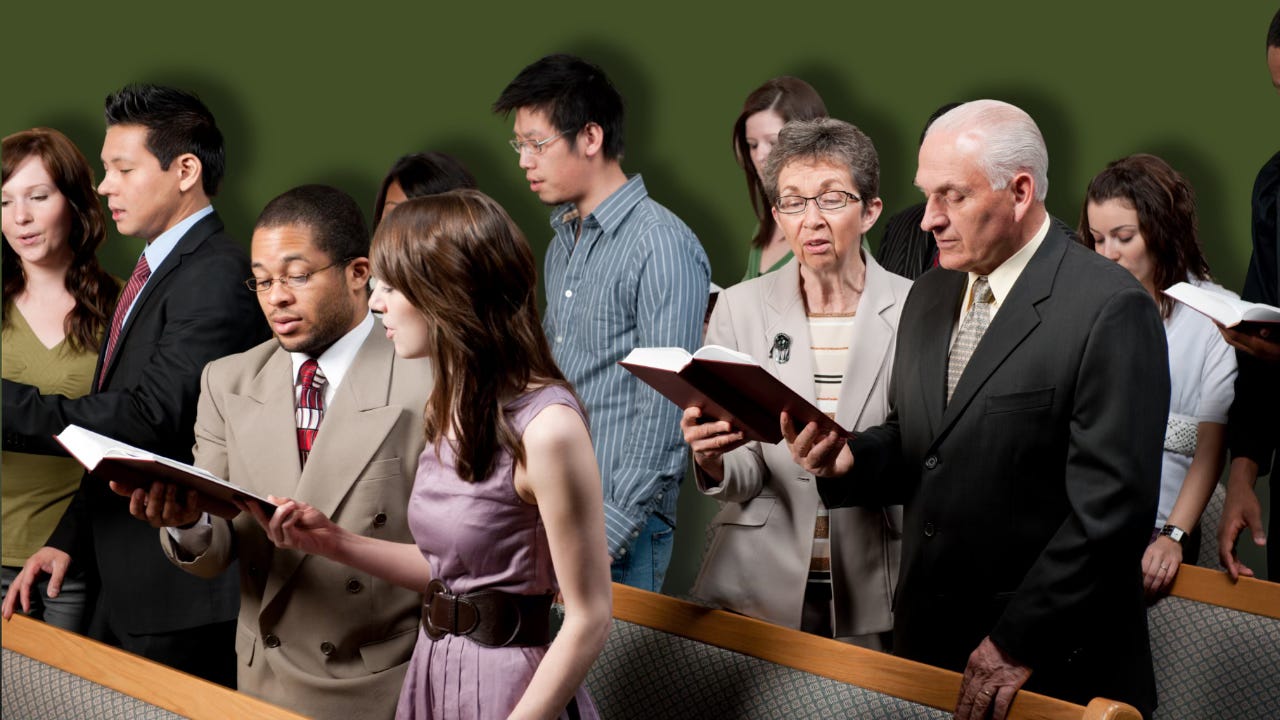
Next, consider the singing in our worship. If any element of worship has generated controversy in the church, it is this one. Should we use musical instruments? Should we sing hymns or only Scripture? Should there be choirs or a full band? What about traditional hymns versus contemporary music? The debate has been extensive.
In fact, in the latter part of the seventeenth century, the Particular Baptists in England even debated whether it was appropriate to sing at all in worship, which is a fitting place to begin. The regulative principle requires a biblical command, so do we have one? The answer is yes.
Jesus and his disciples conclude the Passover meal and the first Lord’s Supper with a hymn (Matthew 26:30).
Paul writes in 1 Corinthians 14:15, “I will pray with my spirit, but I will pray with my mind also; I will sing praise with my spirit, but I will sing with my mind also.” Later in the same chapter, he adds, “When you come together, each one has a hymn, a lesson, a revelation, a tongue, or an interpretation. Let all things be done for building up” (1 Corinthians 14:26).
Ephesians 5 says,
Do not get drunk with wine, for that is debauchery, but be filled with the Spirit, addressing one another in psalms and hymns and spiritual songs, singing and making melody to the Lord with your heart, giving thanks always and for everything to God the Father in the name of our Lord Jesus Christ. (Ephesians 5:18–20)
Similarly, in Colossians 3:
Let the word of Christ dwell in you richly, teaching and admonishing one another in all wisdom, singing psalms and hymns and spiritual songs, with thankfulness in your hearts to God. And whatever you do, in word or deed, do everything in the name of the Lord Jesus, giving thanks to God the Father through him. (Colossians 3:16–17)
Finally, Revelation shows the saints in heaven singing: “And they sang a new song, saying, ‘Worthy are you to take the scroll and to open its seals, for you were slain, and by your blood you ransomed people for God’” (Revelation 5:9).
Notably, they sing a new song, which suggests they are not limited to singing Scripture verbatim.
Today, few would question whether we should sing, but it is worth considering why we sing. These passages consistently connect singing with thanksgiving. We sing because we are thankful. More than that, our singing has two audiences: we sing to one another, and we sing to God.
In Ephesians 5:19, Paul says we are “addressing one another in psalms and hymns and spiritual songs,” while also “singing and making melody to the Lord.” Colossians 3:16 says we are “admonishing one another … singing psalms and hymns and spiritual songs with thankfulness in [our] hearts to God.”
Thus, our singing both ministers to one another and directs praise and gratitude to God.
Because of this, the words we sing are crucial. Colossians teaches that our singing flows from the word of Christ dwelling richly within us. Paul says we admonish one another through singing “in all wisdom,” and in Ephesians, he describes it as addressing or teaching one another. The lyrics, therefore, must be true and biblical. They need not be Scripture quoted verbatim, but they should be clearly drawn from it.
This is why I once refused to sing “Precious Memories” in worship. Though included in the hymnbook, it is driven more by sentimentality than by biblical truth:
Precious mem’ries, how they linger,
How they ever flood my soul;
In the stillness of the midnight,
Precious, sacred scenes unfold.
What does that have to do with the truth of God? “Mary Had a Little Lamb” comes closer to a biblical hymn than that song.
The same concern applies to some modern songs. As a general rule, if a so-called worship song could be sung to a romantic partner without the person knowing it is actually about Christ, it likely lacks the doctrinal clarity needed for corporate worship. It does not communicate biblical truth effectively.
At the same time, there is value in variety. Paul speaks of “psalms and hymns and spiritual songs,” indicating distinctions among them. A psalm is a song of praise, usually sung with musical accompaniment. A hymn is a song with religious content, though not always framed as direct praise. A song is a broader category, which is why Paul specifies spiritual songs.
In 1 Corinthians 14, Paul also says, “When you come together, each one has a hymn” (1 Corinthians 14:26). Whether these were composed or selected, there appears to have been room for diversity in what was sung.
Still, the guiding principle remains that whatever we sing must be “in spirit and truth” (John 4:23). As Paul writes, “I will sing praise with my spirit, but I will sing with my mind also” (1 Corinthians 14:15). Our singing must be sincere, arising from the heart, and it must be governed by the truth of Scripture.
Elements and Circumstances in Worship
What about the other questions people often raise regarding singing—choirs, hymnals versus screens, musical instruments? Under the regulative principle of worship, how do we determine what is acceptable to God and what is not? We can agree that we must sing, since both command and pattern are clearly evident in the New Testament. But what about the details?
This brings us to the distinction between the elements of worship and the circumstances of worship.
The elements are those activities Scripture commands, either explicitly or implicitly. The circumstances are the details surrounding those elements for which Scripture gives no specific instruction. For example, we are commanded to gather for worship and are even given an implied day, but we are not told what time of day to meet. Should it be early morning, mid-morning, or afternoon? That is a circumstance of worship.
How, then, do we determine the circumstances?
The 1689 Baptist Confession is helpful here. In chapter one, paragraph six, it states that “the whole counsel of God concerning everything essential for His own glory and man’s salvation, faith, and life is either explicitly stated or by necessary inference contained in the Holy Scriptures.” It then adds:
We recognize that some circumstances concerning the worship of God and government of the church are common to human actions and organizations and are to be ordered by the light of nature and Christian wisdom, following the general rules of the Word, which must always be observed.
Scripture gives us everything we need either explicitly or by necessary inference. Yet some circumstances are left to be ordered by “the light of nature,” “Christian wisdom,” and “the general rules of the Word.”
The light of nature refers to basic human reasoning. For instance, we would not schedule a worship service at three in the morning, when people are typically asleep.
Christian wisdom builds on this by applying reason shaped by biblical understanding. The light of nature may suggest that 10:30 in the morning is a reasonable time to meet. Christian wisdom might further suggest gathering again in the evening, recognizing that Sunday is the Lord’s Day, not merely the Lord’s morning.
At the same time, we must remain sensible. We do not meet all day without pause. The light of nature reminds us that people need rest, families need time, and children need breaks.
Finally, we consider the general rules of the Word. Even when Scripture does not give direct commands, it provides guiding principles. Are we doing all things decently and in order? Are we edifying the body? Are we promoting reverence, peace, and unity? These questions help shape our decisions.
So while there is liberty and flexibility in the circumstances of worship, we must remain faithful to Scripture in all we do.
With that framework in place, let’s consider some of the common questions about singing.
Choirs
Should we have a choir?
On one hand, a choir is singing, and singing is commanded. But we must begin with a more basic question: who is commanded to sing? In Scripture, the command is always directed to the entire congregation, and the examples consistently show congregational singing. That is our baseline.
So we must ask whether choirs support or hinder congregational singing. While there may not be a definitive answer in every case, history gives reason for caution. Prior to the Reformation, congregational singing had largely disappeared, and worship became a spectator event in which the choir performed while the people listened.
This does not mean choirs are inherently wrong, but it does mean we should be careful about adopting practices that could diminish or replace an element God has clearly prescribed.
For that reason, it may be wise to keep such singing outside the formal worship service. That approach may seem cautious, but caution is appropriate when considering how we worship God. Our guiding question should not be, Can we do this? but rather, What does God want? If there is uncertainty, wisdom calls for careful consideration.
Hymnals, Screens, and Practical Matters
What about singing from a hymnal versus a screen, or even singing from memory?
Scripture gives no specific direction on these matters. They fall under the category of circumstances.
At times, people have drawn unnecessary lines. Some have objected even to musical notation, treating it as an unbiblical innovation. But such conclusions confuse preference or tradition with biblical principle.
What Scripture does emphasize is the content of what we sing. The words must be true, biblical, and edifying. Beyond that, practical considerations come into play. Is it helpful to have musical notation? Often it is. Is it useful to project lyrics for songs not found in a hymnal? That can also be beneficial.
In these cases, the question is not simply a matter of right or wrong. Often, there is no inherent wrong. Instead, we ask what is most helpful and edifying. As Paul writes, “‘All things are lawful,’ but not all things are helpful. ‘All things are lawful,’ but not all things build up” (1 Corinthians 10:23).
This is where Christian wisdom must be applied.
A Final Word
As we evaluate the circumstances of worship, we must distinguish between biblical requirements and personal preferences. There is liberty, but not full license. There is flexibility, but always within the bounds of Scripture.
And perhaps nowhere is this more evident than in the question of musical instruments, a subject that has generated considerable debate. But that is a discussion for next time.


