

We have covered a great deal in our study of worship, so I want to begin with a brief review. This is not an attempt to revisit everything from the past seven weeks, but to recall the central thread running through it all.
We began with a simple yet essential question: Does God care how we worship him? Scripture makes clear that he does. Throughout both the Old and New Testaments, God consistently reveals that worship is not to be shaped by human creativity or preference. He alone determines what is acceptable. This leads us to the regulative principle of worship, which teaches that we are to do in worship only what God has revealed in his Word, either by explicit command or necessary implication.
We have also considered why this matters. The church is a holy people set apart for God, and worship is the most distinct activity we engage in as his people. At the same time, the Bible is both authoritative and sufficient, so God has not left us to guess how he is to be worshiped. When we hold these truths together, it becomes clear that worship must be shaped and governed by God’s Word. Left to ourselves, we will inevitably innovate in ways that distort both worship and our understanding of God.
On a practical level, we have also seen that not everything the church does constitutes worship and is therefore not regulated in the same way. Corporate worship is uniquely holy, and within it Scripture gives us specific elements. So far, we have considered the reading and preaching of the Word, prayer, singing, giving, the Lord’s Supper, and even the congregation’s corporate response to God’s Word.
Finally, we distinguished between the elements of worship and the circumstances of worship. The elements are fixed by Scripture, either explicitly commanded or implied through example or apostolic approval. The circumstances, however, are not always specified and therefore require wisdom guided by general biblical principles. For example, while we are commanded to worship and can infer that the church gathers on Sunday, Scripture does not tell us what time to meet. That decision falls under the category of circumstances that require prudent judgment shaped by biblical wisdom.
Worship in Spirit, Truth, and Reverence
We must also remember that true worship is to be “in spirit and truth” (John 4:24). It must be according to God’s Word, but it must also be sincere, humble, and reverent. And let me emphasize, reverent. Hebrews 12:28–29 says, “Let us offer to God acceptable worship, with reverence and awe, for our God is a consuming fire.”
Acceptable worship, then, is defined in part by the reverence and awe with which we approach God. Careful obedience to his Word is certainly implied. If we truly reverence God, we will submit to what he has said. But this also speaks to our posture or spirit. Do we come before him flippantly or carelessly, or do we approach him with humility and reverence?
There should be a seriousness to our worship. That does not mean we must always be somber, as if attending a funeral. There is and should be deep joy in worship. But, as Paul shows in 1 Corinthians 14, joy is not the same as disorder. It is not disobedience or carelessness. We can approach God with great joy while still doing so with reverence and awe, taking seriously what his Word says about worship. We should take it seriously because, as Hebrews reminds us, “our God is a consuming fire.”
This serves as a governing principle for everything we have considered. In many ways, it forms the foundation of the regulative principle of worship. Worship is not first about our subjective emotional experience, though that has often become the priority in many churches. Acceptable worship is not defined by what we feel but by humble submission to God and careful obedience to what he has revealed as acceptable.
Singing and the Question of Musical Instruments
With that, let’s pick up where we left off. We were considering singing as an element of worship, and, more specifically, the circumstances surrounding it. These are the details for which we do not have explicit commands. We are commanded to sing, but we are not told whether to use choirs or whether to sing from hymnals or a screen. Now we turn to the question of musical instruments.
The use of instruments is not a given. I came from a church that did not use them, arguing that we do not see the apostolic church of the first century using instruments in worship. That observation is true. So before asking which instruments are acceptable or how they should be used, we must first ask whether they should be used at all.
Some may respond instinctively, “The church has used instruments for a long time. Why debate it?” But whatever conclusion we reach, our aim is to “offer to God acceptable worship, with reverence and awe” (Hebrews 12:28). As Solomon says, “Guard your steps when you go to the house of God” (Ecclesiastes 5:1). It is never unwise to think carefully about both the elements and the circumstances of worship. Our first question should not be, What can I do? Rather, if we are approaching worship with reverence and awe, our question should be, What does God want?
So what does God want regarding musical instruments?
First, we must remember that the commanded element is singing. I love music, including instrumental music, but in worship, instruments are not the priority. They may be permissible and even helpful, but they are not primary. According to the New Testament, singing is central, specifically congregational singing. Any use of instruments must serve that purpose.
That gives us our starting point. If the New Testament gives no explicit command regarding instruments, how do we decide? The Baptist Confession helps us here: “We recognize that some circumstances concerning the worship of God … are to be ordered by the light of nature and Christian wisdom, following the general rules of the Word, which must always be observed.”
By the “light of nature,” we can reasonably conclude that instruments may aid our singing. Many find them helpful for pitch, rhythm, and unity. At the same time, we must apply Christian wisdom, guided by Scripture.
When we look to the New Testament, we see no clear example of instruments in the early church’s gathered worship. Historically, there is little evidence of their use for several centuries. Whatever conclusions we draw from that, it at least shows that instruments are not necessary for worship. If they were, we would expect a command or an apostolic example. Since we have neither, we should avoid dogmatism. If a church chooses not to use instruments, that is a position we can respect, even if we do not share it.
Old Testament Precedent and Christian Wisdom
While we do not see instruments used in the New Testament, we do find a clear precedent for them in the Old Testament. For example, in 1 Chronicles 23, we read:
David assembled all the leaders of Israel and the priests and the Levites. The Levites, thirty years old and upward, were numbered, and the total was 38,000 men. “Twenty-four thousand of these,” David said, “shall have charge of the work in the house of the LORD, 6,000 shall be officers and judges, 4,000 gatekeepers, and 4,000 shall offer praises to the LORD with the instruments that I have made for praise.” (1 Chronicles 23:2–5)
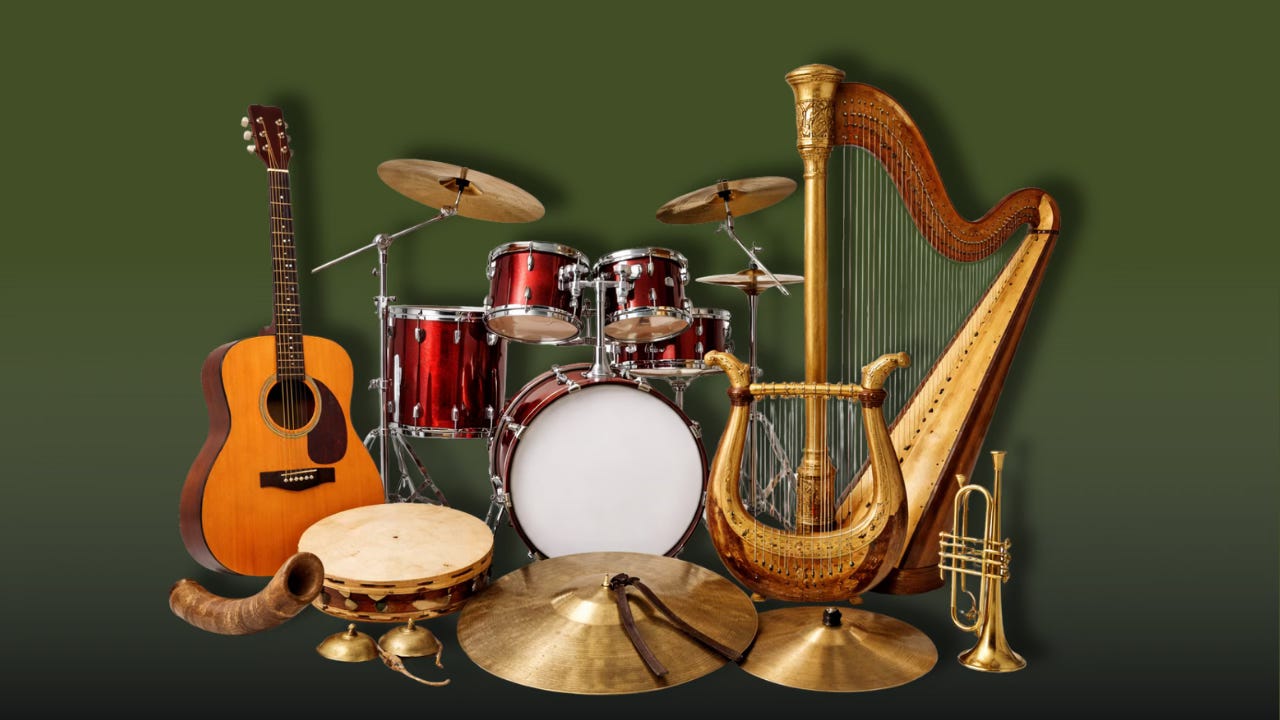
This was a large number of musicians, though they did not all play at once. In 1 Chronicles 25, David organized them into twenty-four divisions to serve in rotation. The primary instruments appear to have been lyres, harps, and cymbals—mainly stringed instruments with some percussion. That detail is worth noting, especially since strong opinions often arise about which instruments are appropriate for worship.
At my previous church, a Reformed Baptist congregation, we did not use instruments, not out of conviction against them, but simply because no one was able to play. We did, however, discuss the subject. One of the other elders expressed comfort with most instruments except drums. I understood his concern. At times, I have heard worship music where the percussion was so prominent that it distracted from the singing. It did not seem fitting.
But does that mean a church should never use drums? Not necessarily. The Old Testament shows that God accepted at least some forms of percussion, so we cannot make a universal rule forbidding them. At the same time, what I have called the doctrine of carefulness should lead us to think critically about how such instruments are used.
This brings us back to the distinction between personal preference and biblical principle. When questions arise about the circumstances of worship, they should be discussed with humility and a desire for unity. Ultimately, however, the church is called to trust its elders’ oversight. Paul tells the elders in Ephesus, “The Holy Spirit has made you overseers, to care for the church of God” (Acts 20:28). Peter exhorts elders to “shepherd the flock of God … exercising oversight” (1 Peter 5:1–2). Hebrews instructs believers, “Obey your leaders and submit to them, for they are keeping watch over your souls” (Hebrews 13:17).
The Lord knows that we will not always agree on matters like these. For that reason, he has given the church overseers to exercise wisdom, guided by the general rules of his Word, and to lead in making such decisions. Because we are dealing with circumstances rather than commanded elements, these issues should never become points of contention or division. In many cases, there is no single right or wrong answer. We should never disrupt the unity of the church over matters of Christian liberty.
The Fullness of Praise in Psalm 150
Let me offer one more example from the Old Testament:
Praise the LORD!
Praise God in his sanctuary;
praise him in his mighty heavens!
Praise him for his mighty deeds;
praise him according to his excellent greatness!Praise him with trumpet sound;
praise him with lute and harp!
Praise him with tambourine and dance;
praise him with strings and pipe!
Praise him with sounding cymbals;
praise him with loud clashing cymbals!
Let everything that has breath praise the LORD!
Praise the LORD! (Psalm 150:1–6)
This is perhaps the fullest list in Scripture of instruments used in the praise of God. We see wind instruments, stringed instruments, and percussion—a full spectrum of sound. Some are loud, some melodic, and some primarily rhythmic. When used rightly, they serve as the means by which the people of God praise him.
It is interesting that the psalm does not explicitly mention singing. It may be implied in the closing line, “Let everything that has breath praise the LORD,” but the omission is still striking. Without presuming the author’s intent, it may be that singing was so universally understood that it did not need to be stated. If so, the emphasis here may be that God is so worthy of praise that voices alone seem insufficient. It’s as if to say, Yes, sing, but those who can play, take up your instruments. Fill the sanctuary with praise. Let it rise to the mighty heavens.
There are moments when that impulse resonates. Worship is not first about emotional experience, but it is not devoid of emotion either. There are times when the greatness of God compels us to sing with greater strength and fullness. We want the sound of praise to reflect, however imperfectly, the worth of the one we worship.
The psalmist even mentions dancing. Scripture does not present dancing as a regular element of corporate worship, and what is described in the Bible may differ from what we typically imagine. Still, its inclusion suggests that, at times, words alone feel insufficient to express the joy of praising God. The body itself responds. This helps explain why some prefer to stand while singing, or why expressions such as raised hands or subtle movement may accompany heartfelt praise.
Tradition and church culture may encourage stillness or limit the kinds of instruments used. Personal preference may do the same. Yet the Old Testament provides a clear precedent: instruments, and a variety of them, can be used in the worship of God. We are seeking to “praise him according to his excellent greatness” (Psalm 150:2). We offer the best of our voices and, where appropriate, the best of our instruments, striving to render a fitting expression of the praise he deserves.
Instruments in Redemptive Context
Those who oppose the use of instruments will rightly note that the Old Testament describes worship under the old covenant. That is true. But when we look ahead to the book of Revelation, we again see instruments in the worship of heaven. Alongside singing, which remains central, we find references to harps accompanying the praise of God’s people.
This presents an interesting pattern. Instruments appear in old covenant worship and in heavenly worship, yet they are absent from the recorded practice of the early church. We can only speculate as to why. It may have been due to practical limitations, or perhaps their use simply was not recorded. The question is whether that absence is sufficient reason to prohibit instruments in the church today. I would argue that it is not, for at least two reasons.
First, the apostles were careful to address practices from both Jewish and Gentile backgrounds that were not appropriate for the church. If instruments—long used in Jewish worship—were no longer permissible, we would expect explicit instruction to that effect. We would expect the apostles to say, “Do not use instruments,” and to explain why. Yet we find no such prohibition.
Second, there are things carried over from old covenant worship, and there are things that are not. What makes the difference? Christ. As the book of Hebrews shows, Jesus fulfilled the ceremonial law—namely, the types and shadows. That is why we no longer offer animal sacrifices.
But musical instruments do not fall into that same category. Though they were later used in temple worship, they were not part of the original structure of the ceremonial law given through Moses. Israel worshiped according to that law both before and after the introduction of instruments, suggesting they were not essential to it. The New Testament also gives us no reason to believe Christ fulfilled or set aside the use of musical instruments.
For that reason, it is best to understand instruments not as elements of worship tied to the ceremonial system, but as circumstances. As such, they may be used with Christian wisdom, in accordance with the general rules of the Word.
Practical Wisdom for the Use of Musical Instruments
Let me offer a few practical considerations regarding musical instruments. These are not hard rules from Scripture but attempts to apply Christian wisdom.
Most importantly, instruments should never distract from or discourage congregational singing. This applies to everything from volume to song selection. If the music is too loud, people will be less inclined to sing, and they will not be able to hear one another. But part of the purpose of singing is mutual edification—we are addressing and teaching one another through song—and that requires hearing one another.
We should also choose songs suited for congregational singing. Songs written for professional performers are often difficult for an entire congregation to sing well. Along similar lines, it is unwise to introduce an entirely new set of songs each week. While variety is good and learning new songs is beneficial, most of what we sing should be familiar so that the congregation can participate confidently.
We must also guard against turning worship into a spectator event. The priority is for the whole church to sing together. Scripture does not prescribe where musicians should be positioned, but we should be careful not to create an environment that feels like a performance. When music becomes something to watch rather than something to join, it has begun to move beyond its proper role. Since instrumental music is not itself an element of worship, its purpose is to support the congregation’s singing. If it ceases to do that and takes on a life of its own, something has gone wrong.
Finally, it is not wise to divide the church into separate “traditional” and “contemporary” services. While this may seem like a practical solution, it is not ideal. Scripture repeatedly calls the church to unity. As Paul writes,
[Be] eager to maintain the unity of the Spirit in the bond of peace. There is one body and one Spirit—just as you were called to the one hope that belongs to your call— one Lord, one faith, one baptism, one God and Father of all, who is over all and through all and in all. But grace was given to each one of us according to the measure of Christ’s gift. (Ephesians 4:3–7)
“There is one body,” Paul says. To divide the church over musical style is, in effect, to divide that body over a matter of circumstance—something shaped largely by preference rather than biblical command.
The Lord’s Supper as an Element of Worship
Having said more than enough about music, though certainly not everything that could be said, let’s turn to the final parts of worship: the Lord’s Supper and baptism. The 1689 Confession states:
Baptism and the Lord’s Supper are ordinances of positive and sovereign institution. They are appointed by the Lord Jesus the only lawgiver and are to be continued in His church to the end of the age.
These ordinances deserve more attention than we can give them here, but we should at least establish that they belong within corporate worship. While they are sometimes treated as distinct from the church’s gathered worship, there is a strong case that they are, in fact, elements of it.
Regarding the Lord’s Supper, Sam Waldron writes:
The first celebration of the Lord’s Supper was in the original church composed of the Lord Jesus Christ and His apostles at what is called the Last Supper. (Matthew 26:19–30)
The Lord’s Supper symbolizes the unity of the church and thus is and must be celebrated in the context of the gathering of a local church where that unity is visible. (1 Corinthians 10:16–17)
The apostolic directions with regard to the celebration of the Lord’s Supper emphasize that it was and is to be celebrated in a meeting of the church in which careful regard was to be had for the visible unity of the church. (1 Corinthians 11:17–34)
First Corinthians 11 makes clear that the Lord’s Supper is intended for the formal, corporate gathering of the church rather than informal settings. Even if it is not observed every time the church gathers—a matter of circumstance not prescribed in Scripture—it should not be viewed as separate from worship.
Consider its purpose. In the Supper, we remember Christ’s atoning work, proclaim his death, and confess our ongoing need for him. We are reminded of how the Lord has saved us and continue to depend upon him. At the same time, this shared participation expresses and strengthens the unity of the church. For that reason, it naturally belongs within the church’s corporate worship.
Baptism as an Element of Worship
Baptism differs somewhat from the Lord’s Supper. We never see the Supper practiced apart from the corporate gathering of the church, and part of its significance is to underscore the body’s unity. Baptism, however, focuses more on the individual, and Scripture gives examples of it occurring outside a formal gathering. As Sam Waldron explains, “Baptism is like prayer, singing, and the preaching of the Word. It may properly be practiced both in informal settings outside the church and in the formal gatherings of the church.”
Even so, baptisms can be, and in most cases should be, part of the church’s formal worship. Under the regulative principle, we must show from Scripture that baptism is positively instituted by Christ, belongs to the gathered church, and functions in a way consistent with other elements of worship.
First, baptism is clearly commanded by Christ: “Go therefore and make disciples of all nations, baptizing them” (Matthew 28:19).
Second, baptism is entrusted to the church. This pattern appears throughout Acts. In Acts 2:41, those who receive the Word are baptized and added to the church. In Acts 8:12, baptism accompanies a believer’s visible identification with the church. In Acts 10:47–48, it is administered under apostolic oversight. Baptism, then, is tied to church membership and visible inclusion under the church’s authority, not merely a private spiritual act.
Romans 6 further suggests its public nature: “We were buried therefore with [Christ] by baptism into death … in order that … we too might walk in newness of life” (Romans 6:3–4). Baptism is a visible and public testimony, and that visibility implies a gathered body to witness it.
Finally, baptism functions in a way consistent with other elements of worship. Preaching proclaims the gospel audibly, while baptism proclaims the same gospel visibly. Romans 6 portrays union with Christ, death to sin, and resurrection to new life—truths ordinarily taught in preaching but dramatized before the congregation in baptism.
It also parallels the Lord’s Supper, which visibly proclaims the gospel: “For as often as you eat this bread and drink the cup, you proclaim the Lord’s death” (1 Corinthians 11:26). Preaching is audible proclamation, baptism is visible initiation into that reality, and the Supper is its ongoing visible proclamation. All three proclaim Christ and, for that reason, belong in the church’s worship.
The Benediction as an Element of Worship
Finally, let me briefly mention one more element of worship: the benediction. It may be understood as a distinct element because it is explicitly instituted by God, publicly pronounced over his gathered people, and functions as a unique act of divine blessing, rather than a prayer offered by the congregation.
In Numbers 6:22–27, the Lord commands the priests to bless Israel with specific words and promises to act through that blessing. This pattern continues in the New Testament, where the apostles regularly pronounce blessings over the churches. Unlike prayer, which is directed to God, the benediction declares God’s favor to his people. It serves as his final word to the assembled church.
For these reasons, it is fitting to recognize the benediction as an element of worship.
With that, we conclude our study of worship. I pray it has been helpful and a blessing.


