



Previously, we began examining the transmission of the New Testament, particularly notable textual variants and how textual critics attempt to determine from them what the autographs, the original writings of the New Testament, actually said.
It should be emphasized again that the vast majority of differences among the manuscripts are virtually meaningless. Most consist of spelling errors or obvious scribal mistakes. Even among the so-called meaningful differences, not one affects any foundational doctrine of the Christian faith. Despite these variations, Christianity itself has not changed in the least.
Luke 23:34 and a Divided Manuscript Tradition
I said previously that I would offer six examples of notable textual variants. We have already considered one of them in John 5. Next, we turn to Luke 23.
From the outset, it should be said that among the textual variants in the New Testament manuscripts that carry any real significance, this one has proven to be among the most difficult. By difficult, I mean that scholars remain deeply divided over whether this statement originally belonged to Luke’s Gospel.
The textual variant appears in the first half of verse 34. In the ESV, we read, “And Jesus said, ‘Father, forgive them, for they know not what they do’” (Luke 23:34).
This is, of course, one of the most well-known statements attributed to Jesus while hanging on the cross. Yet the manuscript evidence raises questions about whether Luke actually recorded Jesus saying this. Luke is also the only Gospel writer who potentially includes the statement. Therefore, if the evidence ultimately showed that the words were not original to Luke’s Gospel, we would have no direct biblical record of Jesus making this statement from the cross.
What, then, does the manuscript evidence reveal?
To answer that question, it is helpful to return to our conceptual table of manuscripts. Previously, we imagined all surviving manuscripts laid out chronologically and grouped according to category. Greek manuscripts were placed together. Ancient translations into other languages formed another category. Then we considered the writings of early Christians, who frequently quoted the New Testament, thereby providing additional evidence for the text’s transmission. We also grouped manuscripts by geographical region in order to determine how widespread particular textual variants became. Returning to that conceptual table allows us to trace what happened to Luke 23:34 throughout the history of the New Testament’s transmission.
In the case of John 5:4, the evidence was relatively straightforward. The verse was absent from the earliest sources for centuries. Eventually, one form of the reading appeared before it was later incorporated into subsequent manuscripts. Luke 23:34, however, presents a much more complex picture.
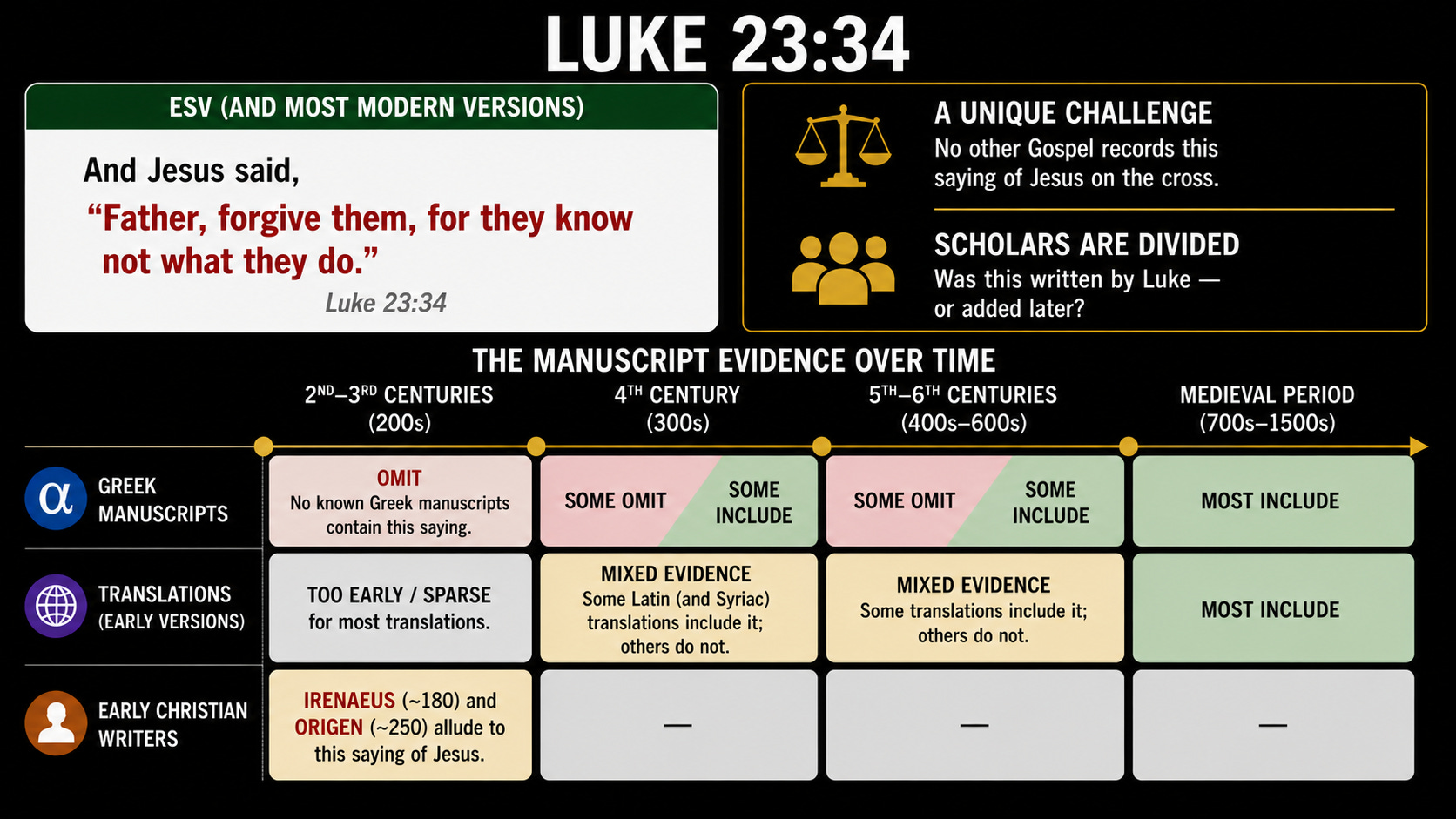
The surviving copies from the second and third centuries do not contain this saying of Jesus. At the same time, both Irenaeus and Origen from roughly the same period appear to allude to the statement. This suggests that they were familiar with it, whether through oral tradition or through copies of Luke’s Gospel available to them.
Moving into the fourth century, some of the most respected and reliable manuscripts omit the statement, while others include it. Most Latin translations from this same period also contain it.
The pattern continues into the fifth and sixth centuries. Some manuscripts include the statement. Others omit it. Some translations preserve it, while others do not. By the medieval period, however, the majority of manuscripts and translations include the passage.
What explains this pattern?
Two primary theories have emerged. Some scholars argue that Jesus truly spoke these words and that Luke originally recorded them, but later scribes omitted the statement. According to this view, scribes may have been troubled by Jesus so readily forgiving those responsible for his crucifixion. Others suggest they were uncomfortable with the possibility that Jesus’ prayer appeared unanswered, especially in light of the destruction of Jerusalem by the Romans in AD 70.
The opposing theory maintains that Luke did not originally write the statement and that it was later added by a scribe. Why would a scribe insert it? Primarily because it sounds very much like something Jesus would say. Some also suggest that the wording may have been influenced by the book of Acts, Luke’s second volume, in which Stephen offers a remarkably similar prayer while being stoned to death.
As noted already, this remains a difficult textual variant. The external evidence is not decisively clear. The statement is absent from the earliest manuscripts, yet it appears very early in the tradition and is referenced by early Christian writers. Furthermore, neither inclusion nor omission is confined to a single geographical region. Both readings appear across multiple locations and textual traditions.
So which reading is original? Does the statement belong in Luke’s Gospel or not?
Unfortunately, there is no definitive answer. Nevertheless, two observations are worth making.
First, whether this statement is original or not, no foundational doctrine is affected. The passage certainly highlights a particular aspect of Jesus’ character, but our understanding of his compassion and willingness to forgive does not rest on this verse alone. Everything revealed about Jesus throughout the Gospels consistently points to that same character.
Second, for what it is worth, I am personally inclined to believe that this is an authentic statement of Jesus preserved by Luke. Reflecting on the principles of textual criticism discussed previously, it seems more plausible to me that a scribe would remove this statement than invent and insert it. Given the hostility that existed between Jews and Christians during portions of this period, it is understandable that some Christians may have been tempted to diminish expressions of Jesus’ compassion toward his executioners. It seems less likely that a scribe would deliberately add words to amplify that compassion.
This also appears to have been the judgment of most Bible translators throughout history, which explains why the statement remains in modern New Testaments.
Finally, the saying fits naturally within Luke’s Gospel itself, where themes of compassion, mercy, and forgiveness consistently occupy a central place.
Acts 8:37 and the History of the Textus Receptus
Next, we move to Acts 8, the account of Philip baptizing the Ethiopian eunuch.
Philip encounters this man reading from the book of Isaiah. The eunuch has questions about what he is reading, and Philip explains the passage to him. In the ESV, we read:
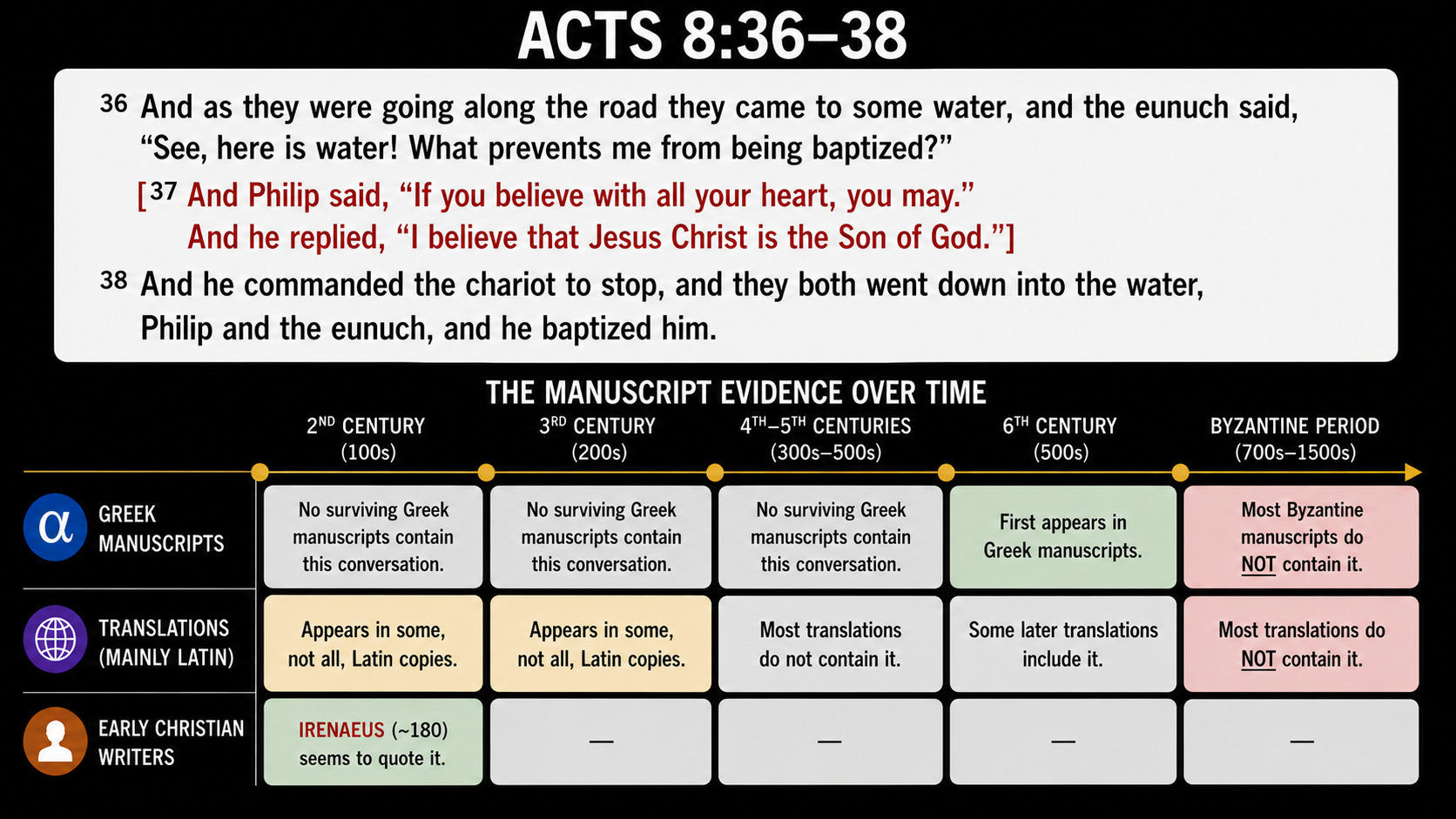
And as they were going along the road they came to some water, and the eunuch said, “See, here is water! What prevents me from being baptized?” And he commanded the chariot to stop, and they both went down into the water, Philip and the eunuch, and he baptized him. (Acts 8:36–38)
Those familiar with the King James Version will immediately notice that part of the conversation appears to be missing. According to the ESV footnote, “Some manuscripts add all or most of verse 37: And Philip said, ‘If you believe with all your heart, you may.’ And he replied, ‘I believe that Jesus Christ is the Son of God.’”
What happened here? Is this an example of modern Bible translations removing a verse from Scripture?
No. In fact, modern translations are remarkably transparent about the manuscript evidence. Even when translators conclude that a verse appearing in an older translation, such as the King James Version, was not part of the original text, they still include the wording in the footnotes. Clearly, there is no attempt at deception.
This brief exchange between Philip and the eunuch does not appear in any surviving Greek manuscript until the sixth century. It is also absent from most ancient translations. However, Irenaeus appears to quote the passage in the latter part of the second century, and it does appear in some, though not all, second and third-century Latin manuscripts.
When all the evidence is considered together, the safest conclusion is that the verse was not original to the text of Acts, though it was clearly a very early addition within the Western-Latin textual tradition.
If we speculate about its origin, it likely emerged from an early baptismal liturgy. The baptizer may have asked, “Do you believe with all your heart?” and the candidate for baptism may have responded, “I believe that Jesus Christ is the Son of God.” Scribes reading the account of Philip and the eunuch may have noticed that the eunuch never explicitly professes faith prior to baptism, and so they inserted the familiar church formula into the narrative. Another possibility is that a scribe wrote the baptismal confession as a margin note, which a later scribe mistakenly incorporated into the text itself.
What is especially interesting about this variant is that it never became widely perpetuated in the Greek manuscript tradition. Frequently, an addition enters the text early and eventually becomes nearly universal among the later Byzantine manuscripts, which again constitute the majority of surviving Greek manuscripts. Over time, the altered reading effectively becomes standardized. Yet that did not happen in this case. Most Byzantine manuscripts do not contain verse 37.
So how did it find its way into the King James Version?
As mentioned previously, the King James Version was translated primarily from a small collection of later Byzantine manuscripts. If most Byzantine manuscripts omitted verse 37, why did the translators include it?
To answer that question, we must consider the work of the Catholic priest and scholar Desiderius Erasmus. Erasmus was a contemporary of Martin Luther, and the two famously debated issues such as total depravity and free will. At the time, the Roman Catholic Church had relied for more than a thousand years on the Latin Vulgate, a Latin translation of the Bible. Erasmus recognized, however, that the Vulgate itself contained numerous scribal errors accumulated through centuries of hand-copying. He therefore set out to produce a fresh Latin translation based directly on Greek manuscripts, since Greek was the original language of the New Testament.
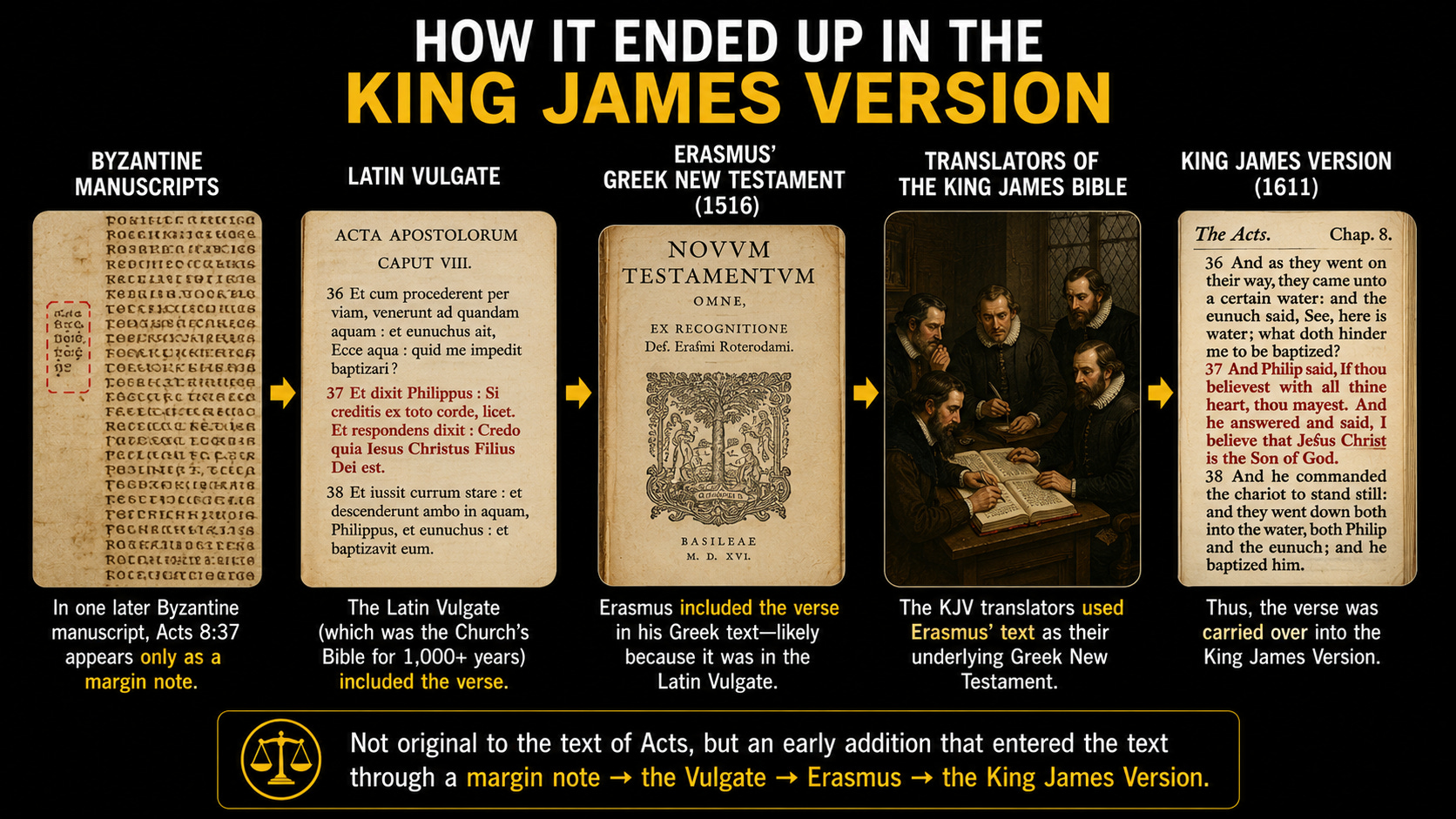
To summarize a complicated history briefly, Erasmus gathered as many Greek manuscripts as he could obtain. Unfortunately, he had access to very few. Depending on how they are counted, he likely worked with somewhere between eight and twelve manuscripts, all of them relatively late Byzantine copies. Arguably, this was still preferable to relying solely on a Latin translation that had itself been copied by hand for over a millennium. Nevertheless, Erasmus lacked access to the much older Greek manuscripts that would later be discovered.
It should also be remembered that Erasmus worked under considerable pressure. He was competing to publish the first Greek New Testament in the age of the newly invented printing press. Speed mattered.
Complicating matters further, Erasmus did not even possess a complete Greek New Testament. In portions of Revelation where his Greek manuscripts were deficient, he back-translated the Latin Vulgate into Greek and then translated it back into Latin again. As strange as that sounds, he did so because he intended to publish a parallel edition with Greek on one side and Latin on the other. He therefore needed a complete Greek text to accompany the Latin.
Erasmus eventually published five editions of his Greek New Testament. Each edition included revisions and corrections to the previous one. This Greek text would later become the foundation for what eventually came to be known as the Textus Receptus, the underlying Greek text behind the King James Version. Technically, later editors revised Erasmus’s work before the King James translators used it, but Erasmus’s text remained its essential basis.
Returning now to Acts 8, verse 37 was absent from most Byzantine manuscripts. Yet among the small number of manuscripts Erasmus possessed, one contained the verse as a marginal note. Why, then, did Erasmus include it in his printed text?
Primarily because it appeared in the Latin Vulgate. Though Erasmus wanted to correct the Vulgate where necessary, he also faced immense pressure not to depart too dramatically from a translation that had served as the Bible of the Western church for more than a thousand years. Altering familiar biblical traditions carried serious risks.
As a result, despite the overwhelming manuscript evidence against including verse 37, evidence that was already available in Erasmus’s own day, he nevertheless included it, likely to avoid unnecessary controversy and secure approval for his work. That reading was then inherited by the King James Version.
Thus, while it may appear at first glance that modern translations have removed a verse from the Bible, the historical reality is the opposite. The verse was a later addition to the text that has now been removed from the main body of Scripture and placed in the footnotes where it belongs.
The Comma Johanneum and the Doctrine of the Trinity
Next, we turn to another textual variant involving Erasmus, this time in 1 John 5.
In the ESV, we read, “For there are three that testify: the Spirit and the water and the blood; and these three agree” (1 John 5:7-8).
Anyone familiar with the King James Version will immediately recognize that something appears to be missing. In the KJV, the passage reads:
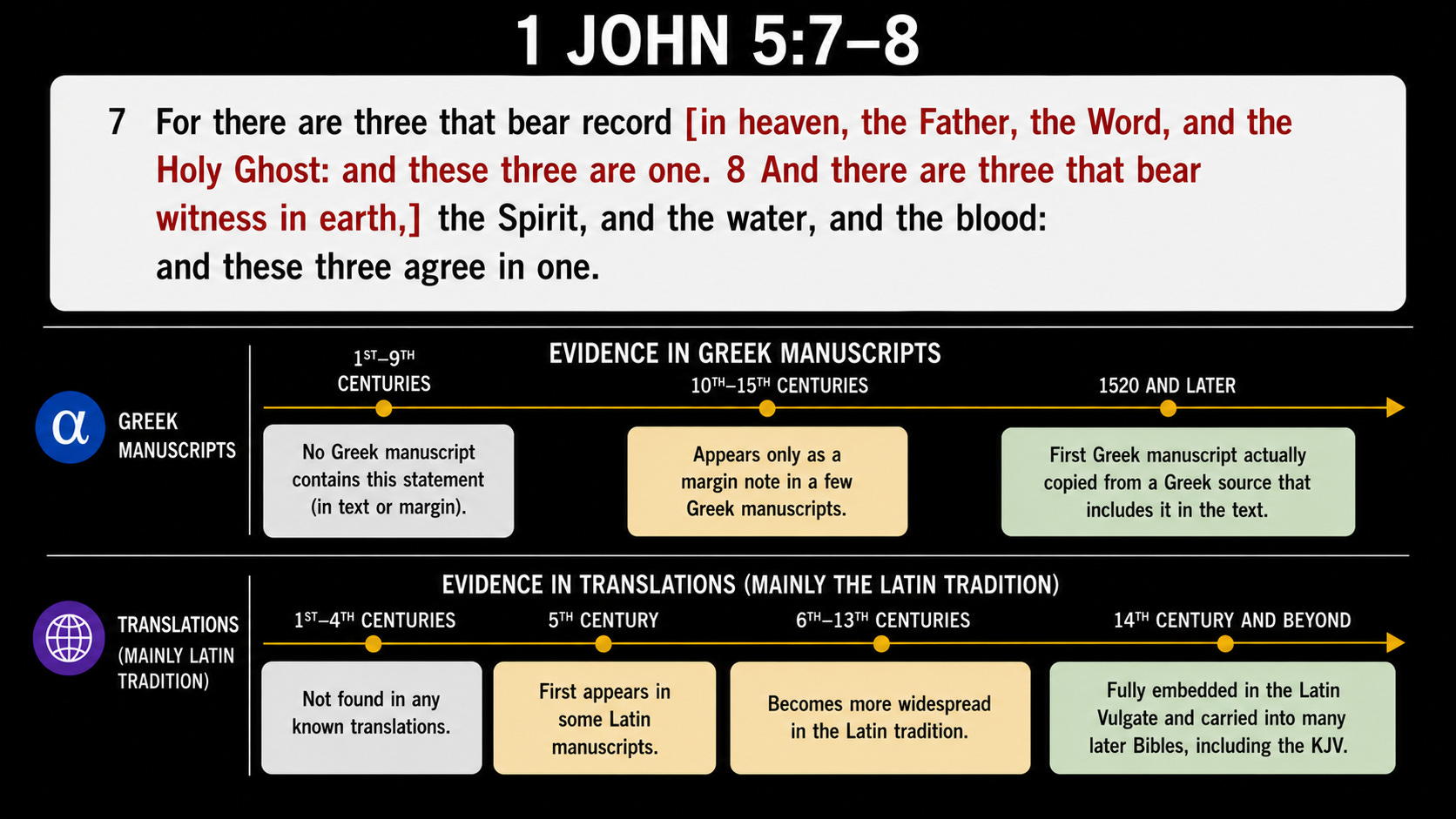
For there are three that bear record in heaven, the Father, the Word, and the Holy Ghost: and these three are one. And there are three that bear witness in earth, the Spirit, and the water, and the blood: and these three agree in one. (1 John 5:7–8)
What may strike us first about this particular variant is that I have repeatedly argued that no textual variant affects any foundational doctrine of the Christian faith, yet here we appear to have an unmistakably explicit Trinitarian statement removed from modern translations. How, then, can it still be said that no textual variant alters Christian orthodoxy?
Before answering that question, we should first examine how this variant entered the textual tradition.
Returning again to our conceptual table of manuscripts, if we focus exclusively on the Greek manuscripts of 1 John, we do not find this Trinitarian statement in a single Greek copy until the tenth century. Even there, it does not appear within the actual text of 1 John itself. Rather, it exists only as a marginal note. The same pattern appears in a few additional Greek manuscripts from the twelfth through the fifteenth centuries. The statement remains in the margins, not in the body of the text.
There is one Greek manuscript from 1215 that includes the phrase in the text. However, this manuscript carries little weight because it is not a normal Greek manuscript copied from another Greek manuscript. Instead, it appears to be a Greek translation made from a Latin source. The same is true of another fourteenth-century manuscript that includes the phrase in the text. Once again, it appears to be dependent on the Latin tradition rather than the Greek.
In short, there is no evidence of a genuine Greek manuscript copied from the Greek textual tradition that includes this Trinitarian statement until approximately the year 1520. That date will be extremely important in a moment.
Looking now beyond the Greek manuscripts to the ancient translations, the phrase first appears in some Latin manuscripts during the fifth century. Over time, it became increasingly common in the Latin textual tradition and eventually became embedded in the Latin Vulgate, which, as noted previously, served as the standard Bible of the Roman Catholic Church for more than a thousand years. This explains why some later Greek manuscripts contain the phrase in the margins and why certain Greek manuscripts translated from Latin include it directly in the text.
Essentially, the phrase entered portions of the Latin manuscript tradition and was perpetuated there, but it never meaningfully penetrated the authentic Greek stream of transmission. That fact alone is highly significant. Indeed, this may be one of the clearest examples of a textual addition not part of the original Scripture. John simply did not write these words.
Further evidence comes from the writings of the early church fathers. Consider someone such as Athanasius, who spent much of his ministry defending the doctrine of the Trinity against various heresies. If this explicit Trinitarian statement had existed in the biblical manuscripts available to him, Athanasius almost certainly would have cited it repeatedly. Yet he never does. Neither do any of the other early defenders of Nicene orthodoxy. The phrase only begins to appear after it emerges in portions of the Latin manuscript tradition.
Where, then, did it originate?
A footnote in the NET Bible offers a likely explanation:
The reading seems to have arisen in a 4th-century Latin homily in which the text was allegorized to refer to members of the Trinity. From there, it made its way into copies of the Latin Vulgate, the text used by the Roman Catholic Church.
In other words, someone interpreted “the Spirit and the water and the blood” allegorically as references to the Trinity. From there, explanatory comments may have been written into the margins before eventually being copied directly into the biblical text itself. Whether this occurred gradually through marginal glosses or through deliberate insertion, the conclusion remains the same. The phrase was not original to 1 John.
This raises an obvious question. If the phrase is absent from the Greek manuscript tradition, how did it enter the King James Version?
Again, the answer brings us back to Erasmus.
When Erasmus published the first edition of his Greek New Testament, he omitted the Trinitarian phrase because it was absent from the Greek manuscripts available to him. He omitted it again in his second edition for the same reason.
This created enormous controversy.
Erasmus was already engaged in tension with many within the Roman Catholic establishment. His stated goal was to correct errors in the Latin Vulgate by returning ad fontes, “to the sources.” He believed translators should go back to the original Greek text and produce a fresh Latin translation from scratch. Yet the church’s response was effectively, “That is acceptable, so long as you do not substantially alter the Vulgate.”
The conflict became especially severe when readers discovered that Erasmus’s New Testament omitted this beloved Trinitarian statement. Critics accused him of heresy and even of denying the Trinity itself.
Erasmus defended himself very simply. If the phrase existed in the Greek manuscripts, he said, he would gladly include it. He was not attempting to promote false doctrine or remove Scripture. He was merely trying to remain faithful to the Greek textual evidence. Eventually, he challenged his critics directly, declaring that if they could produce even one Greek manuscript containing the phrase, he would include it in a future edition.
Predictably, someone soon claimed to have found such a manuscript.
Recall the important date mentioned earlier. Erasmus published his first edition in 1516. The lone Greek manuscript containing the phrase in the text itself dates from approximately 1520. Even Erasmus recognized that this “newly discovered” manuscript was highly suspect. He understood that it had likely been produced specifically to pressure him into including the passage.
Nevertheless, Erasmus eventually yielded and inserted the phrase into his third edition. In the accompanying notes, he explained that he had restored the text “so as not to give anyone an occasion for slander.” He also openly acknowledged that the Greek and Latin manuscripts differed on this reading and remarked that he saw no danger in accepting either text.
In other words, Erasmus knew the phrase belonged to the Latin tradition rather than the Greek. Yet he also believed that including it would not create theological harm. Once inserted into his printed Greek text, the passage was carried forward into the Textus Receptus and ultimately into the King James Version, along with many other Reformation-era translations.
This returns us to the earlier claim that no textual variant undermines Christian orthodoxy.
On one level, this variant certainly touches on Christian doctrine, as it concerns the Trinity itself. Yet the doctrine of the Trinity neither stands nor falls upon this single passage. Long before this phrase appeared in the biblical text, Athanasius and countless other Christians were already defending the doctrine on the basis of Scripture. The Trinity is taught throughout the Bible. This verse may provide a convenient proof text, but the doctrine does not depend upon it.
The Woman Caught in Adultery
With that, we come to two more notable textual variants, and these are by far the largest in terms of length.
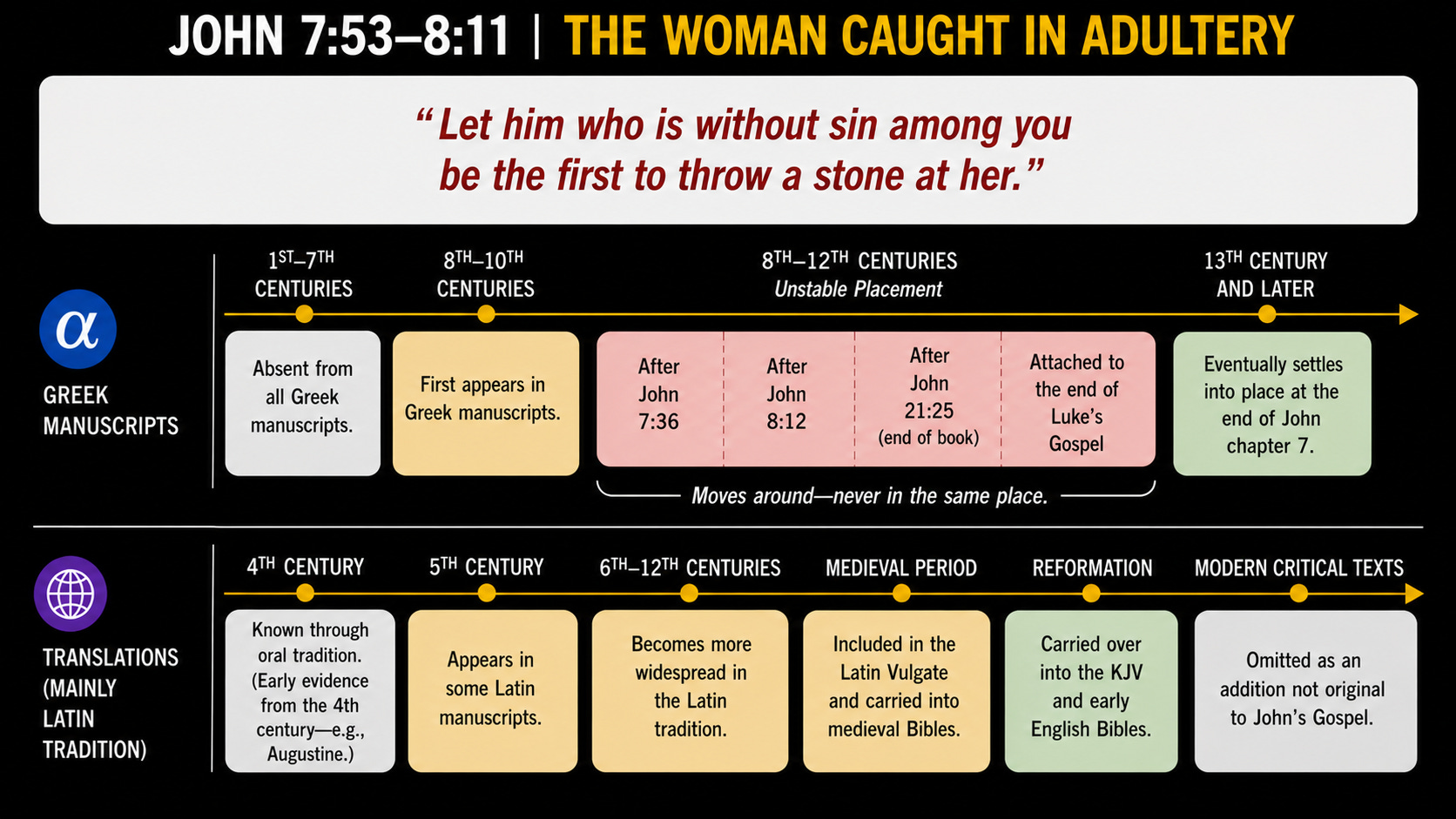
The first appears in John 8, the story of the woman caught in adultery. In the account, the crowd is prepared to stone the woman when Jesus says, “Let him who is without sin among you be the first to throw a stone at her” (John 8:7).
Then Jesus bends down and writes in the dirt. By the time he looks up again, the crowd has dispersed. Finally, he says to the woman, “Go, and from now on sin no more” (John 8:11).
This has long been one of the most beloved stories associated with Jesus. Understandably, many people do not want to hear that there are significant textual questions surrounding it. The good news and bad news, however, depend entirely on how we understand the manuscript evidence.
The story is absent from the Greek manuscript tradition until somewhere between the eighth and tenth centuries. Having said that, there is evidence that the account itself was circulating through oral tradition much earlier. Augustine, for example, was familiar with the story in the fourth century. He even argued that it belonged in Scripture and speculated that some earlier scribes may have removed it because they feared it would encourage adultery by appearing too lenient. As far as we know, Augustine had no actual manuscript evidence to support that theory, but his comments do demonstrate how widespread and influential the story had already become. It also helps explain why the account appears in at least some Latin manuscripts beginning in the fifth century.
Once the story begins appearing in the Greek manuscripts, something unusual happens. The passage moves.
That fact alone is a significant indication that the text did not originally belong to John’s Gospel. In some manuscripts, the story appears after John 7:36. In others, it appears after John 21:25, at the very end of the Gospel. In still others, it comes after John 8:12. Some manuscripts even attach the story to the end of Luke’s Gospel. Only later does the account eventually settle into the familiar location between John 7 and 8.
All of this strongly suggests that the story was not originally part of John’s Gospel, or likely any of the canonical Gospels. At the same time, it was obviously a well-known and beloved story within the early church. Scribes appear repeatedly to have searched for an appropriate place to insert it into the New Testament text.
So, for those who love this story and wish it belonged in the Bible, the bad news is that it almost certainly was not original to John. The good news, however, is that it remains entirely possible that this is a genuine historical account preserved through oral tradition. John himself writes, “Now there are also many other things that Jesus did. Were every one of them to be written, I suppose that the world itself could not contain the books that would be written” (John 21:25).
There is nothing about this story that feels inconsistent with the character of Jesus revealed throughout the Gospels. On the contrary, it reflects his mercy, wisdom, and moral seriousness remarkably well. Personally, I believe the account very likely preserves a true story about Jesus, even though I do not believe it was divinely inspired Scripture in the same sense as the rest of John’s Gospel.
The Longer Ending of Mark
Finally, we come to the last example, the ending of Mark’s Gospel.
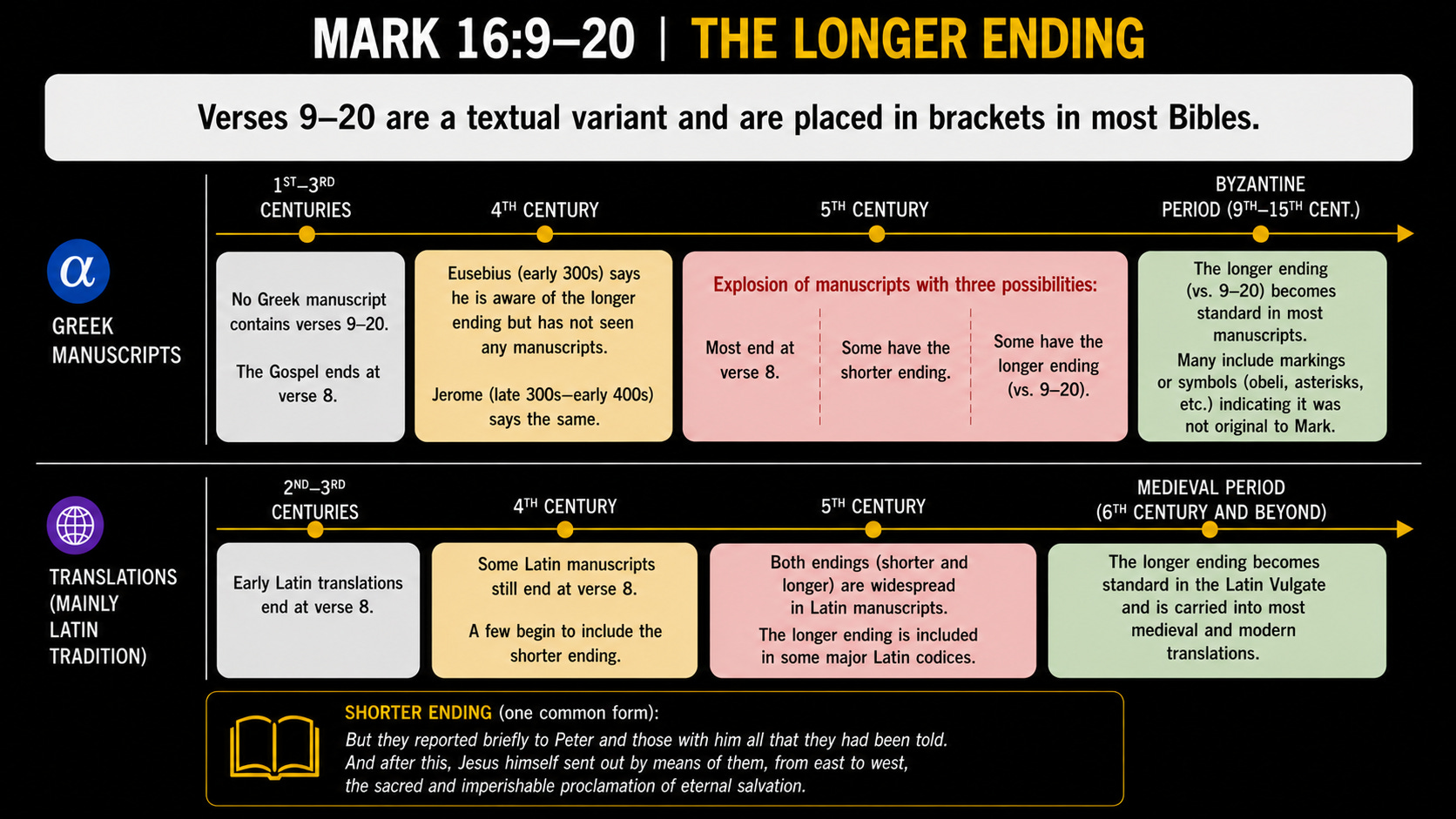
The textual variant in question is Mark 16:9–20, a passage bracketed in most modern Bibles. The entire section constitutes a textual variant.
To summarize the manuscript evidence briefly, no surviving Greek manuscript contains verses 9 through 20 until the fifth century. Interestingly, Eusebius, writing in the fourth century, acknowledged awareness of the longer ending of Mark, though he admitted he had not personally seen any manuscripts containing it. Jerome makes essentially the same observation in the late fourth or early fifth century.
Once we reach the fifth century, however, manuscripts begin appearing with one of two alternate endings. Some manuscripts still conclude at verse 8. Others contain what is commonly called the shorter ending of Mark, which reads,
But they reported briefly to Peter and those with him all that they had been told. And after this, Jesus himself sent out by means of them, from east to west, the sacred and imperishable proclamation of eternal salvation.
There are several minor variations of this shorter ending, but that wording captures its basic form.
Throughout the fifth century, most manuscripts continued to end at verse 8, while some contained the shorter ending and others the longer ending found in verses 9 through 20. This pattern continues until the later Byzantine manuscript tradition largely standardizes the longer ending. Even then, some manuscripts include markings or symbols indicating that scribes questioned its originality.
Beyond the external manuscript evidence, there are also significant internal reasons for doubting that the longer ending was written by Mark.
The first concerns vocabulary and style. The language of the longer ending differs noticeably from the rest of Mark’s Gospel. The vocabulary, sentence structure, and overall style do not align naturally with Mark’s usual writing style.
The second issue involves tensions within the narrative itself. Perhaps “contradictions” is too strong a term, but the longer ending does create certain inconsistencies. For example, Mary Magdalene is reintroduced in verse 9, even though Mark has already mentioned her twice earlier in the narrative. It seems unusual that Mark would pause at this point to provide additional background information about her.
Likewise, Mark records earlier in chapter 14 that Jesus promised to meet the disciples in Galilee. Yet the longer ending, seemingly influenced by the other Gospel accounts, emphasizes appearances occurring in Jerusalem instead.
Then there is the unusual statement in verse 18: “They will pick up serpents with their hands; and if they drink any deadly poison, it will not hurt them” (Mark 16:18).
The reference to handling serpents likely alludes to Paul surviving a snakebite in the book of Acts. The reference to drinking poison has no clear parallel elsewhere in Scripture. More broadly, the themes of snake handling, speaking in tongues, casting out demons, and similar signs feel less like the language and emphasis of the Gospels and more like reflections upon the apostolic era as described in Acts.
Additional examples could be cited, but by this point, the evidence simply continues to accumulate in the same direction. Nearly every line of evidence suggests that the longer ending was not original to Mark’s Gospel.
This leads naturally to the third consideration, which relates directly to the principles of textual criticism discussed previously. The general rule is that the reading that best explains the origins of the other readings is usually the original. Scribes frequently attempted to smooth out difficult passages. Rarely did they make a text more abrupt, confusing, or unresolved.
Now consider how Mark’s Gospel ends if it concludes at verse 8: “And they went out and fled from the tomb, for trembling and astonishment had seized them, and they said nothing to anyone, for they were afraid” (Mark 16:8).
And that is the end of the Gospel.
It is undeniably abrupt. In fact, it feels unresolved, especially when compared to the fuller resurrection narratives found in the other Gospels.
So which scenario appears more likely? Did Mark originally compose the longer ending, only for a scribe later to remove it for no obvious reason? Or did Mark conclude abruptly at verse 8, prompting later scribes to supply a more satisfying conclusion that harmonized more naturally with the other Gospel accounts?
Once all the evidence is considered together, the conclusion becomes fairly clear. Mark did not write the longer ending.
This raises another question. Why do modern translations continue printing these longer textual variants in brackets instead of removing them entirely or placing them only in the footnotes?
The answer is partly transparency. Modern translations aim to present the manuscript evidence honestly and clearly to readers. Scripture did not descend from heaven in a pre-printed English edition exactly as we now possess it. Rather, God providentially preserved His Word throughout a long and complex history of transmission.
The reason these passages are not simply relegated to footnotes is similar to the reason Erasmus retained certain traditional readings from the Latin Vulgate despite weak support from Greek manuscripts. These passages have become deeply embedded in the church’s historical memory and liturgical practice, largely due to the longstanding influence of the King James Version.
At this point, I had hoped to move on to a discussion of Bible translations themselves, but we will extend the series by one additional week. We still need to examine why the NIV may render a passage differently than the ESV, what translation philosophies distinguish these various versions, and how Christians should think about them.
Before concluding the study altogether, we also need to address the issue of inerrancy. Can we still describe the Bible as inerrant after seeing these textual variants? And what should we make of biblical passages that seem to promise that God’s Word would never change?
We will return to those questions next week.


