



Previously, we began examining the transmission of the New Testament. A brief reminder will suffice before moving forward. The copying of the New Testament differed significantly from that of the Old Testament. Old Testament transmission was highly centralized, carried out primarily by professional scribes in specific locations and under strict guidelines.
Such conditions were not possible for the New Testament, at least for several centuries. The early church was geographically dispersed and frequently subjected to persecution. As a result, the copying of New Testament writings was undertaken by a wide range of individuals, both trained and untrained, often working quickly to meet demand. Predictably, this process resulted in less uniform copies. At the same time, it produced far more manuscripts.
Organizing the Manuscript Evidence
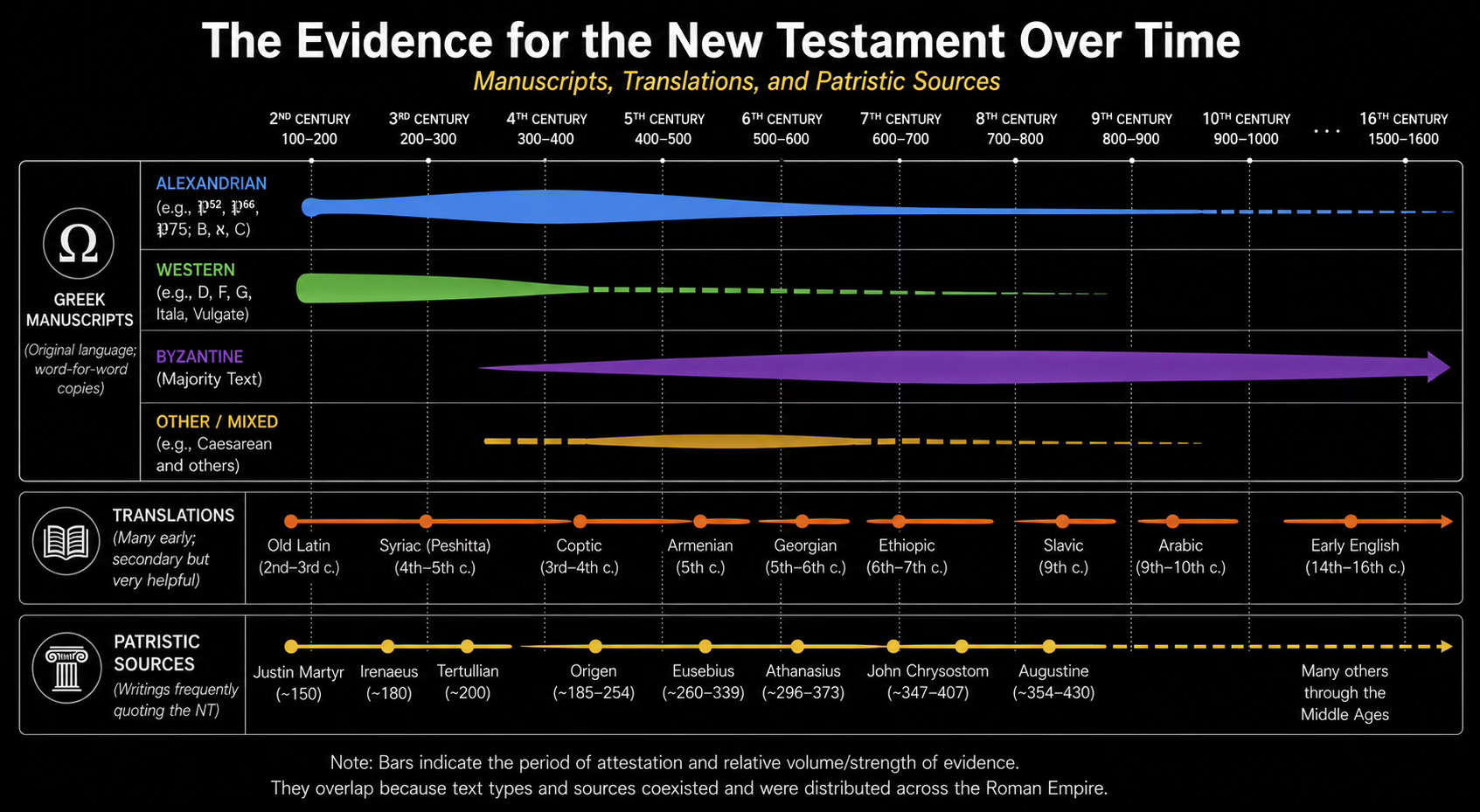
To understand how the New Testament text has been preserved, it is helpful to picture a large table on which every existing manuscript is laid out. In Greek alone, there are approximately 5,800 surviving manuscripts. These demand primary attention because the New Testament was originally written in Greek. They represent direct, word-for-word, letter-for-letter copies of the text.
Alongside these Greek manuscripts are thousands of early translations. Many of these translations are quite ancient and provide valuable insight into the text’s history. Still, they remain secondary witnesses. A copy in the original language necessarily carries greater precision than any translation, no matter how early or careful.
To this collection, we also add the writings of early Christians such as Justin Martyr, Irenaeus, Origen, Eusebius, and Augustine. These authors frequently quoted the New Testament in their works, providing a window into the manuscripts available to them in their own time.
With all of these witnesses before us, the next step is organization. One could arrange the Greek manuscripts in a single chronological sequence by date of production. Beneath them, the translations could be arranged similarly, followed by the extra-biblical patristic sources. Such an arrangement allows us to trace the development of the text over time. Moving along this timeline, it becomes possible to observe when a variant first appears and to follow its trajectory. One can ask whether later scribes recognized and corrected a reading, or continued to reproduce it.
Yet chronological arrangement alone is insufficient. It tells only part of the story. The manuscripts must also be grouped according to what are commonly called text types or manuscript families. Because the early church was scattered throughout the Roman Empire, communities copied the New Testament independently of one another. When a textual change occurred, its origin and geographical spread are significant. A variant confined to a single region carries a different weight than one attested across multiple regions.
Among these manuscript families, two are especially significant: the Alexandrian and Byzantine text types.
The Alexandrian manuscripts are generally earlier and associated with regions such as Egypt, where the dry, stable climate contributed to their preservation. These manuscripts often exhibit readings that are less polished and less harmonized, a feature that will be examined further.
By contrast, the Byzantine manuscripts are later and constitute the majority of surviving copies. This is not surprising, given their chronological proximity. These manuscripts tend to display smoother readings, greater harmonization between parallel passages, and a tendency toward longer forms of the text. The reasons for these characteristics will be considered in due course.
Evaluating Textual Variants
With our table of manuscripts now arranged and organized, an important question emerges. What do we actually learn from this evidence? At first glance, the data can seem alarming. Among the approximately 5,800 Greek manuscripts of the New Testament, there are as many as half a million textual variants.
Such a number may appear troubling. How can the reliability of Scripture be maintained in light of so many differences? Yet raw numbers, taken in isolation, can be deeply misleading.
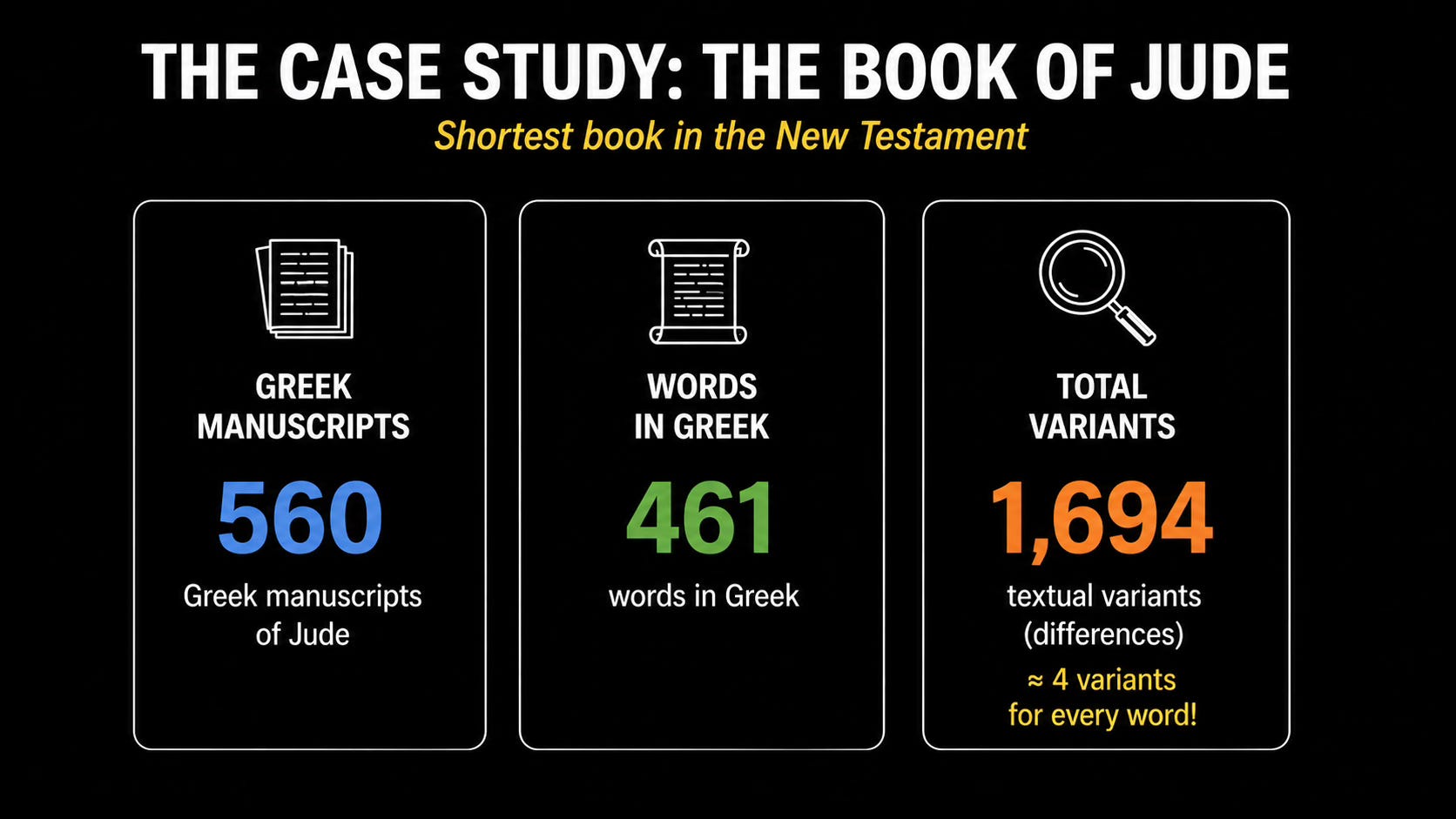
To bring clarity, consider a more controlled example. Set aside all other manuscripts and focus exclusively on the Greek copies of the book of Jude. This epistle serves well as a test case because it is the shortest book in the New Testament, containing approximately 461 words in Greek. In total, there are about 560 surviving Greek manuscripts of Jude. Among them, 1,694 textual variants can be identified.
At face value, this seems overwhelming. It suggests multiple variants for nearly every word in the letter. However, responsible textual criticism does not stop at counting differences. It proceeds by classifying them, recognizing that not all variants carry equal weight.
The first category consists of nonsense readings. These are simple scribal errors, equivalent to typographical mistakes. In many cases, the resulting word is not even a valid Greek term. Such errors are immediately recognizable and require no comparison with other manuscripts to identify and correct.
The second category includes singular readings. These are variants found in only one manuscript. When a reading appears in isolation, it strongly indicates a localized mistake by an individual scribe. Such readings can be set aside with a high degree of confidence.
When nonsense readings and singular readings are removed from consideration, more than half of the total variants disappear. The number is reduced from nearly 1,700 to approximately 785.
The third category involves spelling differences. Ancient spelling was not standardized, and scribes often wrote the same word in different ways. These variations do not affect meaning.
The fourth category includes minor grammatical differences. These may involve word order or the presence of an article before a proper name. For example, a scribe might write “the Paul” instead of simply “Paul.” In Greek, such variations often do not alter the sense of the sentence and are frequently untranslatable into English.
Once these categories are set aside, the number of variants that meaningfully affect the structure of a sentence is reduced to forty-seven. Even this figure requires further qualification. When translated into English, most of these remaining differences have no discernible impact on meaning.
This reality is reflected in modern translations. The New International Version includes only two footnotes in Jude that indicate any significant textual variation, while the English Standard Version includes only one.
The most notable example appears in Jude 5. One reading identifies the subject as “Jesus,” while another identifies it as “the Lord.” The difference is genuine and worthy of discussion, yet its theological impact is minimal. The broader witness of Scripture leaves no uncertainty regarding the identity and work of Christ. Jesus Christ is consistently presented as divine and active in creation and redemption.
Therefore, even in the presence of this meaningful variant, no core doctrine is altered. Whether the text reads “Jesus” or “the Lord,” the theological truth remains intact. The Lord delivered his people from Egypt, and the New Testament affirms that Christ himself is fully involved in God’s saving work.
The Guiding Principle of Textual Criticism
This provides an appropriate moment to introduce what is often called the golden rule of textual criticism. By textual criticism, we mean the careful comparison of manuscripts in order to determine, as closely as possible, what the original writings, or autographs, contained. The guiding principle can be stated simply: the reading that best explains the existence of the other variants is most likely the original. In other words, textual critics prefer the reading that most plausibly accounts for how the other readings arose.
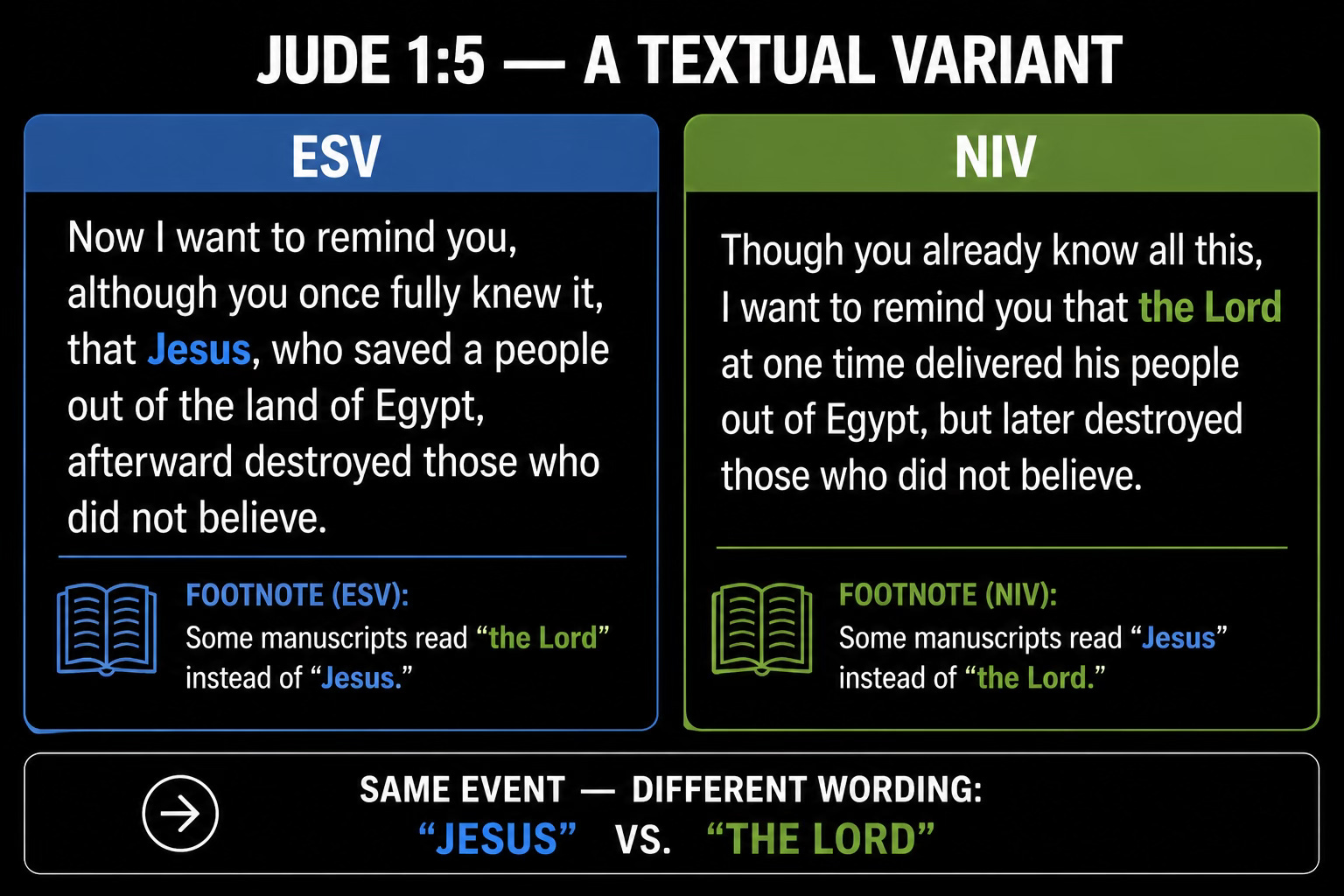
Consider the example of Jude 5 again. The question is whether the original text read “the Lord” or “Jesus.” Which scenario is more likely? Did Jude write “the Lord,” only for a later scribe to change it to “Jesus”? Or did Jude write “Jesus,” with a subsequent scribe altering it to “the Lord”?
At first glance, one might assume that scribes had greater motivation to insert the name “Jesus,” since doing so would make explicit his role in the salvation of God’s people. Yet the opposite possibility deserves careful consideration. A reader familiar with the Exodus account would expect to see “the Lord,” not “Jesus.” Encountering the name “Jesus” in that context could feel unexpected, even unsettling. The shift can be jarring, particularly for those accustomed to translations such as the King James Version, which reads “the Lord,” in contrast to the English Standard Version, which reads “Jesus.”
The manuscript evidence adds further weight. Some of the earliest and most reliable witnesses, along with other ancient sources, support the reading “Jesus.” This presents what is often described as the more difficult reading. While it is theologically sound to affirm that Jesus Christ was active in the salvation of Israel, the explicit use of his name in this context can appear unexpected.
This difficulty is significant. Scribes did not typically make texts more challenging. Their natural tendency was to smooth out perceived problems, to harmonize passages, or to clarify what seemed unclear. A scribe encountering “Jesus” in Jude 5 might well have assumed it to be an error or an awkward expression and replaced it with the more familiar “the Lord.”
This pattern appears frequently in the transmission of the New Testament. Readings tend to become smoother, more harmonized, and more immediately understandable over time.
For this reason, textual critics ask several key questions when evaluating variants. Which reading most plausibly gave rise to the others? Which reading would scribes be most likely to change? Which reading best fits the full range of manuscript evidence? By applying these questions carefully, scholars can weigh the evidence and arrive at well-supported conclusions about the original text.
Scribal Changes and the Growth of the Text
At this point, an important concern may arise. Does this mean that scribes were intentionally altering the words of Scripture? In some cases, yes, but not for the reasons one might initially suspect.
Scribal changes generally fall into two broad categories: accidental mistakes and intentional changes. The accidental mistakes are straightforward and easy to understand. These include misspellings, repeated words, skipped words or lines, confused or reversed letters, and unintentional omissions. Such errors were common, especially given the nature of early manuscripts. They were typically written in all capital letters, with no spaces between words. As a scribe’s eyes moved back and forth between the source text and the copy, it was easy to lose one’s place.
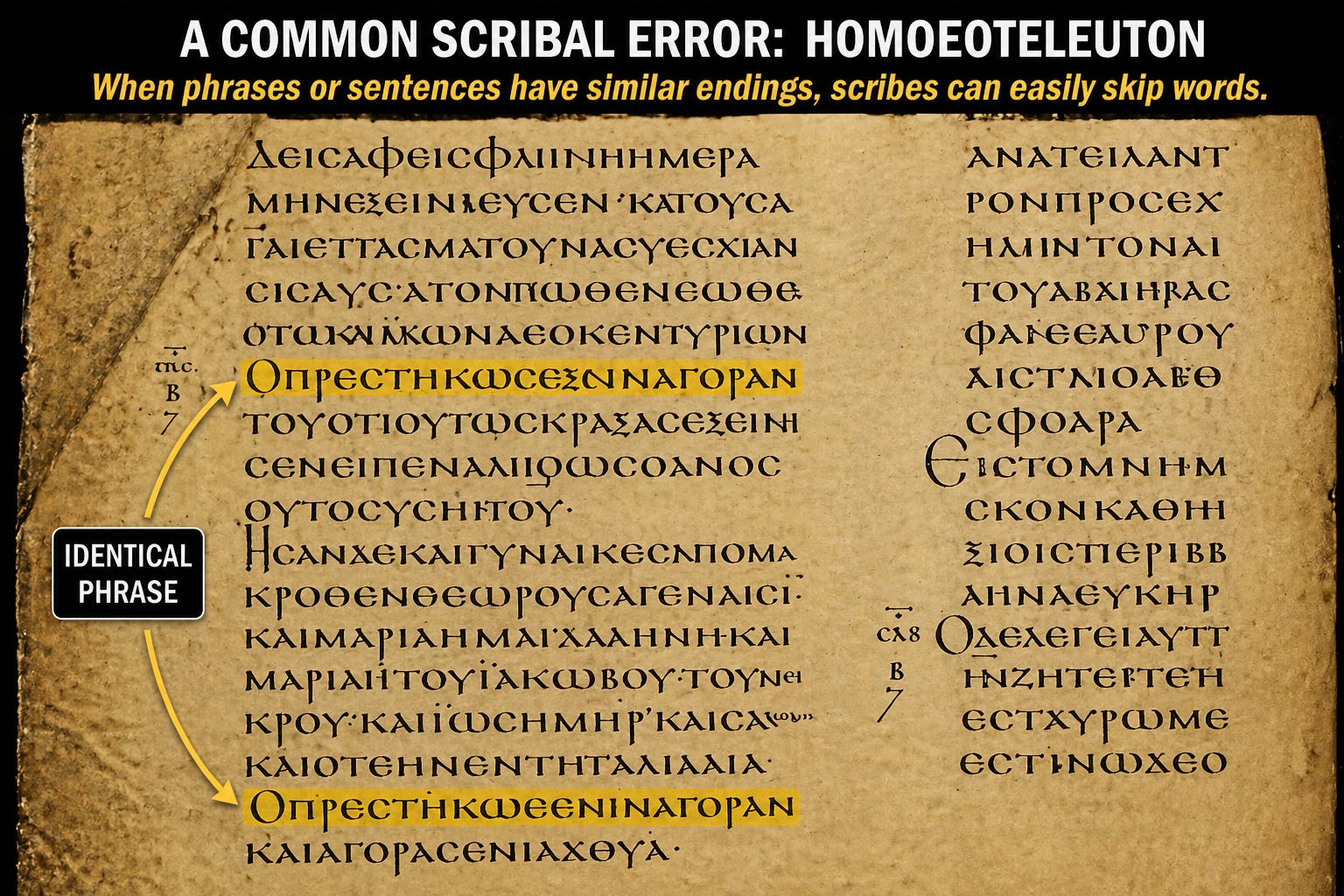
A particularly common error occurred when lines or phrases ended similarly. A scribe might copy a phrase, glance back at the original, and mistakenly resume copying from a later occurrence of the same phrase, thereby omitting the intervening words. These kinds of errors are well understood and readily identified.
Intentional changes, however, require more careful consideration. These were rarely made with malicious intent. On the contrary, scribes who introduced changes typically did so out of reverence for the text. They often believed they were clarifying a difficult passage, harmonizing parallel accounts, or correcting what they perceived to be an earlier mistake. While such actions cannot be justified, they are understandable within the historical context.
This tendency helps explain an important feature of New Testament transmission. Over time, the text became longer. Additions were more common than omissions. This observation is confirmed when comparing earlier Alexandrian manuscripts with later Byzantine manuscripts. The Byzantine tradition, which constitutes the majority of surviving manuscripts, tends to be more expansive, smoother in its readings, and more internally consistent.
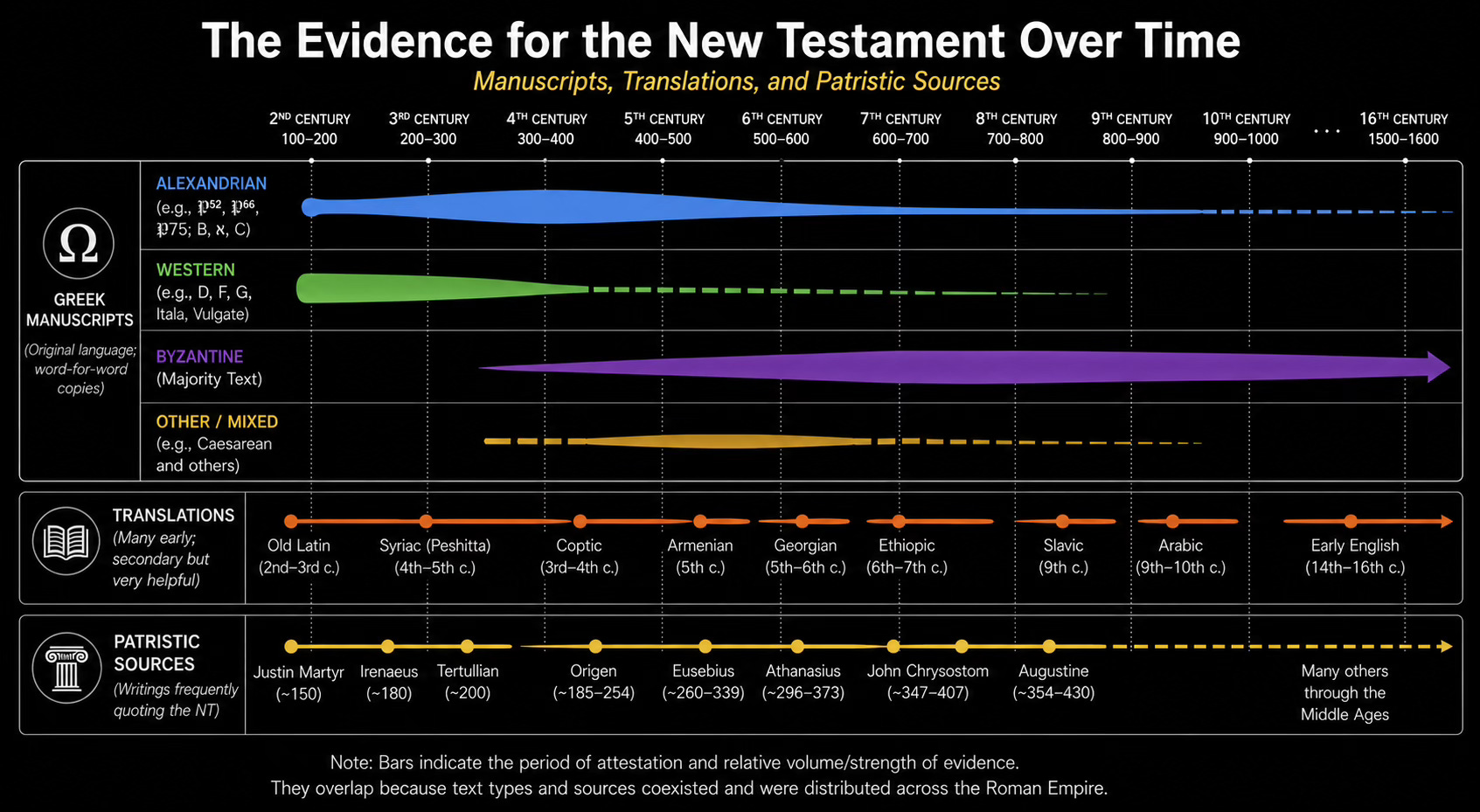
Returning to the conceptual table of manuscripts, this development becomes visible. On one side stand the earlier Alexandrian manuscripts, fewer in number and often less polished. On the other side are the later Byzantine manuscripts, more numerous and more uniform. Their greater consistency reflects a later stage in the transmission process, when persecution had subsided, and copying could occur in more stable and professional environments.
This pattern has important implications. First, it cautions against relying on majority readings alone. The fact that most manuscripts agree on a particular reading does not necessarily mean that the reading is original. Many of those manuscripts may derive from a later stage in the textual tradition and may preserve additions that were introduced earlier in the process.
Second, this sheds light on the longstanding discussion surrounding modern Bible translations and the King James Version. Critics of modern translations often note that versions such as the New International Version or the English Standard Version appear to omit words, phrases, or even entire verses compared with the King James Version. From this, some conclude that material has been deliberately removed.
The historical reality is the reverse. The King James Version was produced using the manuscripts available at the time, which were predominantly later Byzantine texts. As a result, it reflects a longer form of the text. Modern translations, by contrast, draw from a much broader range of evidence, including both later Byzantine manuscripts and earlier Alexandrian witnesses. When translators identify readings that appear to be later additions, they omit them in an effort to recover the earliest attainable form of the text.
In this light, the differences between translations are not the result of deliberate subtraction, but of a more comprehensive engagement with the manuscript tradition. The goal remains the same. It is to approximate as closely as possible the original wording of the New Testament as it was first written.
Reasons for Intentional Scribal Changes
One of the primary motivations behind intentional scribal changes was piety. Scribes often expanded titles for Christ out of reverence. Where earlier manuscripts might simply read “Jesus,” later manuscripts sometimes read “Lord Jesus” or “Lord Jesus Christ.”
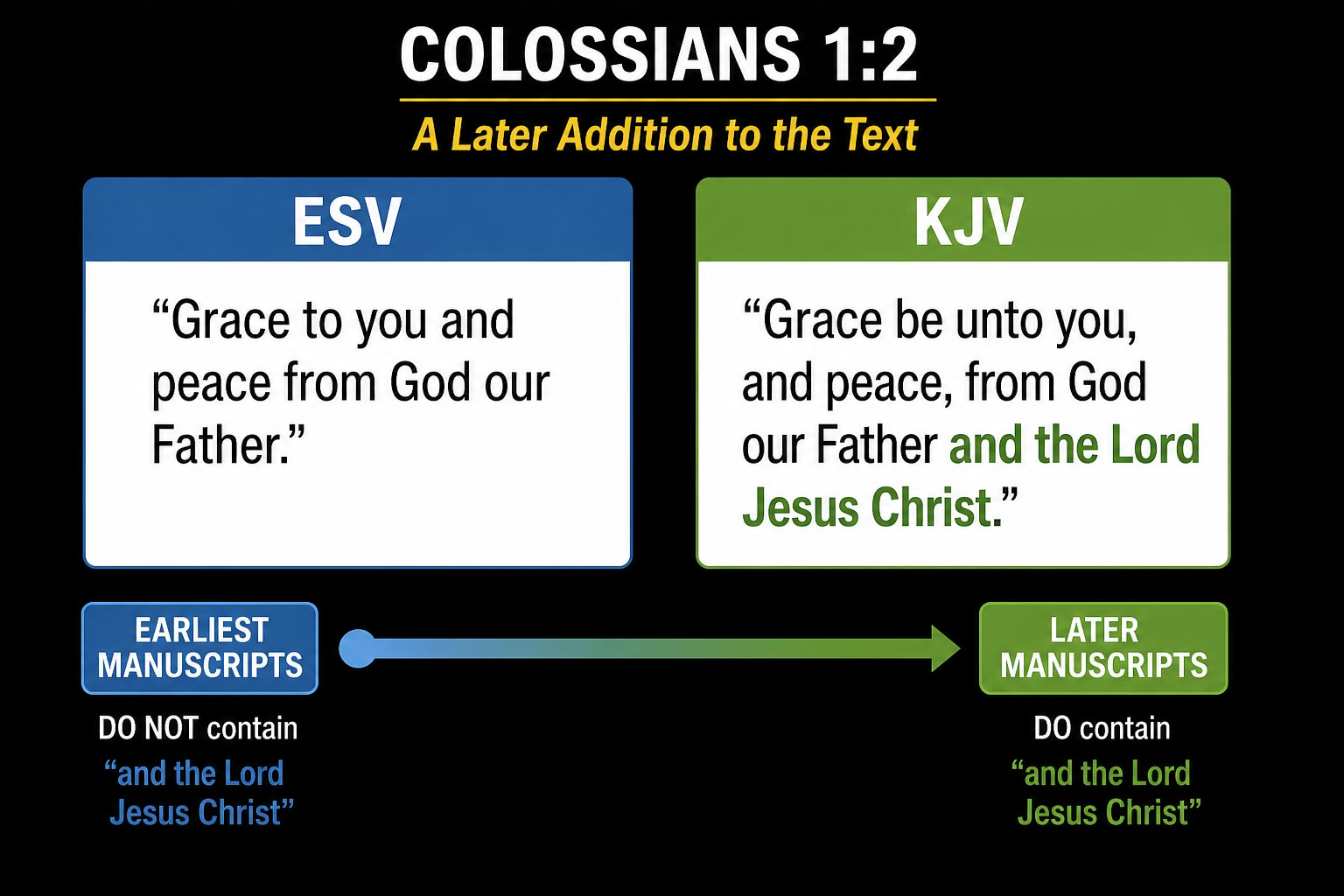
A similar pattern appears in some of Paul’s greetings. In Colossians 1:2, the English Standard Version reads, “Grace to you and peace from God our Father,” while the King James Version reads, “Grace be unto you, and peace, from God our Father and the Lord Jesus Christ.” The earliest manuscripts do not include the phrase “and the Lord Jesus Christ,” whereas later manuscripts do. This suggests that a scribe may have borrowed language from one of Paul’s other letters, either intentionally or unconsciously, or added it as an expression of reverence.
A second major reason for intentional changes is harmonization. This is especially common in the Gospels, where multiple accounts describe the same events. Although the Gospels are already in essential agreement, scribes sometimes sought to make that harmony more explicit.
This tendency is particularly evident in the Gospel of Mark. A scribe familiar with Matthew might perceive Mark’s account as lacking certain details. In response, he might incorporate elements from Matthew into parallel passages in Mark.
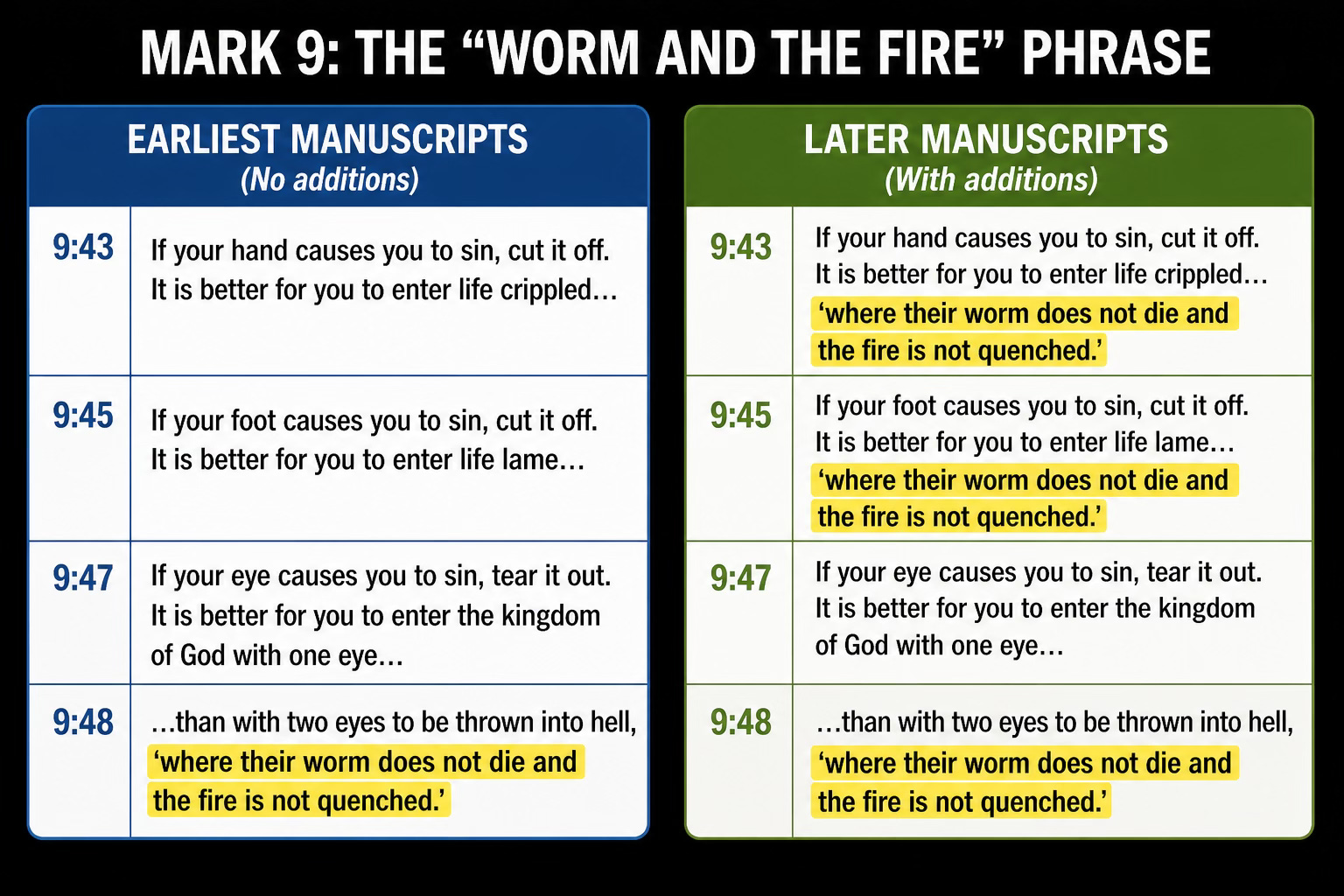
An illustrative example appears in Mark 9. Jesus speaks of the seriousness of sin and its consequences:
And if your eye causes you to sin, tear it out. It is better for you to enter the kingdom of God with one eye than with two eyes to be thrown into hell, ‘where their worm does not die and the fire is not quenched.’ (Mark 9:47–48)
In the earliest manuscripts, the phrase “where their worm does not die and the fire is not quenched” appears only once in this passage, in verse 48. In later manuscripts, however, the same phrase is repeated after verses 43 and 45. The most plausible explanation is that a scribe, perhaps seeking rhetorical emphasis or consistency, duplicated the phrase within the passage.
This example also helps explain the phenomenon often described as “missing verses.” When verse numbers were added to the Bible in the sixteenth century, they reflected the longer form of the text found in later manuscripts, such as those underlying the King James Version. As textual scholarship advanced and earlier manuscript evidence was more fully considered, it became clear that certain phrases were later additions. Consequently, those phrases were removed in modern critical editions, along with their corresponding verse numbers, such as verses 44 and 46 in Mark 9.
What may appear to be missing content is, in reality, the removal of later expansions. In either case, whether one reads the longer or shorter form, no essential doctrine is affected. The meaning of the text remains intact, once again demonstrating the faithful preservation of Scripture’s substance.
The Rules of Textual Criticism
Having established the nature of textual variants, the next step is to examine several of the more significant examples found in the New Testament. The goal is to return to our conceptual table of manuscripts and apply the principles of textual criticism in order to determine, as carefully as possible, what the autographs originally contained. Before doing so, however, it is necessary to clarify the rules that guide this process.
The foundational principle has already been stated. The preferred reading is the one that best explains the existence of the others. The task, then, is to determine how such an evaluation is made. This is where additional criteria come into play.
The first category is external evidence. This involves examining the manuscripts themselves. A textual critic will ask a series of questions. How old is the manuscript? From what region does it originate? To which text type does it belong? Is the reading geographically widespread? Is it found in Greek manuscripts? Is it supported by early translations? Is it cited by early church fathers? What is the general reliability of the manuscript? External evidence provides a tangible historical trail, allowing scholars to trace where and how variations in the text have emerged.
The second category is internal evidence. Here, the focus shifts from the manuscripts to the text itself. The critic considers what the author was most likely to have written and what a scribe would most likely have altered. Does the reading align with the author’s known vocabulary, grammar, and style? Would a scribe have been inclined to add to the text, omit something, or smooth out an awkward expression? Internal evidence seeks to explain the origin of the variants by examining the habits of both authors and scribes.
In addition to these two broad categories, several general tendencies guide the evaluation. One such principle is the preference for the more difficult reading. Although this may seem counterintuitive, scribes typically did not make passages more difficult. Their tendency was to clarify, smooth, and harmonize. Therefore, a reading that appears more challenging is often more likely to be original, though this is not an absolute rule.
Closely related is the preference for the shorter reading. While scribes did occasionally omit material, the overall pattern in New Testament transmission shows expansion rather than contraction. Additions could take the form of clarifications, explanatory notes, expanded titles for Christ, harmonizing phrases, or familiar liturgical expressions. Consequently, the shorter reading is often, though not always, to be preferred.
Another guiding principle is the preference for the less harmonized reading. This is especially relevant in the Gospels. When one manuscript presents a simpler or less refined version of a passage, while another adjusts it to align more closely with a parallel account, the less harmonized form is typically closer to the original.
Finally, textual critics often favor readings that reflect Jewish or Hebrew influence. Although the New Testament circulated widely in Greek-speaking contexts, its authors were Jewish. Later scribes sometimes adjusted idioms, phrasing, or sentence structure to conform to more polished Greek usage. As a result, readings that appear less refined or more reflective of Semitic influence may preserve the original form of the text.
With these principles in place, the task becomes more precise. Each variant can be examined in light of both external and internal evidence, as well as these general tendencies. This framework provides the necessary tools to evaluate specific examples and to arrive at well-supported conclusions regarding the original wording of the New Testament.
A Case Study: John 5:4
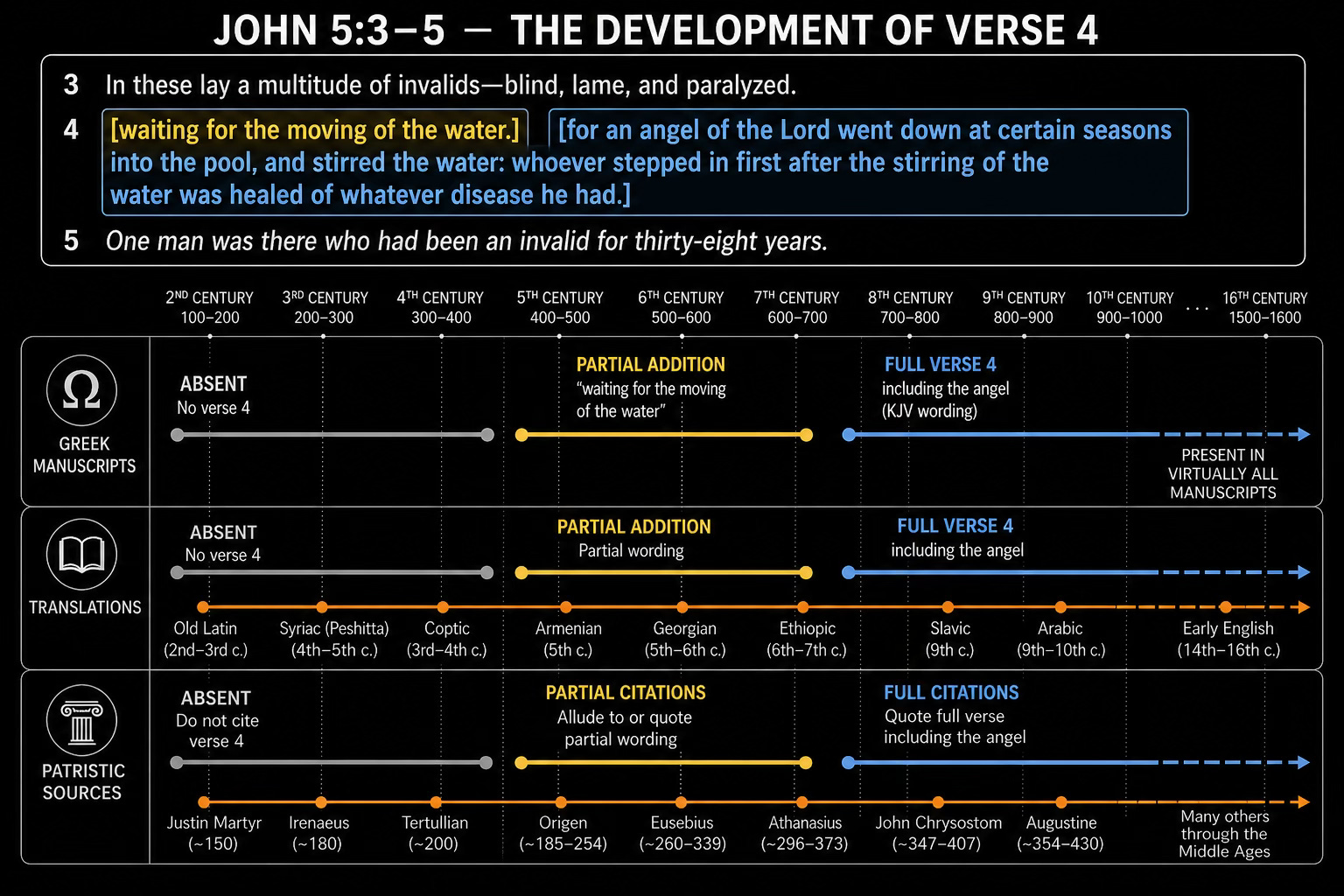
To illustrate how these principles function in practice, consider John 5:4. Reading from the English Standard Version, the passage begins:
Now there is in Jerusalem by the Sheep Gate a pool, in Aramaic called Bethesda, which has five roofed colonnades. In these lay a multitude of invalids—blind, lame, and paralyzed. One man was there who had been an invalid for thirty-eight years. When Jesus saw him lying there and knew that he had already been there a long time, he said to him, “Do you want to be healed?” The sick man answered him, “Sir, I have no one to put me into the pool when the water is stirred up, and while I am going another steps down before me.” Jesus said to him, “Get up, take up your bed, and walk.” And at once the man was healed, and he took up his bed and walked. (John 5:2–9)
This account raises an immediate question. Why were so many disabled individuals gathered at the pool of Bethesda? The text indicates that they were waiting for the water to be stirred, and that entering the water at that moment was believed to bring healing. Yet the passage itself does not explain who stirred the water or why it held such significance.
Those familiar with the King James Version may recall an additional verse that provides an explanation. It states that an angel would descend at certain times, stir the water, and that the first person to enter afterward would be healed. This creates a clear textual variant between manuscripts.
Applying the principles of textual criticism, the first step is to examine the external evidence. The earliest Greek manuscripts, including those from the second and third centuries, do not contain this verse. Even the complete codices from the fourth century omit it. It is not until the fifth and sixth centuries that the text begins to develop. Some manuscripts include only a partial phrase, such as “waiting for the moving of the water,” while others include the full verse. By the time one reaches the later Byzantine manuscripts, the verse appears in nearly all copies, though it is sometimes marked with a symbol indicating doubt.
The same pattern appears in early translations. Latin, Syriac, and Coptic witnesses initially lack the verse, then gradually introduce portions of it, and eventually include it in full in later copies. This consistent trajectory across multiple transmission streams strongly suggests that the verse was not part of the original text but was added over time.
The internal evidence supports this conclusion. The verse functions as an explanatory addition, providing background information to clarify a detail that might otherwise seem obscure. It reads like a marginal note intended to explain the local belief associated with the pool. It is entirely plausible that a scribe, seeking to aid the reader, recorded this explanation in the margin. A later scribe, encountering the note, may have assumed it belonged to the text and incorporated it into the body of the manuscript.
While the precise historical mechanism cannot be proven with certainty, such developments are well attested elsewhere in the manuscript tradition. The cumulative evidence indicates that John did not originally include this verse.
The question then arises, does its absence affect the meaning or doctrine of the passage? It does not. The narrative remains fully intact. The presence or absence of this explanatory detail does not alter any theological teaching or fundamental doctrine.
This example highlights a broader and often overlooked reality. Although there are hundreds of thousands of textual variants across the New Testament manuscripts, only a small fraction have any meaningful impact on the wording of the text. Of that small percentage, none alters any essential doctrine of the Christian faith. Whether John 5:4 is included or omitted, the substance of Christianity remains unchanged.


