


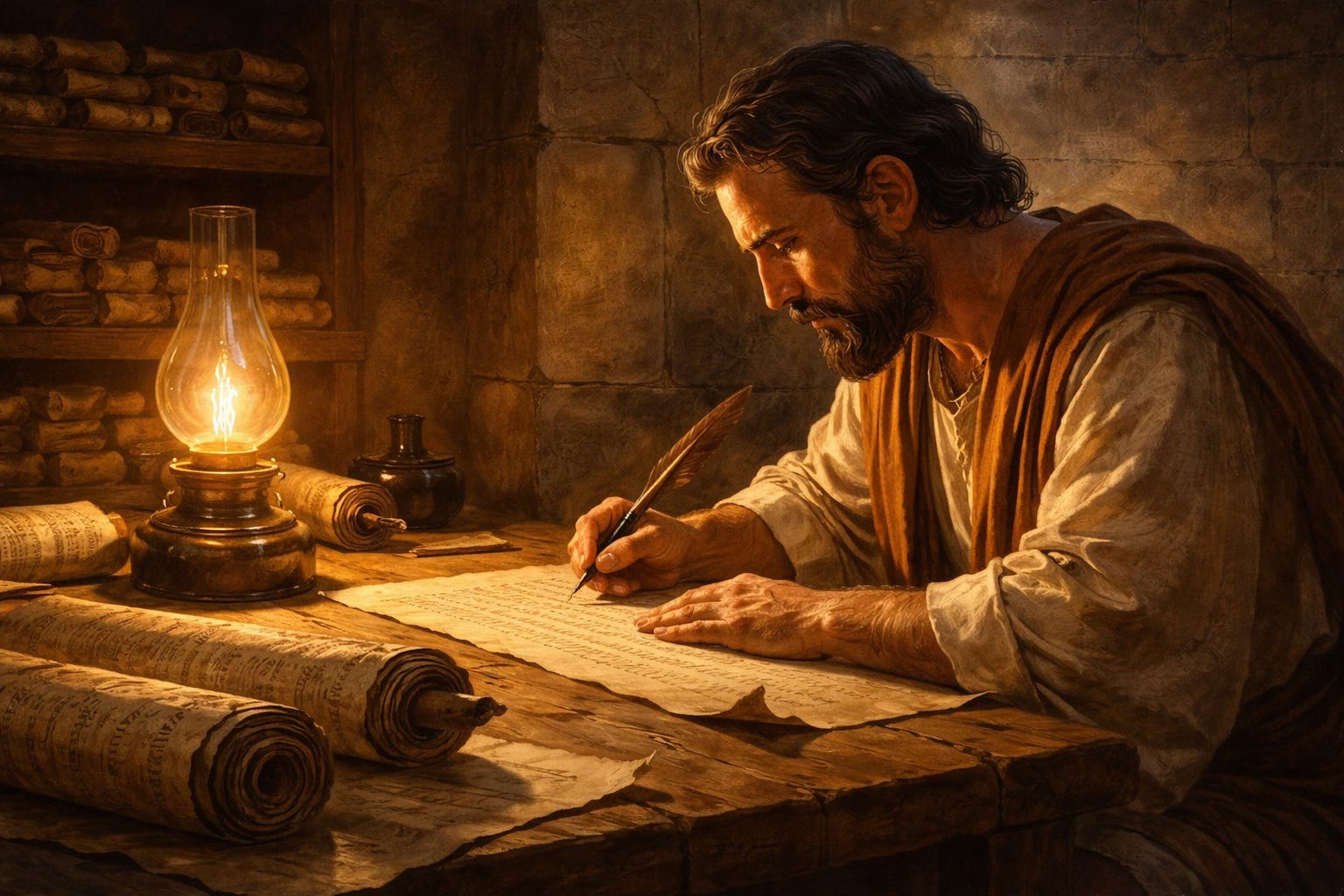
Suppose I’ve written a relatively short book of about 15,000 or 16,000 words by hand. The words are written in ink on papyrus, a paper-like material made from the papyrus plant. It’s fragile. Even a little moisture can ruin it.
I should also mention that I haven’t used a conventional writing style. There are no paragraph breaks, no punctuation, and not even spaces between words. All 16,000 words appear as one long, continuous sentence.
This book is extremely important, so I need as many copies as possible, but no one is allowed to use a copy machine. You can’t scan it or reproduce it digitally. Every copy must be made by hand, using papyrus or, if you can afford it, parchment made from animal skins. Regular paper isn’t an option.
I give my only copy to someone. It must be handled carefully because it’s the only one. That person makes a copy, then others make copies from that copy, and so on, until eventually everyone has one. Because this book is so important, it isn’t read just once but over and over again, with copies continuing to spread.
Over time, however, problems arise. Some copies are lost—spilled on, damaged, or destroyed. Some of you don’t speak English, so you translate the text into your own language. Later, someone else receives that translation and renders it back into English. As anyone who has used a translation tool knows, the wording may not come out exactly the same.
Even with careful copying, mistakes are inevitable. A scribe might skip a word or an entire line, misspell something, or include a marginal note that the next person assumes belongs in the text. From that point on, the addition is copied as though it were original.
Eventually, people begin comparing their copies and notice differences. Now the question arises: Which copy is accurate?
Ordinarily, we would consult the original. But in this case, the original has been ruined—left in a damp basement and lost. So how do we determine what it said?
The best option is to gather every available copy—say, fifty of them—and lay them out for comparison.
Suppose one sentence reads, “We were gentle among you, like a nursing mother taking care of her own children.” But some copies say, “We were little children among you.” One even says, “We were horses among you.”
At first glance, “gentle” seems to make the most sense. “Little children” sounds redundant. Calling oneself both a child and a mother in the same sentence feels awkward. And “horses” clearly does not fit.
But rather than relying on what sounds right, we can take a more careful approach. Arrange the copies chronologically, from oldest to newest, and look for patterns.
When we do that, we find that the five oldest copies all read “gentle.” The sixth introduces “little children,” and nearly every copy after that follows it, except for the single outlier that reads “horses.” While “little children” appears most frequently, “gentle” is found in the earliest witnesses.
Which is more likely to reflect the original? On the one hand, the earliest copies are closer in time to the original and therefore had less opportunity for corruption. On the other hand, the majority reading might suggest that “little children” was widely preserved, perhaps even from earlier copies we no longer possess.
This example is not hypothetical. It comes from 1 Thessalonians 2:7. In the ESV, the verse reads, “We were gentle among you, like a nursing mother taking care of her own children.” But a footnote indicates that “gentle” could also be translated as “infants” or “little children.” Why? Because among the thousands of surviving Greek manuscripts, hand-copied on papyrus or parchment, some read “gentle,” some read “little children,” and at least one reads “horses.”
In Greek, the words are strikingly similar: ēpioi, nēpioi, and hippoi. A small visual or auditory difference could easily lead to confusion. A scribe working with a smudged manuscript or poor lighting might misread the word, and his responsibility was not to interpret but simply to copy what he saw.
In other words, the presence of variation does not indicate carelessness so much as the reality of human transmission. And it is precisely by comparing these variations across many manuscripts that we are able to work back, with considerable confidence, to the original wording.
How Did We Get Our Bibles?
This brings us to the central question we’ll consider over the next few weeks: How did we get our Bibles?
It sounds like a simple question, but the illustration we’ve just considered shows that the answer is not so simple. After all, the sixty-six books of the Bible did not fall out of the sky in English, already bound in leather with gilded pages. No one would explicitly claim that, yet many Christians functionally think this way. We know that God inspired the text, and we assume that he preserved it, but we rarely stop to ask how he preserved it.
Without any real sense of the Bible’s history, it is easy to imagine a perfectly unbroken chain of copies—one flawless, word-for-word reproduction after another, generation after generation. Perhaps it was not in English, and perhaps without the leather binding, but still perfectly preserved in every detail by the hands of fallible men.
That is not what happened, and it is not a helpful assumption to carry.
I come from a King James Only background. My church believed that God preserved a perfect line of manuscripts and that those manuscripts were then translated perfectly into the King James Bible. As a result, no other English translation was considered trustworthy. The NIV, the ESV, and the New King James Version— All were regarded as corrupted.
In time, I studied the issue more carefully and concluded that King James Onlyism is indefensible. To be clear, I can defend the King James Bible, but not King James Onlyism. I will admit, however, that there was a moment in that study when I wondered whether this would undermine my confidence in Scripture. I was learning about thousands of textual variants, or differences between manuscripts, and even the Greek text behind the King James Version had undergone notable changes before its translation. It was enough to raise questions.
But I continued studying, and rather than weakening my confidence, it strengthened it. I came to understand the process. I was no longer relying on assumptions about how we got the Bible; I could see the historical evidence. What emerged was a remarkable testimony to God’s providence.
Over the years, people from my former denomination have reached out with similar concerns. Their messages often sound the same: “I started looking into the history of the Bible, and now I don’t know what to think. Can I really trust the Bible?”
One moment, they believe they are holding God’s perfectly preserved Word in the King James Version. Next, they are unsure whether 1 Thessalonians 2:7 should read “gentle” or “little children.” They notice that some modern translations omit verses. They see brackets around passages like the longer ending of Mark or the story of the woman caught in adultery in John 8, and they begin to wonder whether those passages belong in the Bible at all. Terms like “textual variants,” “textual criticism,” “critical text,” and Textus Receptus only add to the confusion.
For someone unfamiliar with the Bible’s history, it can be overwhelming and even unsettling. But for someone who understands that history, the picture looks very different.
Consider two possible scenarios. In the first, we have only one version of the Bible. Every copy is identical, but we possess no ancient manuscripts and no evidence tracing its history. We are forced to assume that the text has remained unchanged for thousands of years, but we have no way to verify that assumption.
In the second scenario—that is, our current reality—we possess thousands of manuscripts, some dating back many centuries. They are not identical. There are differences between them, and we must work through those differences carefully. But those very differences allow us to compare, analyze, and trace the text’s history with remarkable precision.
Which scenario is preferable?
The first has the advantage of simplicity. The second has the advantage of evidence, and with it, historical authenticity.
If the Bible is anything, it is historically authentic. Both its content and its transmission unfold within real history, among real people. God works through ordinary, fallible means to accomplish his purposes. The story of Scripture itself reflects this pattern. Even the lineage of the Messiah is marked by flawed and sinful individuals, yet God’s purposes stand.
For contrast, consider the claims often made about the Quran. It is frequently said to be perfectly preserved, sometimes as a critique of the Bible’s textual history. But what is often left unsaid is that many variant manuscripts of the Quran were intentionally destroyed in its early history. As a result, there is far less ability to trace its textual development over time.
The Bible presents a different case. Yes, scribes made mistakes. But because we have so many manuscripts, those mistakes are visible. They can be identified, compared, and evaluated. We can often determine not only what the original likely said, but also how and why variations arose.
If we had only one copy, we would have no such ability. If 1 Thessalonians 2:7 read “horses,” we would have no basis for questioning it.
The Inspiration of Scripture
Before we consider differences between manuscripts and how they are resolved, we need to go back to the beginning and ask how the Bible was inspired.
The clearest statement on this is found in 2 Timothy 3:16, where Paul writes, “All Scripture is breathed out by God.” Some translations, such as the King James Version or the New King James Version, say, “given by inspiration of God.” That is an acceptable rendering, but it does not fully capture Paul’s meaning. The word he uses literally means “God-breathed.” Scripture is not merely inspired in the way we might speak of being inspired by a beautiful sunset. Rather, its very origin is divine. The words themselves are breathed out by God.
What, then, does that mean?
Much of our understanding here is indebted to B.B. Warfield, who studied this term extensively. Today, most translations clarify the meaning by rendering it “God breathed out,” which is helpful. Some, however, have suggested the opposite—that God breathes into Scripture, much like he breathed life into Adam in Genesis 2:7. On that view, human authors produced the words, and God later infused them with life.
But as Warfield observed, Paul’s term does not support that idea. The emphasis is not on God breathing into human words but on God himself breathing out the words of Scripture. The Bible is not ultimately the product of human initiative later elevated by God; it is of divine origin from the beginning.
What role, then, did the human authors play? How did God breathe out his words through them?
In some cases, Scripture reflects what might be called direct dictation. For example, in Revelation 2:1, Christ tells John exactly what to write, but this is not the norm. More often, what we see is what is called double authorship—that is, God and man, working simultaneously.
The apostle Peter describes it this way: “For no prophecy was ever produced by the will of man, but men spoke from God as they were carried along by the Holy Spirit” (2 Peter 1:21). The words are not produced by human will, yet the human authors are not bypassed. They are “carried along” by the Spirit.
This is evident in the distinct voices we encounter throughout Scripture. When we read Amos, we hear the voice of a shepherd, with simple language and agrarian imagery. When we read Isaiah, we encounter elevated, refined poetry, consistent with someone moving in royal circles. The personalities, experiences, and writing styles of the authors are fully present.
God did not treat these men as passive instruments, as though they were merely typewriters. A better illustration, though still imperfect, is that of a ship. The ship is constructed with sails and a rudder, and a human hand steers it, but the wind drives it to its destination. In a similar way, the human authors wrote in their own voices, yet they were carried along by the Spirit to produce exactly what God intended.
To understand this more fully, we must consider the providence of God. Wayne Grudem summarizes it well:
In cases where the ordinary human personality and writing style of the author were prominently involved, as seems the case with most of Scripture, all that we are able to say is that God’s providential oversight and direction of the life of each author was such that their personalities, their backgrounds and training, their abilities to evaluate events in the world around them, their access to historical data, their judgment with regard to the accuracy of information, and their individual circumstances when they wrote were all exactly what God wanted them to be, so that when they actually came to the point of putting pen to paper, the words were fully their own words but also fully the words that God wanted them to write, words that God would also claim as his own.
In other words, God did not only act in the moment of writing. He was preparing these men over the course of their lives so that, when they wrote, they would produce the precise words he intended.
This helps explain the variety we see in Scripture. At times, the authors declare, “Thus says the Lord,” recording direct revelation. At other times, the writing appears to be the result of ordinary human effort. Consider the introduction to Luke’s Gospel:
Inasmuch as many have undertaken to compile a narrative of the things that have been accomplished among us, just as those who from the beginning were eyewitnesses and ministers of the word have delivered them to us, it seemed good to me also, having followed all things closely for some time past, to write an orderly account for you, most excellent Theophilus, that you may have certainty concerning the things you have been taught. (Luke 1:1-4)
Luke describes a careful investigative process, including examining sources, consulting eyewitnesses, and compiling an orderly account. He is not receiving a vision at that moment; he has done historical work. Yet through that process, God is bringing about his Word. Luke’s study, judgment, and writing are all part of the means by which God breathes out Scripture.
This was true throughout the entire Bible, written by roughly 40 human authors across three continents over about 1,500 years.
We are often tempted to think of the Bible as though it descended from heaven in finished form. When we think that way about inspiration, it is easy to assume that its preservation must have happened in the same way—detached from history, untouched by human limitations.
But that is not how God has worked. From inspiration to canonization to transmission and translation, he has operated through ordinary means, through real people, and within the circumstances of history. Those people were fallible, and the process was often messy, yet God’s providence governed it all.
For that reason, when we encounter scribal errors or textual variants, they should not lead us to question the reliability of Scripture. They are consistent with the way God has always worked. The history of Israel, the life of the New Testament church, and even the accomplishment of redemption itself all testify to a God who fulfills his purposes through imperfect people and real historical processes.
Scripture did not fall out of the sky. God sovereignly guided the lives of its authors so that, in due time, they would write exactly what he intended.
The Wisdom of the Written Word
Before moving on from the inspiration of Scripture, it is worth emphasizing the wisdom of God in the medium he chose. In a world where oral tradition was common, he chose the written word as the vehicle for his revelation. In Exodus 17:14, he tells Moses, “Write this as a memorial in a book.” Later, in Exodus 31:18, he reinforces this by personally inscribing the Ten Commandments on stone tablets, “written with the finger of God.”
Why would God choose writing rather than relying on oral tradition? There are at least three practical reasons.
First, writing provides greater accuracy in preservation. As many mistakes as can occur when copying a written text, far more would arise if a message were passed along only by word of mouth. Writing establishes a fixed, enduring record. It not only preserves the message more reliably across generations, but it also allows for a much greater volume of content to be retained. The human mind has limits. Very few people could commit all sixty-six books of the Bible to memory.
Second, writing allows for widespread accessibility and dissemination. If God’s revelation were purely oral, it would be limited to those within earshot of a prophet or apostle. Writing, however, enables the message to travel. It can be carried across regions and nations, making God’s Word accessible to people far removed from its original setting.
Third, the written word allows for repeated inspection. It can be studied carefully and revisited as often as needed. This is one reason I have transcribed my sermons for years. When we listen, we inevitably miss things. Even with notes, our retention is limited. But a written text allows us to examine every word at our own pace. As one preacher once cautioned me, “You may suffer wounds by what you speak, but you can die by what you write.” In other words, spoken errors may pass quickly, but written words endure.
Of course, God does not err in his speech, so he intends for his Word to have that permanence. He calls his people to return to it continually: “Blessed is the man [whose] delight is in the law of the LORD, and on his law he meditates day and night” (Psalm 1:1–2). Such meditation is made possible because God has given his Word in a tangible, written form.
It is also worth noting the significance of the alphabet itself. Written languages based on symbols or hieroglyphics required memorizing thousands of characters. By contrast, an alphabet reduces language to a small set of letters—twenty-two in Hebrew, twenty-six in English—that can be combined to form any word. This simplicity and flexibility greatly expand the accessibility of written communication. It is not difficult to see the providence of God even here, equipping humanity with a system well suited for the transmission of his Word.
Next, we will consider the canonization of the Bible, both Old and New Testaments, before turning to its transmission throughout history.


