

I’ve been asked before whether I would rather preach at a funeral or at a wedding, and my answer often surprises people. If you ask me which one I would rather attend, hands down, I would choose a wedding. But believe it or not, I would rather preach at a funeral than at a wedding.
Why? At a wedding, people aren’t paying much attention to the preacher. It’s all about the happy couple. But at a funeral, people are far more inclined to listen. They want to hear what the preacher has to say. They hope for some word of encouragement. I may be exaggerating a bit, but at a wedding, I can feel somewhat like a placeholder.
As strange as it may seem, in Revelation 19, we have both a funeral and a wedding. It is clearly a time of celebration: “The marriage of the Lamb has come, and his Bride has made herself ready,” yet a large part of the celebration is because the great prostitute, Babylon, is now dead (Revelation 19:7, 2). We see smoke rising from her remains, prompting the twenty-four elders and the four living creatures to cry, “Amen. Hallelujah!” (Revelation 19:3, 4).
So this is both a funeral and a wedding, yet there is not the slightest hint of sorrow or grief. It is a scene of pure joy, because anyone with reason to mourn is no longer present. This moment marks a transition from the harlot of Babylon to the bride of Christ. It moves from the destruction of carnality and evil to the celebration of the righteous saints in heaven (Revelation 19:8).
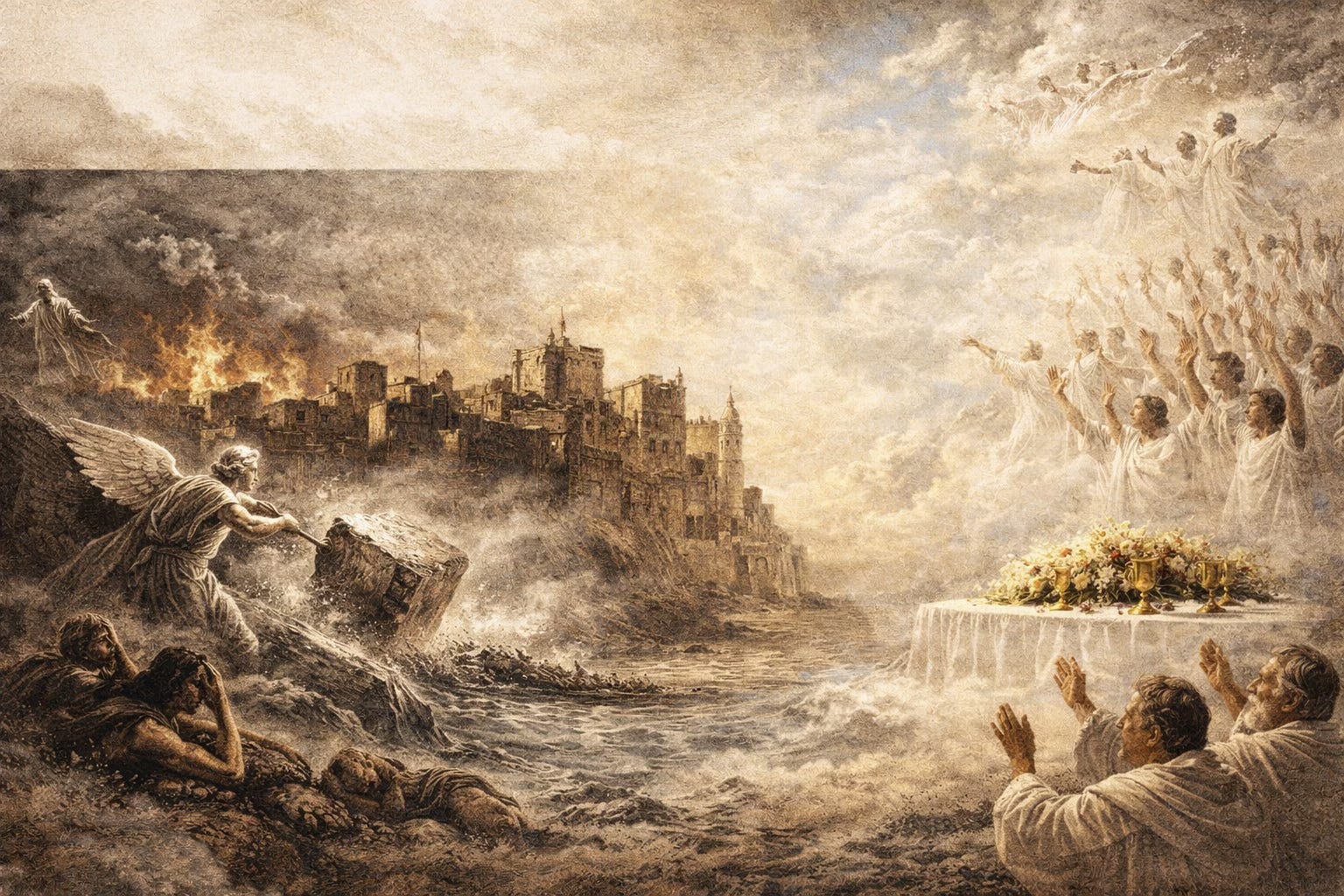
If we were to imagine Revelation 18 and 19 as a movie, chapter 18 would be the dramatic climax, when the tension reaches its peak. The earth is made bright with the glory of an angel just before Babylon, with all her wickedness, is struck with death and mourning and famine and burned up with fire (Revelation 18:1, 8). Those who gained wealth from her stand far off in fear, weeping and mourning as they watch the smoke rise from their once-great city (Revelation 18:15, 18). They cry out, “In a single hour she has been laid waste” (Revelation 18:19).
As the scene unfolds, there is a tremendous amount of noise—people screaming, city walls collapsing. Then a mighty angel takes up the city and throws it into the sea. As it sinks, everything goes quiet (Revelation 18:21). Only faint ripples remain on the surface of the water.
A moment later, however, a faint roar begins to rise in the distance. The scene shifts upward, through the clouds, into heaven. Suddenly, a great multitude appears, singing and shouting:
“Hallelujah! Salvation and glory and power belong to our God, for his judgments are true and just; for he has judged the great prostitute who corrupted the earth with her immorality, and has avenged on her the blood of his servants.” (Revelation 19:1-2)
“Hallelujah!” they cry, “Hallelujah!” (Rev 19:3, 6).
That is the scene unfolding in this part of Revelation, and we need to watch it play out before we attempt to examine its individual parts. It has been said that Revelation is a picture book, not a puzzle book. We are meant to absorb its drama and see the story. The details can be studied and better understood, but the story itself comes first. That is the nature of this kind of biblical literature. It is more like a movie than a textbook.
With that in mind, let’s work our way through Revelation 19.
A Great Multitude in Heaven
After the fall of Babylon, John “heard what seemed to be the loud voice of a great multitude in heaven” (Revelation 19:1). According to Revelation 7, this is “a great multitude that no one could number, from every nation, from all tribes and peoples and languages” (Revelation 7:9). People from all walks of life are represented here. Though that thought perplexed the Lord’s first disciples, God’s redemptive power has reached far beyond the borders of Israel. The gospel has found a home among every nation, tribe, people, and language.
Some, however, are puzzled by Revelation’s description of a great multitude in heaven (Revelation 19:1). How can there be a great multitude if the Bible elsewhere suggests that God’s redeemed people are relatively few? For example, Jesus said,
For the gate is wide and the way is easy that leads to destruction, and those who enter by it are many. For the gate is narrow and the way is hard that leads to life, and those who find it are few. (Matthew 7:13-14)
Which is it? Are God’s people few or a great multitude? The answer is both.
At this very moment, there are billions of people on the planet. By one estimate, Protestant Christians alone number in the hundreds of millions. Even if we assume all of them are genuine believers, not accounting for those who have lived in the past or will live in the future, that is still an enormous number. It is certainly a great multitude. Yet, compared to the total population, it remains a relatively small percentage. Believers can be a minority in this world while still forming a vast multitude in heaven.
Regardless, there is a great multitude in heaven, and when John sees them following the collapse of Babylon, they are shouting, “Hallelujah!” (Revelation 19:1).
Hallelujah is one of the most universal words in the world. It is so significant that English Bibles do not translate it but simply carry it over from the original Hebrew. Many other languages do the same. The word is composed of two parts: hallel, meaning “praise,” and Yah, a shortened form of Yahweh, the covenant name of God. Hallelujah, then, means “Praise Yahweh,” or “Praise the Lord” (Revelation 19:1).
Interestingly, Revelation 19 is the only place in the New Testament where this word appears, and here it is used four times. In the Old Testament, it appears only in the Psalms, a total of twenty-four times. The final psalm ends with it: “Let everything that has breath praise the LORD! Praise the LORD!” (Psalm 150:6).
What we have in Revelation 19, then, is another hallel psalm, or a song of praise to the Lord. It is, in a sense, Psalm 151. Yet there is something that may strike us as unusual about this song. It praises God specifically for his judgment of the great prostitute, Babylon (Revelation 19:2). “Hallelujah! … For he has judged the great prostitute who corrupted the earth with her immorality. … Hallelujah! The smoke from her goes up forever and ever” (Revelation 19:1–3).
We may not often sing about God’s final judgment, but it is a perfectly legitimate reason to praise him. This does not mean we take pleasure in the destruction of sinners. God himself says, “I have no pleasure in the death of the wicked” (Ezekiel 33:11). He would rather that the wicked turn from his way and live. But if the sinner refuses, justice will be accomplished, and the punishment will be appropriate. Sinners will be judged along with Babylon, to whom they gave their allegiance.
So while we are more inclined to praise God for his mercy and grace, as we should, it is no less appropriate to praise him for his justice.
Salvation Through Judgment
“Hallelujah! Salvation and glory and power belong to our God, for his judgments are true and just; for he has judged the great prostitute who corrupted the earth with her immorality, and has avenged on her the blood of his servants.” “Hallelujah! The smoke from her goes up forever and ever.” (Revelation 19:1-3)
Notice the reasons the saints in heaven give for praising God. We have already considered the first: his justice will prevail.
Second, there is salvation (Revelation 19:1). Salvation cannot be accomplished apart from the destruction of wickedness.
Consider the flood in Noah’s day. Peter writes, “Eight persons were brought safely through water” (1 Peter 3:20). Some translations make the point even more explicit, saying Noah and his family were saved through or bythe floodwaters. They were not merely saved from the water by the ark; they were saved by the water. From what were they saved? Genesis tells us that “the LORD saw that the wickedness of man was great in the earth, and that every intention of the thoughts of his heart was only evil continually” (Genesis 6:5).
The flood saved Noah and his family from the rampant evil that had filled the world. God delivered them by removing that evil, physically and decisively.
That event gives us a glimpse of what he will do again at the end of time. He will take every last trace of wickedness and destroy it once and for all. Hallelujah. Praise God.
The older I get, the more I find myself meditating on a passage in Romans 8. The apostle Paul writes,
For I consider that the sufferings of this present time are not worth comparing with the glory that is to be revealed to us. For the creation waits with eager longing for the revealing of the sons of God. For the creation was subjected to futility, not willingly, but because of him who subjected it, in hope that the creation itself will be set free from its bondage to corruption and obtain the freedom of the glory of the children of God. For we know that the whole creation has been groaning together in the pains of childbirth until now. And not only the creation, but we ourselves, who have the firstfruits of the Spirit, groan inwardly as we wait eagerly for adoption as sons, the redemption of our bodies. (Romans 8:18-23)
I suspect many of us can relate to the kind of groaning Paul describes. Even on the best days, life is marked by frustration and decay. We grow tired. We fall sick. Small inconveniences pile up. Even moments of rest are not free from discomfort. And beyond our personal experience, we see a world filled with suffering—reports of believers enduring persecution, headlines marked by injustice, war, corruption, and violence.
It produces a longing, a desire to be free from this world in its present condition. We long to be free from tyranny, corruption, violence, persecution, injustice, materialism, unthankfulness, godlessness, suffering, sorrow, and death. We long to be free even from our own struggles with sin. Like Paul, we groan inwardly as we wait for the day when God will bring it all to an end (Romans 8:23). He will save us from it, not temporarily, but forever.
Babylon will fall because God will judge the great prostitute who corrupted the earth with her immorality (Revelation 19:2). And the saints will cry, “Hallelujah! Salvation and glory and power belong to our God” (Revelation 19:1). We will be free, and as the smoke from the harlot rises forever and ever, we will never forget what God has saved us from (Revelation 19:3).
Glory and Power Belong to Our God
The third reason the great multitude in heaven praises God is for his glory and power (Revelation 19:1).
In the Hebrew mind, glory conveys a sense of weightiness. God is not small or insignificant. He is not to be treated lightly. Yet those seduced by Babylon regard him as negligible—someone who can be ignored without consequence. They dismiss his power, if they acknowledge it at all.
The truth is that a day is coming when every knee will bow to God and every tongue will confess to him (Romans 14:11). The whole world will see his glory, recognize his undeniable weightiness, and behold his power. And when that day comes, the saints will cry with joy, “Hallelujah! Salvation and glory and power belong to our God” (Revelation 19:1). Amen.
The saints, however, are not alone in their praise. “The twenty-four elders and the four living creatures fell down and worshiped God who was seated on the throne, saying, ‘Amen. Hallelujah!’” (Revelation 19:4). Even the angelic beings in heaven join in, affirming that his works are true and worthy of celebration.
Then a voice from the throne calls out, “Praise our God, all you his servants, you who fear him, small and great” (Revelation 19:5). Every God-fearing servant is summoned to worship—to turn away from Babylon and give glory to the one true God.
If the thought of celebrating the destruction of wickedness, and, consequently, the wicked, remains troubling, then fix your eyes on the God of our salvation (Revelation 19:1). Consider his glory. Consider his power. Aren’t his judgments true and just? (Revelation 19:2). Does not the great prostitute, who corrupted the earth with her immorality, deserve the judgment she received? Has not God avenged on her the blood of his servants?
She was an unrelenting temptress, intent on drawing the saints away from God. And when she could not entice them, she killed them. But the Lord has delivered his people. “The smoke from her goes up forever and ever” (Revelation 19:3). Her end is final.
From Funeral to Wedding
As we come to verse 6, the sound intensifies. John hears what seems to be “the voice of a great multitude, like the roar of many waters and like the sound of mighty peals of thunder, crying out” (Revelation 19:6). The focus of the scene begins to shift. The harlot of Babylon fades into the background as the bride of Christ comes into clearer view.
In other words, we have reached a transition in the text. The song of praise continues, but the vision moves from the destruction of Babylon to the wedding of Christ and his bride—that is, the church. We leave the funeral behind and enter the wedding.
And the multitude cries out,
“Hallelujah! For the Lord our God the Almighty reigns. Let us rejoice and exult and give him the glory, for the marriage of the Lamb has come, and his Bride has made herself ready; it was granted her to clothe herself with fine linen, bright and pure.” (Revelation 19:6-8)
Now, to be clear, there has never been a moment when God was not reigning as the Almighty Lord. But this is the moment when the entire world sees it (Revelation 19:6). Today, as Psalm 2 describes, the nations rage and the rulers take counsel together against the Lord (Psalm 2:1–2). But in this moment, every such rebellion is brought to an end. As the psalmist says, “He who sits in the heavens laughs” (Psalm 2:4).
Once again, the church declares, “Hallelujah! For the Lord our God the Almighty reigns” (Revelation 19:6). No one is higher. No one is more powerful.
We can see how the world continually attempts to create its own version of a utopia. People strive to build perfect societies, yet those efforts consistently fail. More often than not, they result in oppression and moral chaos. Babylon presents herself as having all the answers, as if she can offer hope and perfection. But something essential is missing: she denies God. A perfect kingdom cannot exist without God. It cannot exist without man’s submission to him. And it cannot exist where sin remains.
By this point in the vision, however, all of that is behind us. There are no more nations raging or plotting against the Lord (Psalm 2:1–2). No one is attempting to construct a perfect world on flawed foundations. As Paul writes, “When the perfect comes, the partial will pass away” (1 Corinthians 13:10). Here in Revelation 19, the perfect has come, and the saints respond, “Let us rejoice and exult and give him the glory” (Revelation 19:7).
The saints have waited long for this moment. They have suffered, endured, and hoped. Now they have reached the consummation of all that God has been accomplishing from the beginning.
God promised this day soon after the fall into sin and continued to reveal it through the generations. In time, the promised Messiah came. We saw his life and ministry, his death and resurrection, and his ascension into heaven. And then came the waiting.
Even in the first century, some began to wonder if the promise would be fulfilled. Peter writes,
Do not overlook this one fact that with the Lord one day is as a thousand years, and a thousand years as one day. The Lord is not slow to fulfill his promise as some count slowness” (2Pe 3:8-9).
He goes on to say,
The day of the Lord will come like a thief, and then the heavens will pass away with a roar, and the heavenly bodies will be burned up and dissolved, and the earth and the works that are done on it will be exposed.
Since all these things are thus to be dissolved, what sort of people ought you to be in lives of holiness and godliness, waiting for and hastening the coming of the day of God. (2 Peter 3:10-12)
We must not lose sight of the day of God.
There are times when the weight of the world feels overwhelming. The sin and godlessness of our culture, along with our own struggles, can produce anxiety, fear, and even anger. We may feel the urge to fix what is broken, to reclaim what has been lost, to build something better here and now.
But Christ redirects our gaze. He reminds us that our time here is brief. He reminds us that we were not redeemed to find satisfaction in a fallen world. We were redeemed for something far greater. As Paul writes,
For we know that the whole creation has been groaning together in the pains of childbirth until now. And not only the creation, but we ourselves, who have the firstfruits of the Spirit, groan inwardly as we wait eagerly for adoption as sons, the redemption of our bodies. For in this hope we were saved. (Romans 8:22-24)
Our hope is not that humanity will finally succeed in building a utopia on earth. Our hope is in Christ, who says, “Behold, I am making all things new” (Revelation 21:5). Only he can accomplish the perfect world that we long for.
The Marriage of the Lamb
The focus of the latter part of this passage is not merely on the perfect world to come. That is implied in the celebration over Babylon’s destruction, but the central focus is Christ himself and, more specifically, the church’s ultimate union with him.
“Let us rejoice and exult and give him the glory” (Revelation 19:7). Why? “For the marriage of the Lamb has come.”
The Bible uses many analogies to describe salvation, but the imagery of a wedding conveys a uniquely deep level of intimacy. To be the Bride of the Lamb implies profound closeness (Revelation 19:7). Few relationships are as intimate as that between a husband and his wife.
Consider John 17. On the night of his arrest, just before his crucifixion, Jesus prays for his disciples and defines for us the essence of eternal life. Notably, he does not speak of mansions, streets of gold, or even a painless existence. Instead, he says,
“Father, the hour has come; glorify your Son that the Son may glorify you, since you have given him authority over all flesh, to give eternal life to all whom you have given him. And this is eternal life, that they know you, the only true God, and Jesus Christ whom you have sent.” (John 17:1-3)
According to Christ, the crowning joy of eternal life is to know him and his Father. This is not mere intellectual knowledge. It is more than understanding facts about God. Even the demons believe, and in many ways their theology is more accurate than ours (James 2:19).
Yet the demons do not enjoy a personal, intimate relationship with God. When Jesus speaks of knowing, he refers to a deep, personal knowledge, like that of a husband and wife (John 17:3). It is the kind of union that Scripture describes when it says, “Adam knew Eve his wife, and she conceived and bore Cain” (Genesis 4:1), and again, “Adam knew his wife again, and she bore a son and called his name Seth” (Genesis 4:25).
It is difficult to understand how someone can claim to be a Christian and yet have no desire to read the Bible, hear it preached, or grow in the knowledge of Christ.
“Do you want to go to heaven?”
“Of course.”
“Do you realize that the greatest feature of heaven will be our marriage to Christ?”
“Okay.”
“Then why is there no desire to cultivate that relationship now? Did you not pursue your spouse before marriage? Did you not want to learn everything you could about him or her?”
How can we say we long to be joined to Christ in heaven if we show little interest in knowing him now?
Think of Mary. Her desire to know Christ led Jesus to say, “Mary has chosen the good portion, which will not be taken away from her” (Luke 10:42). While Martha was distracted with much serving, Mary devoted herself to the one thing necessary. She sat at the Lord’s feet and listened to his teaching (Luke 10:39–40). She wanted to hear every word he spoke.
Mary was devoted. She wanted to know Christ, to be near him, to understand what pleased him. She longed for closeness with her Savior.
I’m reminded of my own relationship with my wife. For much of our courtship, we lived hundreds of miles apart, and there were times when I felt a deep longing simply to be with her. I could hardly wait for the day when we would be married and no longer separated.
Paul expresses a similar longing at the end of his life:
I have fought the good fight, I have finished the race, I have kept the faith. Henceforth there is laid up for me the crown of righteousness, which the Lord, the righteous judge, will award to me on that day, and not only to me but also to all who have loved his appearing. (2 Timothy 4:7-8)
Do we share that longing? Do we desire the day when we will be perfectly united with Christ, free from every hindrance, especially sin? And do our daily habits reflect that desire? I pray they do.
The Bride Made Ready
The saints and angels in heaven declare, “The marriage of the Lamb has come, and his Bride has made herself ready; it was granted her to clothe herself with fine linen, bright and pure” (Revelation 19:7–8).
The true Bride of Christ will be ready (Revelation 19:7). As Jesus teaches in Matthew 25, she will be prepared for the Lord’s sudden appearing. Yet even this readiness is a gift; it was granted to her (Revelation 19:8). By his grace and purpose, God clothes his church with fine linen, bright and pure. And that fine linen is defined here as the righteous deeds of the saints.
We do not clothe ourselves. It is not our righteousness that justifies us. God himself grants the fine linen. He creates in us a clean heart, puts his Spirit within us, and works in us to do his will once we come to him in faith (Revelation 19:8).
Then the angel says to John, “Write this: Blessed are those who are invited to the marriage supper of the Lamb … These are the true words of God” (Revelation 19:9).
Overwhelmed by the vision, John falls at the angel’s feet to worship him. But the angel immediately corrects him: “You must not do that! I am a fellow servant with you and your brothers who hold to the testimony of Jesus. Worship God” (Revelation 19:10). Praise belongs to God alone.
Living in Anticipation
This scene in Revelation 19 has not yet come to pass. Babylon, with all her temptations and sufferings, has not yet fallen. The marriage of the Lamb has not yet come (Revelation 19:7).
That reality carries important implications. First, we are not yet celebrating Babylon’s fall. Instead, we are called to be ambassadors for Christ to those still deceived by her (2 Corinthians 5:20). We are to call them out and plead with them on behalf of Christ to be reconciled to God.
Second, we must be ready. Jesus makes this point in the parable of the ten virgins. Five were unprepared when the bridegroom came. They were not watching or anticipating his arrival, and they were shut out. They cried, “Lord, lord, open to us,” but he answered, “I do not know you” (Matthew 25:11–12). Jesus concludes, “Watch therefore, for you know neither the day nor the hour” (Matthew 25:13).
Paul echoes this longing: “There is laid up for me the crown of righteousness … which the Lord … will award … to all who have loved his appearing” (2 Timothy 4:8).
We may be Christians, but every part of us should be shaped by a sincere longing not merely to be betrothed to Christ, but to be finally united with him. Our affections for him should run deep. We should desire, above all else, to be with him.
That day has not yet come, but it will. May we live in eager anticipation of it.
If you are not joined to Christ by faith, do not wait. Come to him as Noah entered the ark. Seek him. Pray to him. Cry out, “Lord, save me, for I am a sinner.” He may return at any moment. Those outside of Christ will share Babylon’s fate, but those who are in Christ will be freed from the groanings of this fallen world forever.


