

A Bible that cannot be understood cannot be profitable.
That may seem too obvious to require saying. Yet the history of Scripture’s translation shows that Christians have not always agreed on its implications. If the Bible remains locked in languages unknown to the people of God, then for most hearers it is effectively silent. It may be honored, carried, displayed, and recited, but it cannot instruct, correct, comfort, or convert those who cannot understand its words.
The original languages of Scripture are Hebrew, Aramaic, and Greek. Most English-speaking Christians do not know them. Without translation, then, the Bible would remain inaccessible to them. The apostle Paul said, “If with your tongue you utter speech that is not intelligible, how will anyone know what is said? For you will be speaking into the air” (1 Corinthians 14:9).
God gave Scripture to be read, heard, believed, obeyed, preached, prayed, sung, and handed down. Translation is necessary, therefore, for the church’s life and mission.
But translation also introduces a difficulty. Whenever one language is carried into another, something more complicated than mechanical word substitution must take place.
The Myth of the Perfectly Literal Translation
An old Italian proverb says, “Translators are traitors.” Every translation must, in some measure, alter the form of the original in order to communicate its meaning in another language.
This is especially important when discussing Bible translation. Christians sometimes speak as though there are two simple options: a “literal” Bible that gives exactly what God said, and a less literal Bible that has passed through human interpretation. The instinct behind that concern is understandable. We should want the words of Scripture, not the private opinions of translators. But the problem is that a perfectly literal, word-for-word translation from Hebrew or Greek into English does not exist. Even if it did, it would often be unreadable.
Languages do not share identical grammar, syntax, idioms, or vocabulary. Greek, in particular, can convey relations between words through endings and forms in ways that English often must convey through word order. Hebrew idioms often sound strange if carried woodenly into English. A translator cannot simply move one word at a time from one language into another and expect the result to make sense.
John Wycliffe’s late medieval English Bible illustrates the point. Wycliffe and his followers translated from the Latin Vulgate into English, often preserving the Latin structure very closely. Where a modern English Bible might render Genesis 1:1, “In the beginning, God created the heavens and the earth,” Wycliffe’s version reads, “In the firste made God of nought hevene and erthe.” It is English, but not English as most modern readers can easily follow.
There are, of course, translations that are more formal or more literal than others. But no translation is purely literal. Every translation requires judgment. Every translation involves interpretation. The question is not whether translators will interpret, but whether they will interpret carefully, reverently, transparently, and in submission to the text.
Scripture Itself Endorses Translation
Some religious traditions have feared translation because translation inevitably changes the form of a sacred text. Islam, for instance, has historically treated the Qur’an in Arabic as uniquely authoritative, making translation theologically fraught. Christianity has taken a different path because Scripture itself gives us reason to do so.
The clearest evidence is found in the New Testament.
When Jesus and the apostles quote the Old Testament, they often do not quote directly from the Hebrew text. They frequently quote from the Septuagint, the ancient Greek translation of the Old Testament. In other words, the New Testament writers cite that Greek translation as authoritative Scripture.
One striking example appears in Acts 15. At the Jerusalem Council, James appeals to Amos 9:11–12 to explain the inclusion of the Gentiles among the people of God. In the Hebrew text, Amos speaks of the restoration of David’s fallen booth “that they may possess the remnant of Edom and all the nations who are called by my name.” But in Acts 15, James quotes the passage in a form that follows the Greek Septuagint: “that the remnant of mankind may seek the Lord, and all the Gentiles who are called by my name” (Acts 15:17).
The wording is not identical. There are textual and translational differences. Yet James treats the Greek rendering as the Word of God. The apostles did not hesitate to use a translation of Scripture authoritatively.
The Great Commission points in the same direction. Christ commanded his church to “make disciples of all nations” (Matthew 28:19). Revelation shows the redeemed gathered “from every tribe and language and people and nation” (Revelation 5:9). Paul teaches that “faith comes from hearing, and hearing through the word of Christ” (Romans 10:17). Put those truths together, and translation becomes unavoidable. If the nations must hear the Word of Christ, the Word of Christ must come to them in languages they can understand.
Bible translation is therefore not merely permitted. It is implied by the church’s mission and modeled in the New Testament itself.
When the English Bible Was Forbidden
The need for translation may seem obvious now, but it was not always treated as obvious in the life of the church.
For centuries, the Latin Vulgate served as the primary Bible of the Western church. In time, however, Latin ceased to be the language of ordinary people. The Bible remained present in the church, but increasingly unintelligible to the people. It could be read by priests and scholars, but not by the plowman, the merchant, the mother, or the child.
John Wycliffe saw the problem clearly. Living in the fourteenth century, nearly two centuries before the Reformation, Wycliffe argued that the church’s authority ultimately rested not in the papacy but in the Word of God. But if the Word of God was the church’s supreme authority, then the people needed access to it.
Wycliffe and his followers, then, translated the Bible into English. Their translation was imperfect by later standards. It was made from the Latin Vulgate, not from the Hebrew and Greek originals. It appeared before the full flowering of Renaissance language scholarship in the West and before the printing press made mass production possible. Yet its significance was immense because it represented the conviction that Scripture belonged not only to church officials but to the people of God.
The opposition was fierce. Wycliffe died of natural causes, but condemnation pursued him even beyond the grave. Decades after his death, church authorities exhumed his remains, burned his bones, and cast his remains into a river as a sign of judgment against him.
In short, the translation of Scripture into the language of common people was not always viewed as harmless devotional assistance. It was seen as dangerous because it placed the Word of God into the hands of those who had long been dependent on others to mediate it to them.
William Tyndale and the English Bible
If Wycliffe was the “Morning Star of the Reformation,” William Tyndale was the father of the modern English Bible.
Tyndale shared Wycliffe’s conviction that ordinary people needed the Scriptures in their own tongue. But Tyndale had advantages Wycliffe did not. He lived after the recovery of Greek and Hebrew learning in the West. He could translate from the original biblical languages rather than from the Latin Vulgate. He also lived in the age of the printing press, which made it possible to produce copies of Scripture in quantities that authorities could not easily suppress.
Tyndale’s purpose was famously expressed in his reply to a clergyman who preferred the pope’s laws to God’s laws. Tyndale answered, “If God spare my life, ere many years, I will cause a boy that driveth the plough shall know more of the Scripture than thou dost.”
That sentence captures the heart of the English Reformation: the plowboy must have the Bible.
Tyndale fled England and spent the rest of his life working in exile. He translated the New Testament and portions of the Old Testament, and copies were smuggled back into England. His work was illegal, dangerous, and enormously influential.
It also cost him his life. Betrayed and captured, Tyndale was executed in 1536. He was tied to a stake, strangled, and then burned. His final prayer was, “Lord, open the King of England’s eyes.”
Within a short time, that prayer began to be answered. The Matthew Bible, based heavily on Tyndale’s work, was licensed for use in England. The very monarchy under which Tyndale had been condemned soon authorized an English Bible shaped by his labors.
Tyndale’s influence on the English Bible can hardly be overstated. A very large portion of the King James New Testament later followed Tyndale’s wording. Many phrases commonly associated with the King James Version entered English through Tyndale: “fight the good fight,” “the signs of the times,” “in the twinkling of an eye,” “gave up the ghost,” and “filthy lucre.” He also gave English readers theological words and expressions such as “atonement,” “Passover,” and “scapegoat.”
Tyndale did not merely translate the Bible into English. He helped shape English itself.
From Tyndale to the King James Version
After Tyndale, English Bible translation continued rapidly.
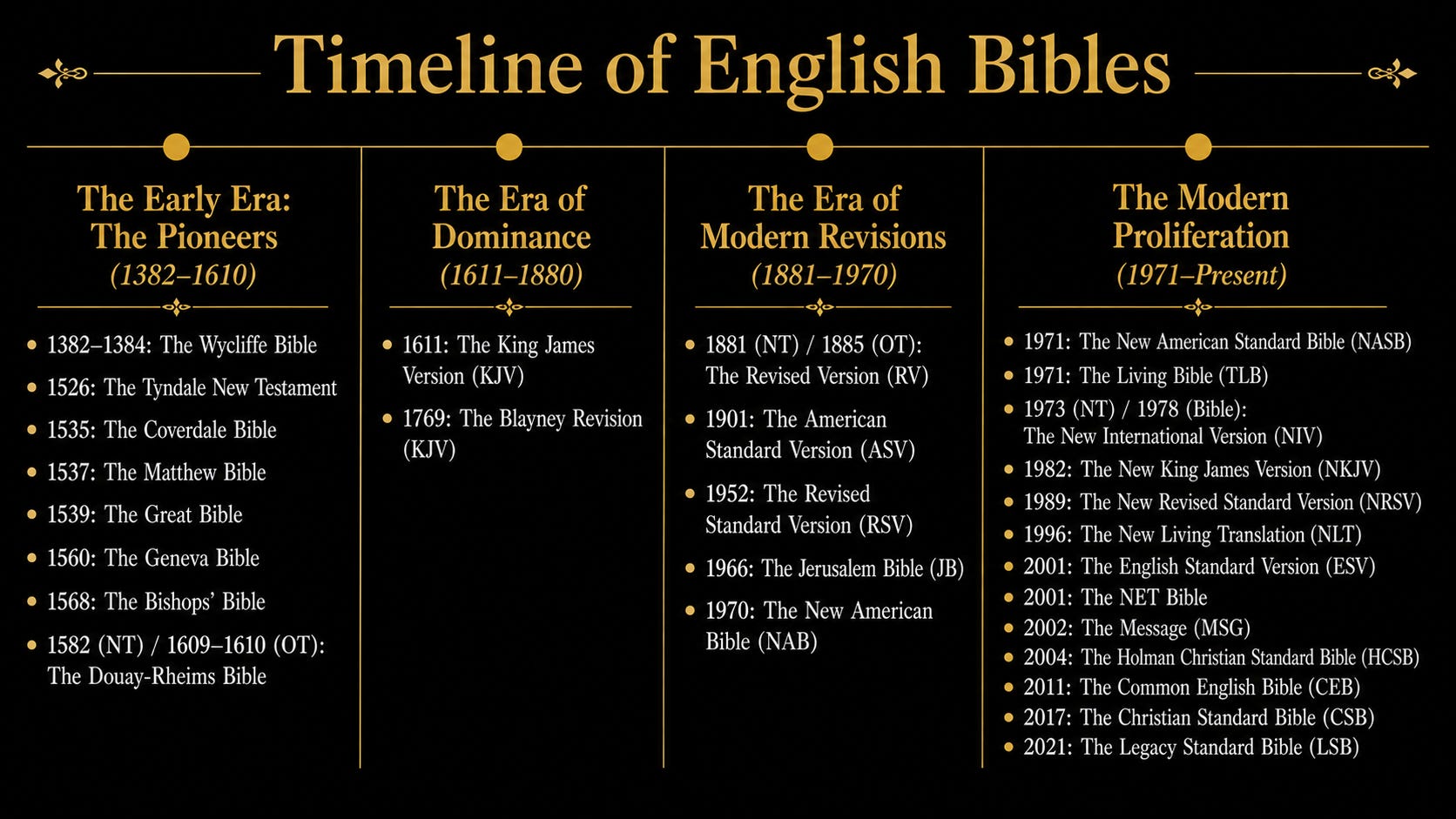
Miles Coverdale produced the first complete printed English Bible in 1535, relying heavily on Tyndale’s work. In 1537, John Rogers, a friend of Tyndale, published the Matthew Bible under the pseudonym Thomas Matthew. It became the first officially authorized English Bible.
Then came the Geneva Bible in 1560, produced by English Protestant exiles in Switzerland. It was enormously popular. It was the first English Bible to use verse numbers, and its extensive marginal notes made it something like a Reformation study Bible. They taught readers how to understand Scripture from a Reformed perspective.
The Church of England responded with the Bishops’ Bible in 1568. It was intended to provide an authorized alternative to the Geneva Bible, but it never achieved the same popularity. The Geneva Bible was affordable, portable, and loved by the people. The Bishops’ Bible was used in churches, but the Geneva Bible was used in homes.
This tension formed part of the background to the King James Version.
King James I disliked the Geneva Bible, especially some of its marginal notes, which he regarded as politically subversive. At the same time, the Bishops’ Bible had not won the affection of the people. A new translation offered a possible solution: one Bible to replace both the popular Geneva Bible and the official Bishops’ Bible.
The King James Version, first published in 1611, was not a wholly new translation from scratch. The translators were instructed to use the Bishops’ Bible as a base and revise it, consulting earlier English translations and the original languages. This is important because English Bible translation has often proceeded by revision. Translators return to the Hebrew and Greek, consider manuscript evidence, and make fresh judgments, but they also stand within an English tradition shaped by earlier translations.
One major strength of the King James Version was its committee structure. Nearly fifty scholars participated, working in companies. This provided checks and balances that individual translators lacked. Yet the arrangement also produced minor inconsistencies, as different companies sometimes rendered the same words differently.
The King James Version itself was later revised. The Bible most readers know as the KJV today is not exactly the 1611 edition. It reflects later corrections and standardizations, especially the 1769 edition associated with Benjamin Blayney.
None of this diminishes the majesty or influence of the King James Version. It remains one of the most consequential works in the history of the English language and one of the most beloved Bible translations ever produced. But it should remind us that even the KJV belongs to the ordinary history of translation, revision, printing, correction, and preservation.
The King James Translators Knew Their Work Could Be Improved
Some modern defenders of the King James Version speak of it in ways the translators themselves would not have recognized.
The original 1611 edition included a preface, “The Translators to the Reader,” in which the translators explained their purpose. They did not claim to have produced a perfect Bible. They understood themselves to be improving good translations already available. They also recognized the legitimacy of alternate renderings and included many marginal notes to show readers that more than one translation was sometimes possible.
This is an important point. The King James translators were not embarrassed by textual and translational complexity. They did not believe that acknowledging alternate readings weakened confidence in Scripture. On the contrary, they believed such transparency helped readers.
Two areas especially show why later revision and modern translation are reasonable.
First, language changes. The English of 1611, and even of 1769, is not the English of today. Words shift in meaning. Expressions fall out of use. Syntax becomes unfamiliar. The King James translators wanted Scripture in the common language of the people. In their day, “vulgar” meant common, ordinary, accessible. If that was their aim, then the principle behind their work supports vernacular translation in every age.
Second, manuscript evidence has increased. The KJV Old Testament was translated from the traditional Hebrew Masoretic Text, and its New Testament from the Greek text later known as the Textus Receptus. The Textus Receptus grew out of the printed Greek New Testament first produced by Erasmus in the early sixteenth century, based on a small number of later manuscripts, with some places filled in by back-translation from the Latin Vulgate.
Modern translators have access to far more manuscript evidence: earlier Greek manuscripts, ancient translations, quotations in early Christian writers, the Dead Sea Scrolls for the Old Testament, and a much broader range of textual witnesses. This does not mean modern translators are always right or that older translations are worthless. It means they have evidence that earlier translators did not possess.
The question is not whether God preserved his Word. The question is how he did so.
Textual Basis and Translation Philosophy
When comparing English Bibles, two issues must be distinguished: textual basis and translation philosophy.
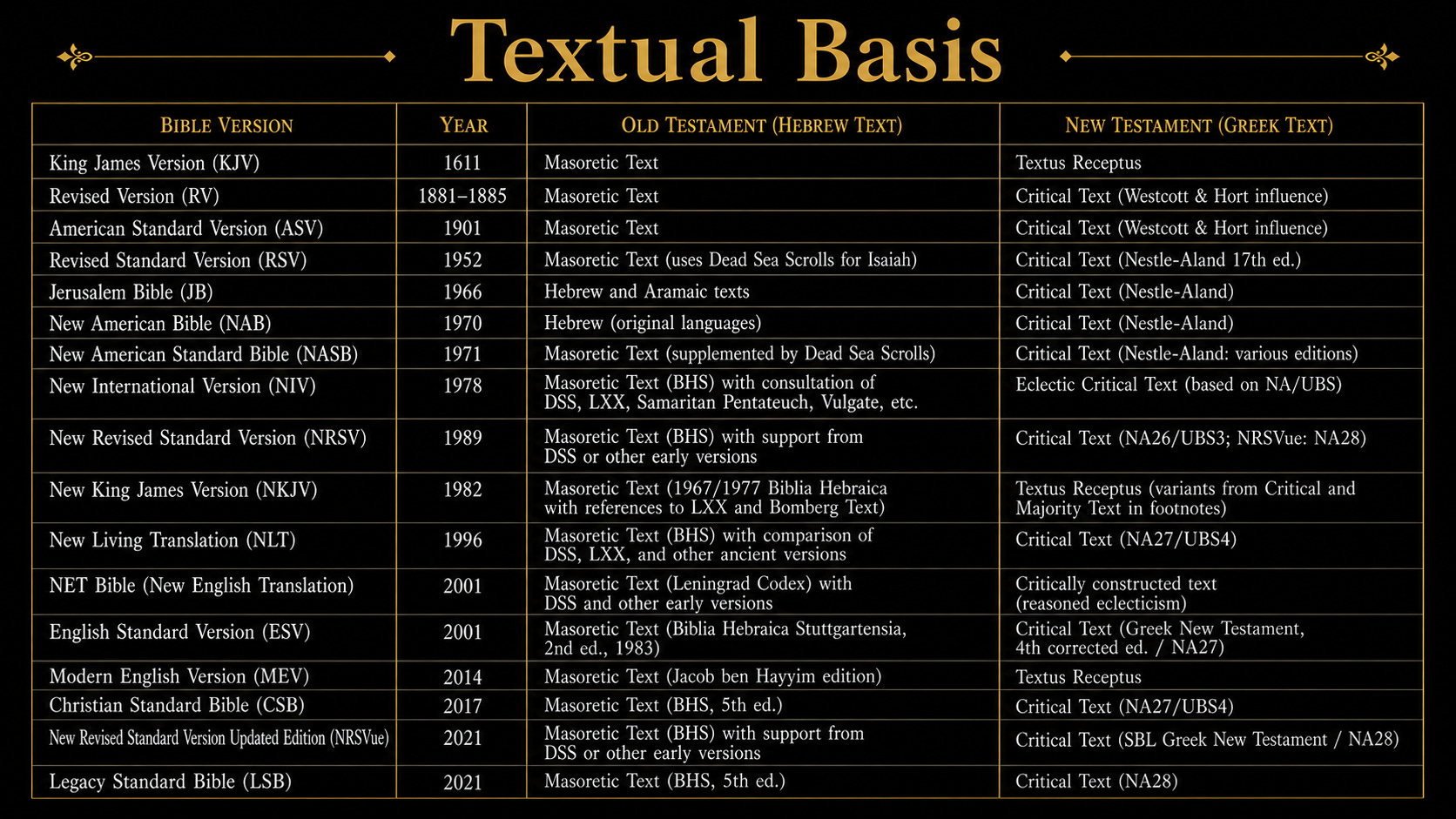
The textual basis asks, “What Hebrew and Greek text is this Bible translating?” For the New Testament, the King James Version and New King James Version follow the Textus Receptus. Most modern translations follow an eclectic critical text, produced by comparing the full range of available manuscript evidence.
This explains many differences between the KJV tradition and modern translations, including the so-called “missing verses.” In most cases, modern versions do not remove verses from the Bible. Rather, translators are judging that certain words or verses found in later manuscripts were not part of the original text.
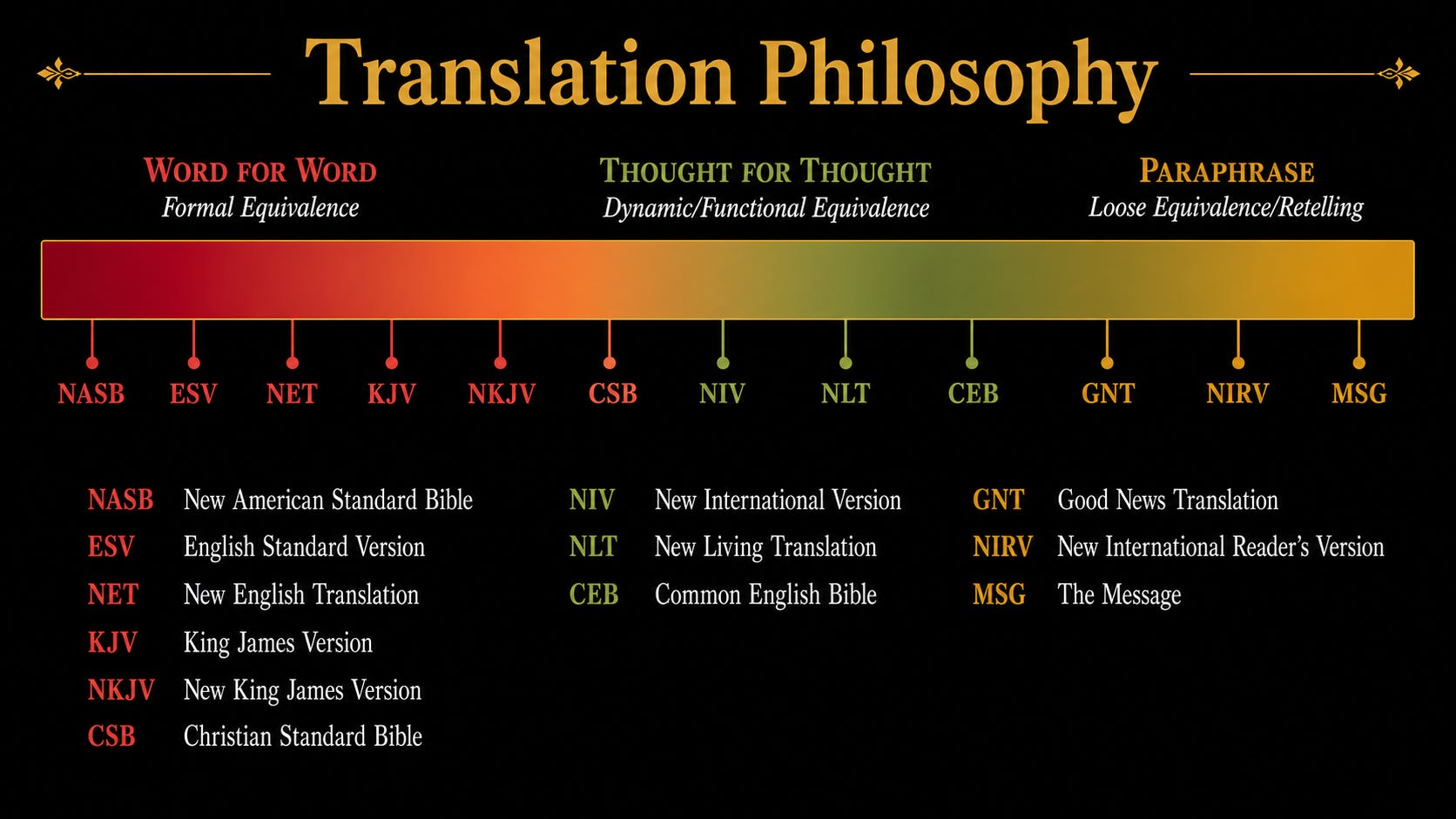
Translation philosophy asks a different question: “How should the meaning of the original be carried into English?”
Some translations are more formal. They try to preserve the structure, word order, and idioms of the original languages as much as is allowed by readable English. The NASB, ESV, KJV, and NKJV fall toward this side of the spectrum.
Other translations are more dynamic. They seek to render the meaning of phrases or sentences into natural contemporary English, even when that requires moving further away from the form of the original. The NIV and NLT fall more toward this side. The CSB is often described as occupying a middle position, sometimes referred to as “optimal equivalence.”
These are not rigid categories. They are points on a spectrum. A formal translation will sometimes render dynamically because a wooden translation would be unintelligible. A dynamic translation will often preserve formal structure where it works well in English.
For example, in Luke 9:44, a formal rendering may say, “Let these words sink into your ears.” A dynamic rendering may say, “Listen carefully to what I am about to tell you.” The English expressions differ, but their meanings are substantially the same. One brings the reader closer to the world of the biblical idiom; the other brings the idiom into the modern reader’s world.
Psalm 17:8 gives another example. A wooden rendering of the Hebrew idiom would sound something like, “Keep me as a little man of the daughter of an eye.” No standard English Bible translates it that way because almost no one would understand it. Instead, even formal translations say, “Keep me as the apple of your eye.”
That is not a failure of literalness. It is a faithful translation.
Why Christians Should Read More Than One Translation
The best question is not, “Which translation philosophy is superior?” The better question is, “What are the strengths and weaknesses of each?”
Formal translations help readers see more of the structure and texture of the original languages. They are often excellent for close study, teaching, preaching, and tracing repeated words or theological arguments. But if used alone, they can sometimes leave readers with unclear English or misunderstood idioms.
Dynamic translations often communicate meaning more immediately. They can be especially helpful for reading large portions of Scripture, for newer readers, and for clarifying difficult expressions. But if used alone, they can sometimes obscure interpretive decisions or shift too freely from translation to paraphrase.
For that reason, Christians benefit from reading multiple translations side by side. The differences can, then, become windows. Where translations differ, the careful reader is invited to slow down and ask what is happening in the text.
The King James translators themselves understood this principle. As mentioned, their marginal notes often supplied alternate renderings, acknowledging that translation sometimes requires judgment.
This also explains why paraphrases should be used carefully. A paraphrase can be useful as a commentary-like aid, but it should not become a person’s only Bible. If Genesis 1:2 is rendered only as “a mighty wind swept over the surface of the water,” the reader may miss the theological significance carried by the more traditional rendering, “the Spirit of God was hovering over the face of the waters.” A paraphrase may illuminate one aspect of a text while obscuring another.
The safest practice is not to flatten all translations into one preferred version, nor to treat every translation as equally useful for every purpose. It is to use them wisely.
Inerrancy, Autographs, and the History of Transmission
Translation also raises a deeper doctrinal question: What becomes of inerrancy when Scripture has been copied, transmitted, and translated through centuries of human labor?
Christians confess that Scripture is the Word of God. Because God is true and cannot lie, his Word is true and without error. The doctrine of inerrancy expresses this conviction: Scripture, in the original autographs, is without error in all that it affirms.
God inspired the prophets and apostles by a unique act of divine providence so that what they wrote was his Word. But God did not extend that same guarantee of inerrancy to every scribe, translator, printer, or publisher who later handled the text. The history of the Bible includes copying errors, spelling variations, harmonizations, marginal notes that entered the text, printing errors, and translational decisions that can be improved.
This should not alarm Christians. Human fingerprints in the transmission of Scripture do not erase its divine origin. They simply remind us to distinguish inspiration from transmission.
God preserved his Word, but he did not do so through one flawless line of manuscripts or one perfect translation. He preserved it through a multitude of manuscripts, versions, quotations, translations, and witnesses. The abundance of evidence allows scholars to compare readings and, where necessary, reconstruct the original text with remarkable confidence.
The text of Scripture has been preserved through centuries of human fallibility. The remaining textual questions do not overthrow Christian doctrine. No essential teaching of the faith depends on a disputed textual variant.
The story of preservation is therefore not the story of a pristine manuscript descending untouched through history. It is the story of God keeping his Word through the ordinary, messy, providential means of history.
Not One Iota Will Pass Away
Some Christians appeal to passages such as Matthew 5:17–18 to argue that God must have preserved a perfect manuscript line or a perfect translation. Jesus says, “Do not think that I have come to abolish the Law or the Prophets; I have not come to abolish them but to fulfill them.” Then he adds, “Until heaven and earth pass away, not an iota, not a dot, will pass from the Law until all is accomplished.”
Those are strong words. They teach the abiding authority and certainty of God’s Word. But they do not specify the mechanism of textual preservation. Jesus is not promising that no scribe would ever misspell a word, skip a line, or make a copying mistake. He is declaring that the Law and the Prophets would not fail. Their authority would stand. Their purpose would be fulfilled in him.
Scripture cannot be broken. God’s promises do not collapse. His Word does not fail. But the Bible does not tell us that preservation would occur through a flawless chain of copies or through one inspired translation. History shows something different and, in its own way, more wonderful.
God preserved his Word through human weakness.
He preserved it through scribes who sometimes made mistakes, translators who had to make difficult judgments, printers who introduced errors, scholars who compared manuscripts, churches that read and preached the text, and believers who carried Scripture across languages and nations.
That is how God often works. He accomplishes his purposes not by avoiding the messiness of history, but by ruling over it.
The Providence of a Translated Bible
The Bible in English is easy to take for granted. It is available in print, online, on phones, in dozens of translations, with study notes, cross-references, audio recordings, and searchable tools. That abundance can make us forget the cost of access.
Wycliffe’s bones were burned. Tyndale was strangled and burned. Translators labored in exile. English Bibles were smuggled, banned, revised, authorized, challenged, loved, and read. Committees debated words. Printers corrected editions. Scholars compared manuscripts. Churches received the Word in their own tongue.
Behind every English Bible is a long history of providence.
Translation is not a betrayal of Scripture’s authority. Faithful translation is an expression of Scripture’s purpose. The God who spoke through prophets and apostles intended his Word to be heard by the nations. The Christ who redeems people from every language sends his church to preach the Word in languages people can understand.
So Christians should love the translated Bible without pretending translation is simple. We should value accuracy without chasing the myth of a perfectly literal English Bible. We should respect the King James Version without treating it as untouchable. We should use modern translations without despising the older ones. We should read carefully, compare wisely, and give thanks.
God has preserved his Word, and by his providence, the plowboy, the child, the scholar, the pastor, and the ordinary believer may open the Scriptures and hear, in their own tongue, the wonderful works of God.
Additional Resources For Study
Know How We Got Our Bible by Ryan Matthew Reeves & Charles E. Hill
Scribes and Scripture: The Amazing Story of How We Got the Bible by John D. Meade & Peter J. Gurry
The Origin of the Bible by F.F. Bruce, J.I. Packer, Philip Comfort, & Carl F.H. Henry
The King James Only Controversy: Can You Trust Modern Translations? by James R. White
Bible Translations for Everyone: A Guide to Finding a Bible That’s Right for You by Tim Wildsmith
Authorized: The Use and Misuse of the King James Bible by Mark Ward


