

Last week, I began addressing the subject of worship. Does God care how we worship? If so, how should we worship under the new covenant? What does the Bible teach about worship in the church today?
I attempted to show that God, in fact, cares how we worship. This is evident in the Old Testament, where God gave Israel detailed and precise instructions concerning worship, with serious consequences for disobedience.
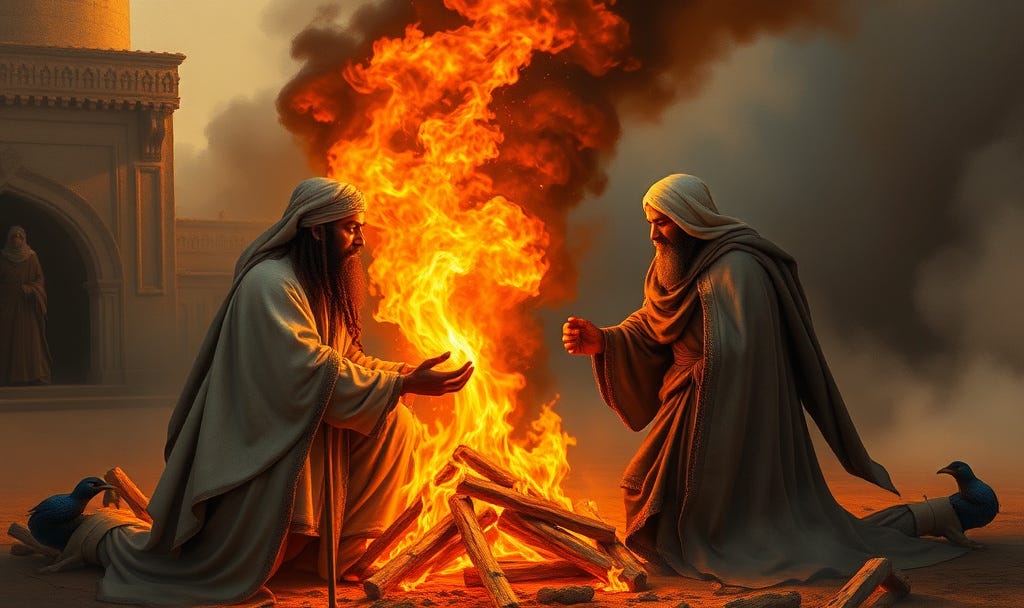
Leviticus 10 recounts the story of Nadab and Abihu, priests serving in the tabernacle:
Now Nadab and Abihu, the sons of Aaron, each took his censer and put fire in it and laid incense on it and offered unauthorized fire before the LORD, which he had not commanded them. And fire came out from before the LORD and consumed them, and they died before the LORD. Then Moses said to Aaron, “This is what the LORD has said: ‘Among those who are near me I will be sanctified, and before all the people I will be glorified.’” (Leviticus 10:1–3)
When these men chose to worship God in a way he had not commanded, they were immediately judged. God declares, “Among those who are near me I will be sanctified.” God will be treated as holy.
This principle appears elsewhere. In Deuteronomy 4, God commands, “You shall not add to the word that I command you, nor take from it” (Deuteronomy 4:2).
In 1 Samuel 15, the Lord instructed King Saul to destroy the Amalekites completely. Saul spared the best of their livestock, claiming he intended to sacrifice them to God. Though this sounded noble, Samuel responded, “Has the LORD as great delight in burnt offerings and sacrifices, as in obeying the voice of the LORD?” (1 Samuel 15:22). Worship divorced from obedience is unacceptable. If worship exceeds or ignores what God has commanded, he does not receive it.
These examples come from the period of tabernacle worship, when the ceremonial law was in force. Many of its specific elements were fulfilled by Christ in types and shadows. Yet an enduring principle remains: God cares how he is worshiped, and only he can prescribe what is acceptable.
We saw this even before the ceremonial law, in the account of Cain and Abel. God accepted Abel’s offering and rejected Cain’s. The Ten Commandments, part of God’s moral law rather than the ceremonial system, also affirm that only he determines how he is to be worshiped.
Some object that these examples come from the Old Testament, which many treat as largely irrelevant. But Scripture is one unified revelation. The Old Testament is not merely background material. Paul writes, “Whatever was written in former days was written for our instruction” (Romans 15:4). Jesus says, “You search the Scriptures … and it is they that bear witness about me” (John 5:39). We do not have the full instruction of God or the full revelation of Christ without the Old Testament.
Even so, we must ask whether this principle continues under the new covenant. Consider Matthew 15. Some assume that Jesus liberated worship from divine prescription. Let’s consider what he says.
Jesus Condemns Human Traditions in Worship
By the time we come to Matthew 15, the Jewish leaders had developed a complex system of laws and traditions in addition to God’s law. In their minds, these traditions served as a fence around God’s commandments, preventing anyone from violating them.
For example, the fourth commandment forbade work on the Sabbath. To avoid breaking it, they created 39 categories of work and developed detailed rules for each. Writing and erasing were both considered work. According to the Mishnah, no one should write more than two letters on the Sabbath, and erasing those letters to write two more would count as writing four letters, thus violating the Sabbath.
They also ruled that a person could not travel more than 2,000 cubits (roughly three-quarters of a mile) from home on the Sabbath. Yet they created loopholes. If a fence stood within that distance, a person could walk to the fence and then travel another 2,000 cubits from there.
This was the religious environment in which Jesus’ public ministry took place. These were the kinds of traditions behind the Pharisees’ frequent accusations that he violated the Sabbath.
When we read a passage like Matthew 15, we might assume the Pharisees were wrong because they were too strict, and that Jesus came to liberate people from strict worship. But Jesus was not opposing God’s law. He said plainly, “Do not think that I have come to abolish the Law or the Prophets; I have not come to abolish them but to fulfill them” (Matthew 5:17). His correction was not that they were too scrupulous, but that they were too lax.
Then Pharisees and scribes came to Jesus from Jerusalem and said, “Why do your disciples break the tradition of the elders? For they do not wash their hands when they eat.” He answered them, “And why do you break the commandment of God for the sake of your tradition? For God commanded, ‘Honor your father and your mother,’ and, ‘Whoever reviles father or mother must surely die.’ But you say, ‘If anyone tells his father or his mother, “What you would have gained from me is given to God,” he need not honor his father.’ So, for the sake of your tradition, you have made void the word of God. You hypocrites! Well did Isaiah prophesy of you, when he said:
“‘This people honors me with their lips, but their heart is far from me; in vain do they worship me, teaching as doctrines the commandments of men.’” (Matthew 15:1–9)
The first thing to notice is that Jesus treats this entire controversy as a matter of worship. He makes that clear by quoting Isaiah. Whatever others may have assumed, Jesus identifies this issue as one concerning worship.
Second, the Pharisees do not appeal to God’s law. They ask, “Why do your disciples break the tradition of the elders?” (Matthew 15:2). The tradition in question was ceremonial handwashing, not for hygiene, but as a religious ritual meant to prevent ceremonial defilement.
Jesus does not accuse them of being too strict. He accuses them of breaking God’s law. “Why do you break the commandment of God for the sake of your tradition?” (Matthew 15:3).
He illustrates this with the tradition known as Corban. Suppose a man’s parents needed financial help. The fifth commandment says, “Honor your father and your mother,” which certainly includes caring for them (Exodus 20:12). But the man could declare his money Corban, meaning dedicated to God. This did not require him to give the money immediately. He could continue using it for himself, while claiming it was reserved for the temple upon his death.
In reality, he was not giving the money to God. He was using a religious vow as an excuse to avoid helping his parents.
Jesus exposes this as subtraction by addition. By adding their tradition, they nullified God’s command. “For the sake of your tradition, you have made void the word of God” (Matthew 15:6). Their tradition did not reflect sincere devotion but hypocrisy.
Jesus was not criticizing them for being too strict. He was condemning them for violating God’s law. By quoting Isaiah, he shows that their worship was empty—mere lip service. It was a human invention that exceeded God’s prescription.
Their failure was both internal and external. Their hearts were far from God, and their worship did not conform to his command. Both their motivation and their standard were wrong.
As Jesus fulfills the law, certain aspects of worship will change in form. But there will always be a standard, and God alone determines it. Jesus shows that violating this standard can occur not only by removing what God has commanded, but also by adding to it. If God commands something and we neglect it, we disobey him. And if God commands something and we add to it, we also disobey him, implying that what he has revealed is insufficient.
Worship in Spirit and Truth
Previously, I referenced Jesus’ statement to the Samaritan woman several times, so let’s consider its context.
As Jesus and his disciples passed through Samaria, a region between Galilee and Judea, he met an unnamed Samaritan woman at a well. He asked her for a drink, and she eventually suspects he was a prophet. So she asked him to settle a long-standing dispute between the Samaritans and the Jews.
The woman said to him, “Sir, I perceive that you are a prophet. Our fathers worshiped on this mountain, but you say that in Jerusalem is the place where people ought to worship.” Jesus said to her, “Woman, believe me, the hour is coming when neither on this mountain nor in Jerusalem will you worship the Father. You worship what you do not know; we worship what we know, for salvation is from the Jews. But the hour is coming, and is now here, when the true worshipers will worship the Father in spirit and truth, for the Father is seeking such people to worship him. God is spirit, and those who worship him must worship in spirit and truth.” The woman said to him, “I know that Messiah is coming (he who is called Christ). When he comes, he will tell us all things.” Jesus said to her, “I who speak to you am he.” (John 4:19–26)
The dispute concerns the proper place of worship. In the Old Testament, God chose Jerusalem as the place where his temple would be built and where his people would worship him. But the Samaritans, who emerged after the Assyrian conquest of Israel and the intermingling of peoples, developed a corrupted form of religion. They believed Mount Gerizim was the proper place of worship rather than Jerusalem.
In his response, Jesus first points to an upcoming shift in the place of worship. He says, “The hour is coming when neither on this mountain nor in Jerusalem will you worship the Father” (John 4:21). In other words, worship would no longer be tied to a specific geographic location. God would be worshiped wherever his people are found.
This helps explain why many of the Reformers kept their church buildings locked during the week. They wanted to emphasize that while the church building was where believers gathered for corporate worship, it was not a sacred location required for meeting with God. As the 1689 Baptist Confession states:
Under the gospel, neither prayer nor any other part of religious worship is now restricted to or made more acceptable by the place where it is done or toward which it is directed. Instead, God is to be worshipped everywhere in spirit and in truth—daily in each family and privately by each individual. Also, more formal worship is to be performed in public assemblies, and these must not be carelessly or deliberately neglected or forsaken when God, by his word or providence, calls us to them.
Second, Jesus shows that worship must be governed by revelation. Even though the place of worship would change, he answers the woman’s question about old covenant worship, saying, “You worship what you do not know; we worship what we know, for salvation is from the Jews” (John 4:22).
The Samaritans were wrong to worship on Mount Gerizim. God had revealed that worship was to occur in Jerusalem. It was not right for the Samaritans, or anyone else, to choose their own way.
Notice how Jesus connects their faulty worship with ignorance of God himself. “You worship what you do not know” (John 4:22). They were not only confused about how to worship but about whom they worshiped. What God reveals flows from who he is. When we add to, subtract from, or alter what he has revealed, we obscure his character.
For example, if a church never corporately confesses sin or calls its people to repentance, it obscures God’s righteousness and holiness. If the Lord’s Supper is neglected, the centrality of Christ’s atoning work is diminished. If worship is structured around performance and production, with the focus on the audience’s emotional experience, it becomes a manufactured feeling rather than a response to God’s inherent worthiness.
When worship is shaped by revelation, it reflects God’s character. When it is not, it reflects ours. False worship says more about us than about God.
We could extend this further and say that how you worship will shape what you become. If the church minimizes sin, it not only obscures God’s holiness but also produces people who do not take sin seriously. Ultimately, it produces people who do not take God seriously.
My wife and I once visited a satellite campus of a large megachurch in Atlanta. When we walked in, the bass from the music was so loud you could feel it in your chest. Throughout the service, people mostly sat and watched a few individuals perform on stage. During the sermon, the lights were so dim I could barely see the Bible on my lap. As for the preacher, he was not physically present. We watched him on a large screen as he preached at another campus.
As I observed the service, I made mental notes of what seemed wrong. If I looked for negative commands in Scripture—“Thou shalt not play music loudly” or “Thou shalt not videocast your preacher”—I would not find them. It reminded me of Justice Potter Stewart’s remark about pornography: “I can’t define it, but I know it when I see it.”
I’ve spoken with many people who feel something is off in their church but cannot identify why. They search for negative commands in Scripture and, finding none, assume everything must be acceptable. But what if they searched for positive commands instead? What if they examined what Scripture actually prescribes?
Jesus did not need to say, “Do not worship on Mount Gerizim,” because he had already revealed where worship was to occur.
Finally, Jesus shows that worship remains essential under the new covenant. Though its form would change, its importance would not. He says, “The hour is coming, and is now here, when the true worshipers will worship the Father in spirit and truth, for the Father is seeking such people to worship him” (John 4:23).
God desires worshipers. He seeks people who will worship him.
Christ Alone Governs New Covenant Worship
Next, let’s consider what the apostle Paul says about worship under the new covenant, beginning with Colossians 2.
In this passage, Paul addresses the false teaching that had begun to trouble the church. When we read it, our attention is naturally drawn to the errors he confronts. But in correcting those errors, Paul also teaches something positive about worship.
Therefore, let no one pass judgment on you in questions of food and drink, or with regard to a festival or a new moon or a Sabbath. These are a shadow of the things to come, but the substance belongs to Christ. Let no one disqualify you, insisting on asceticism and worship of angels, going on in detail about visions, puffed up without reason by his sensuous mind, and not holding fast to the Head, from whom the whole body, nourished and knit together through its joints and ligaments, grows with a growth that is from God. (Colossians 2:16–19)
At first glance, this may seem entirely negative—focused only on what should not be done. But Paul begins by reminding the church that they are no longer under the ceremonial law. The form of worship had changed under the new covenant. The ceremonial aspects of the law, including the seventh-day Sabbath and religious festivals, were shadows fulfilled in Christ.
Paul then confronts other false practices—asceticism, angel worship, and claims of special visions. These practices gave an appearance of humility but were rooted in human pride. Instead of “holding fast to the Head,” who is Christ, they were embracing ideas and practices that departed from him.
This reveals something essential about worship. True worship is not merely subjective or internal. It is governed by an objective standard outside of ourselves. There is a right way to worship and a wrong way, and false worship represents a departure from Christ himself. He is not only the object of our worship but also the one who governs it.
When Paul says, in effect, “Do not worship this way,” he implies that there is a true way to worship, and that true way does not originate with us. It comes from the Lord.
This brings us to the two principles of worship I mentioned previously: the normative principle and the regulative principle. The normative principle says that whatever is not forbidden in Scripture is permissible in worship. The regulative principle says that only what God has commanded is permissible.
At first glance, Paul’s prohibitions might seem to support the normative principle. But look more closely. Paul rejects humanly imposed regulations precisely because they do not come from God (Colossians 2:16-17). Then, he describes these practices as “self-made religion” (Colossians 2:23). Their fundamental problem is their origin. They are man-made.
Paul also identifies Christ as the Head of the church (Colossians 2:19). This means Christ alone has authority over the church and its worship.
The normative principle says that whatever is not forbidden is acceptable, but Paul assumes the opposite. If a practice does not come from Christ, the Head of the church, it has no place in worship. We cannot invent elements of worship simply because Scripture does not explicitly forbid them. Worship must be governed by what Christ himself has revealed. There is no place in the church for self-made religion.
Five Principles for Orderly and Biblical Worship
In 1 Corinthians 14, Paul addresses the proper use of spiritual gifts, particularly tongues and prophecy. This instruction is given within the context of corporate worship. This is important because some claim the New Testament does not teach formal corporate worship, treating it instead as an Old Testament concept. They argue that while the church gathers, it does not gather for structured worship. But this chapter clearly shows the church assembling for corporate worship, and Paul insists that this gathering be structured and orderly.
First, Paul writes, “When you come together, each one has a hymn, a lesson, a revelation, a tongue, or an interpretation. Let all things be done for building up” (1 Corinthians 14:26). This shows that God regulates worship under the new covenant. Corporate worship is not a free-for-all. Paul does not permit anything simply because it is not forbidden. Instead, he establishes a clear standard: whatever is done must build up the church.
Second, Paul places limits on participation. He writes, “If any speak in a tongue, let there be only two or at most three, and each in turn, and let someone interpret” (1 Corinthians 14:27). He applies similar limits to prophecy—two or three at most, and always one at a time. If there is no interpreter, those with the gift of tongues must remain silent (1 Corinthians 14:28). Even legitimate spiritual gifts are subject to regulation.
Third, Paul shows that worship reflects God’s character. He writes, “For God is not a God of confusion but of peace” (1 Corinthians 14:33). Worship must be orderly because God himself is orderly. Worship is regulated not only by explicit commands but also by what God’s nature reveals.
Fourth, Paul emphasizes that worship is governed by divine command. He writes, “If anyone thinks that he is a prophet, or spiritual, he should acknowledge that the things I am writing to you are a command of the Lord” (1 Corinthians 14:37). Some claim that structure and regulation quench the Spirit. But Paul makes clear that even Spirit-given gifts must operate under the Lord’s authority. The Spirit does not contradict the Lord’s commands.
Fifth, Paul concludes, “All things should be done decently and in order” (1 Corinthians 14:40). Worship must always remain in submission to Christ, the Head of the church, who alone has authority to determine what is proper.
The Bible does more than show us that there is such a thing as corporate worship and that God cares about how it is done. The Bible testifies, in both New Testament and Old, in its teachings about God and his enduring moral norms, by precept and example, that corporate worship is to be conducted in careful response to divine revelation.
Similarly, Sam Waldron writes:
The church is holy, and thus its formal assemblies are holy, and for this reason governed by God in a special and distinctive way. Scripture alone, in its special application to the church, governs the church’s worship in a way and with a specificity that it does not govern the rest of human life. When this special function of Scripture as the regulative principle of the church is properly appreciated, then it guides us to a biblical pattern of worship to which nothing substantial should be added and from which nothing should be subtracted because the pattern is divinely established!
Scripture consistently shows that God cares how he is worshiped. We see this in the Old Testament with Nadab and Abihu and with King Saul, who were judged for adding to or departing from God’s commands. We see it in Cain and Abel, demonstrating that this principle predates the ceremonial law. And we see it in Christ and the apostles, confirming that it continues under the new covenant.
Jesus rejects man-made traditions that go beyond divine revelation. Paul likewise condemns self-made religion and affirms that the Lord alone regulates corporate worship. Even those exercising spiritual gifts must submit to his authority.
Therefore, we must be careful in how we worship. New ideas and practices should be examined in light of Scripture. Every element of worship must be governed by what God has revealed.


