


We have come to our eighth and final lesson in our study of the doctrine of assurance. We have been using the eighteenth chapter of the 1689 Baptist Confession as our guide, and we come now to the final paragraph of the chapter:
True believers may, in various ways, have the assurance of their salvation shaken, decreased, or temporarily lost. This may happen because they neglect to preserve it, or fall into some specific sin that wounds their conscience and grieves the Spirit. It may happen through some unexpected or forceful temptation, or when God withdraws the light of His face and allows even those who fear Him to walk in darkness and to have no light.
Yet, they are never completely lacking the seed of God, the life of faith, love of Christ and the brethren, sincerity of heart, or conscience concerning their duty.
Out of these graces, through the work of the Spirit, this assurance may at the proper time be revived. In the meantime, they are kept from utter despair through them.
This paragraph answers a question that many Christians have faced: What happens when the assurance of our salvation—this assurance we once enjoyed—becomes weak?
What happens when the promises that once seemed so bright to us now seem dim or distant? What happens when sin wounds the conscience, temptation throws the mind into confusion, or God seems to hide His face from us?
Does this mean salvation has been lost? Has justification somehow been reversed? Has our adoption been canceled by God the Father? Has the believer been severed from Christ?
Both the Confession and the Bible answer these questions with a resounding no. We may lose a comfortable sense of our salvation. We may lose the joy of our salvation, but that does not mean we have lost salvation itself. Assurance can be shaken, but God’s grace remains. It can be diminished while Christ continues to intercede for us. Our assurance can be interrupted while the Spirit continues to preserve the life He has given us.
Here is the key takeaway from this paragraph: The assurance of a true believer may be seriously weakened or temporarily interrupted, but God preserves the life of grace within him or her and may, through the operation of the Spirit, revive that assurance in due time.
Our Standing Before God and Our Sense of It
Before we consider the various causes of weakened assurance, we need to make one distinction very clear. We talked about this last time, but I think it bears repeating.
A believer’s standing before God, and his present sense of that standing, are not the same thing. Last time, we focused on the distinction between saving faith and assurance. Here, I am making a broader distinction between the reality of our salvation and how we might feel at any given moment.
A Christian may feel forgiven, or he may feel condemned in a particular moment. He may feel close to God, or he may feel as though God is very far away. He may pray with confidence, or he may struggle to put two words together in a prayer. But none of those feelings change what God has done in Christ.
Chapter 11 of the Confession, on the subject of justification, says:
God continues to forgive the sins of those who are justified. Even though they can never fall from a state of justification, they may fall under God’s fatherly displeasure because of their sins.
We will talk about that particular issue, as well as the way God sometimes hides the light of His countenance from us. But notice the distinction. Believers do not and cannot fall from their justification. They cannot become unjustified.
“Those whom He justified He also glorified” (Romans 8:30). “Who shall bring any charge against God’s elect? It is God who justifies. Who is to condemn?” (Romans 8:33–34).
At the same time, a believer may not always feel or sense God’s favor. We talked about David and his confession in Psalm 51. He says, “Restore to me the joy of Your salvation” (Psalm 51:12). It was not salvation that had been lost. It was the joy of that salvation. David’s sin had destroyed his comfort. It had silenced his praise for a time. It had wounded his conscience.
This helps us understand what the Confession says here. Believers may, in various ways, have the assurance of their salvation shaken, decreased, or temporarily lost—or, as the original wording says, “shaken, diminished, and intermitted.”
In other words, salvation remains, but the assurance of that salvation is shaken. Confidence that once seemed so settled becomes disturbed for a time, like throwing a rock into a lake. Still water becomes rippled.
To say assurance is diminished is to say it remains, but it is not at its former strength. It is not what it used to be. And if assurance is intermitted, the enjoyment we experience has been temporarily interrupted.
Why does this happen? The Confession gives us four reasons.
Neglecting to Preserve Assurance
The first cause is negligence in preserving it.
Last time, we talked about the ordinary means of grace, such as:
Reading the Bible
Hearing the Word of God preached
Christian fellowship
The Lord’s Supper
Prayer
We are commanded in Scripture to use these so-called ordinary means to make our calling and election sure (2 Peter 1:10).
The author of Hebrews tells us, “We desire each one of you to show the same earnestness to have the full assurance of hope until the end, so that you may not be sluggish, but imitators of those who through faith and patience inherit the promises” (Hebrews 6:11–12).
Looking at this positively, we are commanded to do everything the Bible prescribes for pursuing greater assurance. On the negative side, what happens if we fail to pursue greater assurance?
Consider a few verses from Song of Solomon 5. In this poetic back-and-forth between the bride and the bridegroom, the bride hears her beloved knocking. But she does not rush to the door. Instead, she hesitates. She has already gotten dressed for bed. She has bathed her feet and does not want to get them dirty again (Song of Solomon 5:2–3).
It reminds me of my kids in the evening. If they have already taken their baths, and I suggest that we go for a walk after dinner, assuming they do not want to go, they will say, “Oh, we can’t. We can’t go outside now. We’ve already had our baths. We’re all clean. We’ll get dirty again.”
Of course, if there is something they want to do outside, their tone is very different: “Can we please go outside? I promise we won’t get dirty.”
The bride in Song of Solomon is using a pretty lousy excuse. But the point is that she delays. By the time she opens the door, her bridegroom is gone, and when she sees that he is not there, she begins wandering through the city trying to find him (Song of Solomon 5:4–8).
I do not think this scenario is too difficult to recognize in the context of the Christian life. Christ speaks to us through His Word. He speaks to us through the preaching of His Word. He is with us in our fellowship with other Christians. He communes with us as we pray. But what happens when we neglect all of these things?
Eventually, we find ourselves longing for His presence, but He is nowhere to be found. We finally open the door, but He is gone.
Hebrews 2 warns us, “We must pay much closer attention to what we have heard, lest we drift away from it” (Hebrews 2:1).
That word drift seems to be the perfect word. It is not as though the bride hears the bridegroom knocking and says, “Get out of here. I don’t want to see you.” No, she simply fails to get up right away and open the door. She delays. She hesitates.
Christ calls us through His Word, but we delay. Our conscience may warn us, but we tell ourselves we will deal with it soon enough. Prayer becomes too inconvenient. Worship becomes mere routine. The things we know we ought to be doing, we postpone for one reason or another.
We make a series of small compromises. Each one seems too small to matter, but they compound. Basically, the Lord says, “Come,” and we answer, “Sure, in a little while.”
At least three times in the book of Hebrews, we are told, “Today, if you hear His voice, do not harden your hearts” (Hebrews 3:7–8, 15; 4:7). We have to be told this because we have a bad habit of thinking we always have tomorrow.
No, Hebrews says, do it today. Today. Now is the time.
You do not have to start the engine of your boat to drift far from shore. In fact, this kind of drifting may be even more dangerous because it is not so obvious. It is not as though we are blatantly rebelling against God. We are just slowly, quietly drifting away.
We are not reading our Bibles. We are not praying as we should. We are not doing the things we ought. And then what?
Consider the church in Ephesus. Jesus speaks to them in Revelation 2:
I know your works, your toil and your patient endurance, and how you cannot bear with those who are evil but have tested those who call themselves apostles and are not, and found them to be false. I know you are enduring patiently and bearing up for My name’s sake, and you have not grown weary. (Revelation 2:2–3)
He offers them some wonderful commendations. Looking at them from the outside, we would think they had their act all together, wouldn’t we? They look pretty good. They are working. They are enduring. They are standing firm against false doctrine and false teachers.
“But,” Jesus says, “I have this against you, that you have abandoned the love you had at first. Remember therefore from where you have fallen; repent, and do the works you did at first. If not, I will come to you and remove your lampstand from its place, unless you repent” (Revelation 2:4–5).
According to Jesus, how had they abandoned the love they had at first? He tells them: “Do the works you did at first.” It is not as though they were openly sinning against God in some obvious way. Their sin seems to have been negligence.
So He tells them to remember, repent, and return. They were to remember from where they had fallen. They were to repent of their coldness, if you will. And they were to return to the duties they had neglected over time.
That is the first cause of losing our assurance.
Sin That Wounds the Conscience and Grieves the Spirit
The second cause is falling into some specific sin that wounds the conscience and grieves the Spirit.
First, the conscience is God’s witness within us, accusing or excusing our conduct (Romans 2:15). When a believer sins against the clear commandments of God, the conscience testifies against him. It reminds him of what he knows to be true.
One of the most telling ways I have found to know that the conscience is at work is when I find it very difficult to pray. Why is that? Prayer becomes very challenging when you know you have sinned against the God you are now approaching in prayer.
Isn’t this what David describes in Psalm 32? He says that when he kept silent, his bones wasted away as he groaned all day long. Day and night, God’s hand was heavy upon him, and his strength dried up as in the heat of summer (Psalm 32:3–4).
David had tried to ignore his sin. He had attempted to conceal it, or at the very least avoid it, but he lost all sense of peace. It produced what he described as wasting, groaning, and the heavy hand of God upon him.
But then he turns around in verse 5 and says, “I acknowledged my sin to You, and I did not cover my iniquity. I said, ‘I will confess my transgressions to the Lord,’ and You forgave the iniquity of my sin” (Psalm 32:5).
The healing of David’s conscience began when he stopped trying to cover his sin. He named his sin before God. He confessed it, and the Lord forgave. David knew it.
Psalm 51 takes us even further into that same experience. David asks to hear joy and gladness again. He asks God to hide His face from his sins, create in him a clean heart, renew a right spirit within him, and restore the joy of his salvation (Psalm 51:8–12).
He says, “Uphold me with a willing spirit” (Psalm 51:12). What is he really asking for? He is not asking for the consequences of his sin to be removed. He is not asking to feel better despite his sin. He wants to be clean. He wants to be changed.
“Wash me. Renew me. Make me willing to obey.” Then he knows his communion with God can be restored.
Second, the Confession mentions grieving the Spirit. That language is borrowed directly from Ephesians 4:30, where Paul writes, “Do not grieve the Holy Spirit of God, by whom you were sealed for the day of redemption” (Ephesians 4:30).
That is practically the whole subject of assurance in a nutshell, isn’t it? Paul brings warning and comfort together in the same verse.
He says we can grieve the Holy Spirit by our conduct. The Spirit will never be comfortable with anything that dishonors God, dishonors Christ, or dishonors Him. And yet that same Spirit has sealed believers for the day of redemption.
Yes, we still sin. Yes, we certainly grieve the Spirit at times. But that same Spirit has sealed us for the day of redemption. We cannot be ultimately lost.
This is why a believer’s lack of assurance may itself be an expression of God’s fatherly love. Hebrews 12 tells us:
My son, do not regard lightly the discipline of the Lord, nor be weary when reproved by Him. For the Lord disciplines the one He loves, and chastises every son whom He receives. (Hebrews 12:5–6)
This is something every parent can understand. When a child disobeys and a parent has to discipline that child for his own good, the fellowship between them may be disturbed for a little while.
There have been times when my son has not wanted to speak to me. I will never forget the time when my daughter, at only two years old, looked me right in the eyes and said, “I do not like you.” They had done something wrong, and I had to correct them.
More to the point, the reason I corrected them, the reason I punished them, the reason there was a rift between us for the moment, was that I loved them. I was trying to help them understand. I was trying to teach them. I was doing it for their own good. I was doing it because I loved them.
But fatherly discipline is not the same thing as eternal condemnation.
First John 1:9 says that God “is faithful and just to forgive us our sins and to cleanse us from all unrighteousness” (1 John 1:9).
So, if you are a believer who is lacking assurance, and through a process of self-examination you know you are harboring some unrepentant sin, remember John’s words. He also said, “If anyone does sin, we have an advocate with the Father, Jesus Christ the righteous” (1 John 2:1).
Confess your sin. Repent. Seek forgiveness. Trust that God will restore or renew your assurance.
Sudden and Forceful Temptation
The third cause of a believer’s lack of assurance is some unexpected or forceful temptation. The older wording says “some sudden or vehement temptation.”
This is different from negligence or deliberate sin. This is a temptation that comes with unusual speed or aggression. It could be a thought that enters the mind suddenly and unexpectedly. It could be fear. It could be an accusation that appears to carry the weight of authority in our minds.
The believer, reacting in panic, may for a time lose the ability to judge his own spiritual condition clearly.
We have an example of this in Psalm 31. David writes:
Blessed be the Lord, for He has wondrously shown His steadfast love to me when I was in a besieged city. I had said in my alarm, “I am cut off from Your sight.” But You heard the voice of my pleas for mercy when I cried to You for help. (Psalm 31:21–22)
As David was surrounded by his enemies, his first reaction was to cry out, “I am cut off from Your sight,” which meant that the Lord had abandoned him. He felt completely destitute in the moment.
But notice how David came to that conclusion. He writes, “I said in my alarm, ‘I am cut off from Your sight.’” In other words, he admits that when he said it, he spoke out of sheer panic.
We see the same thing in Psalm 116:11. The psalmist writes, “I said in my alarm, ‘All mankind are liars’” (Psalm 116:11). Again, he is alarmed. He is under pressure. This causes him to speak inaccurately about the situation.
We see this throughout the Psalms, especially in the psalms of lament. We see men making statements that are not really true. Sometimes, within the same psalm, they admit those things are not true. But they are speaking out of fear. They are speaking out of despair. They act as though their emotions in the moment—the way they feel—are absolute truth.
I think we can all relate:
I feel rejected. Therefore, I am rejected.
I was assaulted by a blasphemous thought. Therefore, I must secretly hate God.
I felt a powerful temptation. Therefore, I cannot be born again.
I do not feel assurance in this moment. Therefore, I must not be saved.
This is one reason Ephesians 6 describes Satan’s attacks as flaming darts (Ephesians 6:16). They are fast. They are dangerous. And Satan is very good at what he does.
He makes an accusation that usually begins with something true, but then he leads us to a false conclusion. For example, he may remind us that we have sinned, and that is certainly true. But then we may reach the conclusion, “Therefore, God cannot love me. Christ cannot receive me,” which is patently false.
Or we may be tempted by something hideous within ourselves, and that leads us to the conclusion, “Therefore, this temptation expresses my deepest desire and proves I must be lost.”
But no, that is not necessarily the case.
First, remember that temptation is not the same thing as sin. This is most obvious when we consider that Christ Himself was tempted, yet without sin (Hebrews 4:15).
Now, let us take our temptations seriously. Let us resist them. Let us flee from sin. We must take our thoughts captive (2 Corinthians 10:5). We must refuse to make provision for the flesh (Romans 13:14).
But remember that a believer who hates these temptations, grieves over them, and runs to Christ in them should not think of the temptations themselves as proof of anything.
In fact, your hatred of the temptation reveals something very important. The unbeliever may be at peace with sin, but the born-again, redeemed child of God is disturbed by it.
So, the fact that you are troubled by the temptations you have experienced is a good thing. The point is that these temptations can hinder our assurance. But the appropriate response is not to conclude that we must not be saved. No, the right thing to do is to draw near to Christ.
Hebrews 4 says that because our High Priest was tempted just as we are, He can sympathize with our weaknesses, and we can approach the throne of grace to receive mercy and help in time of need (Hebrews 4:15–16).
Pray about it. Speak with a mature Christian who can help you distinguish temptation from consent, conviction from condemnation, or fear from fact.
When God Hides the Light of His Face
The fourth cause, according to the Confession, is the most mysterious to us. Assurance may be weakened when God withdraws the light of His face and allows even those who fear Him to walk in darkness and have no light.
What does that mean? Listen to what David writes in Psalm 30:
As for me, I said in my prosperity, “I shall never be moved.” By Your favor, O Lord, You made my mountain stand strong; You hid Your face; I was dismayed. To You, O Lord, I cry, and to the Lord I plead for mercy. (Psalm 30:6–8)
Do you hear some confidence in David at the beginning of that passage? “I shall never be moved,” he says. But then God hides His face, and suddenly David is dismayed. He is crying out to the Lord for mercy.
In a previous lesson, I read from Isaiah 50:10, where the servant who fears the Lord and obeys His voice is nevertheless walking in darkness and has no light (Isaiah 50:10).
In both of these passages, and many others we could turn to, we are shown that not every dark season or every lack of assurance can be traced to a particular sin or an act of rebellion.
Sometimes our negligence is obvious. Sometimes a specific sin has clearly caused a wounded conscience. But sometimes a believer is seeking the Lord, obeying as best as he can, and yet he still lacks a sense of God’s favor toward him.
What does Isaiah tell him to do? “Let him trust in the name of the Lord and rely on his God” (Isaiah 50:10). In David’s case, he persisted in prayer.
It is not as though we can manufacture God’s light. Nowhere does Scripture tell us to pretend that the darkness is pleasant. Instead, we are simply told to trust in the Lord and lean upon our God. We are in the situation we are in by His wise providence.
We all know the story of Job and his sufferings. Job’s friends immediately assumed that his suffering was caused by some specific sin. He must have done something to displease God, and if only he would admit it and repent, his problems would go away (Job 4–31).
That is a tidy explanation, but it is altogether wrong, and it only added insult to Job’s injury.
God may have purposes for our lack of assurance that we cannot identify. He may be humbling us. He may be deepening our hunger for Christ. He may be loosening our dependence upon this world and material things. He may be teaching us how better to live by His promises. He may be preparing us to comfort others who are afflicted.
But if we ever feel tempted to cry out, as David did, “My God, why have You forsaken me?” (Psalm 22:1), we should understand that the Lord has not forsaken us.
How do we know? We know because Jesus Christ entered into the judicial abandonment that our sin deserved, bearing the curse as our substitute and crying out on the cross in our place, “My God, My God, why have You forsaken Me?” (Matthew 27:46; Mark 15:34).
Because He was forsaken under God the Father’s judgment, no one united to Him by faith will ever be forsaken or condemned. We will never be called an enemy.
We may feel deserted at times. Yes, God may hide the light of His countenance, but the abandonment of hell can never fall upon us.
The Graces That Remain
After naming the four causes—the reasons we might lack assurance—the Confession turns sharply toward hope. It says that true believers are never completely lacking the seed of God, the life of faith, love of Christ and the brethren, sincerity of heart, or conscience concerning their duty.
Despite how we may feel or what we may go through, the believer is never completely lacking these graces.
The Seed of God
First, the believer is never completely lacking the seed of God. First John 3:9 says, “No one born of God makes a practice of sinning, for God’s seed abides in him” (1 John 3:9).
To be clear, John does not mean that a Christian never commits sin. I think that is pretty obvious. Earlier in the same epistle, he says that anyone who claims to have no sin deceives himself, and anyone who claims not to have sinned makes God a liar (1 John 1:8, 10).
His point is not that a believer never sins, but that the new birth changes our nature. We can never be content with sin. There will always be conflict, conviction, grief, and a desire to repent.
That seed of God may be hidden beneath a great deal of wreckage, but it cannot die. It will remain.
The Life of Faith
Second, the believer is never completely lacking the life of faith.
On the night before His crucifixion, Jesus said to Peter, “Simon, Simon, behold, Satan demanded to have you, that he might sift you like wheat. But I have prayed for you that your faith may not fail. And when you have turned again, strengthen your brothers” (Luke 22:31–32).
Peter certainly failed that night. His courage failed. His public confession failed. His conduct failed terribly. But just as Jesus prayed, his faith could not utterly fail.
Beneath Peter’s denial, his faith remained because the Lord had preserved it. After Peter sinned, he went out and wept bitterly (Luke 22:62). Those tears did not earn his restoration, but they certainly showed that Peter was not at peace with what he had done. The Christ he had denied was still precious to him despite his sin.
Hebrews 7 says that Jesus “is able to save to the uttermost those who draw near to God through Him, since He always lives to make intercession for them” (Hebrews 7:25).
Even when a believer’s faith is reduced to a cry or a groan, Christ, the founder and perfecter of our faith, keeps that faith alive (Hebrews 12:2).
Love for Christ and the Brethren
Third, the believer is never completely lacking love for Christ and the brethren.
After Peter’s denial, Jesus asked him three times, “Do you love Me?” (John 21:15–17). Peter could not appeal to his behavior over the previous few days, could he? But he finally says, “Lord, You know everything; You know that I love You” (John 21:17).
We might say that his love was cowardly and inconsistent at times, but it was no less real.
The same is true of our love for the brethren. This is a point the Apostle John makes throughout his first epistle. We cannot say that we love God if we have no love for His people (1 John 4:20). But the point here is that God’s people do love God’s people, and they will continue to love God’s people.
Not perfectly, of course. Sometimes we can be awfully ugly toward one another. But they will love His people. They will love the church.
Sincerity of Heart
Fourth, the Confession says that sincerity of heart also remains. I think this one is pretty easy to understand.
The hypocrite is content with merely putting on a show. But the sincere believer welcomes God searching him for authenticity and sincerity. He prays, “Search me, O God, and know my heart” (Psalm 139:23).
He does not want to be a hypocrite. He wants to be a genuine follower of Christ.
A Conscience Concerning Duty
Fifth, there remains a conscience concerning duty.
What I believe this means is that even when assurance is absent, the believer still knows he should seek God, confess sin, pray, worship, obey, and hope in God. He cannot be at peace with abandoning his Christian duties.
I think we hear something of this in John 6. Many of the disciples who followed Jesus because of His miracles turned away, left Him, and no longer followed Him (John 6:66). So Jesus turned to the Twelve and asked, “Do you want to go away as well?” (John 6:67).
I love Peter’s answer. He is very quick to reply, “Lord, to whom shall we go? You have the words of eternal life” (John 6:68).
That may be all a troubled believer can say: “I do not have the assurance I once had. I do not know when the light will return to me. But where else can I go? Christ alone has the words of eternal life. So I will cling to Him.”
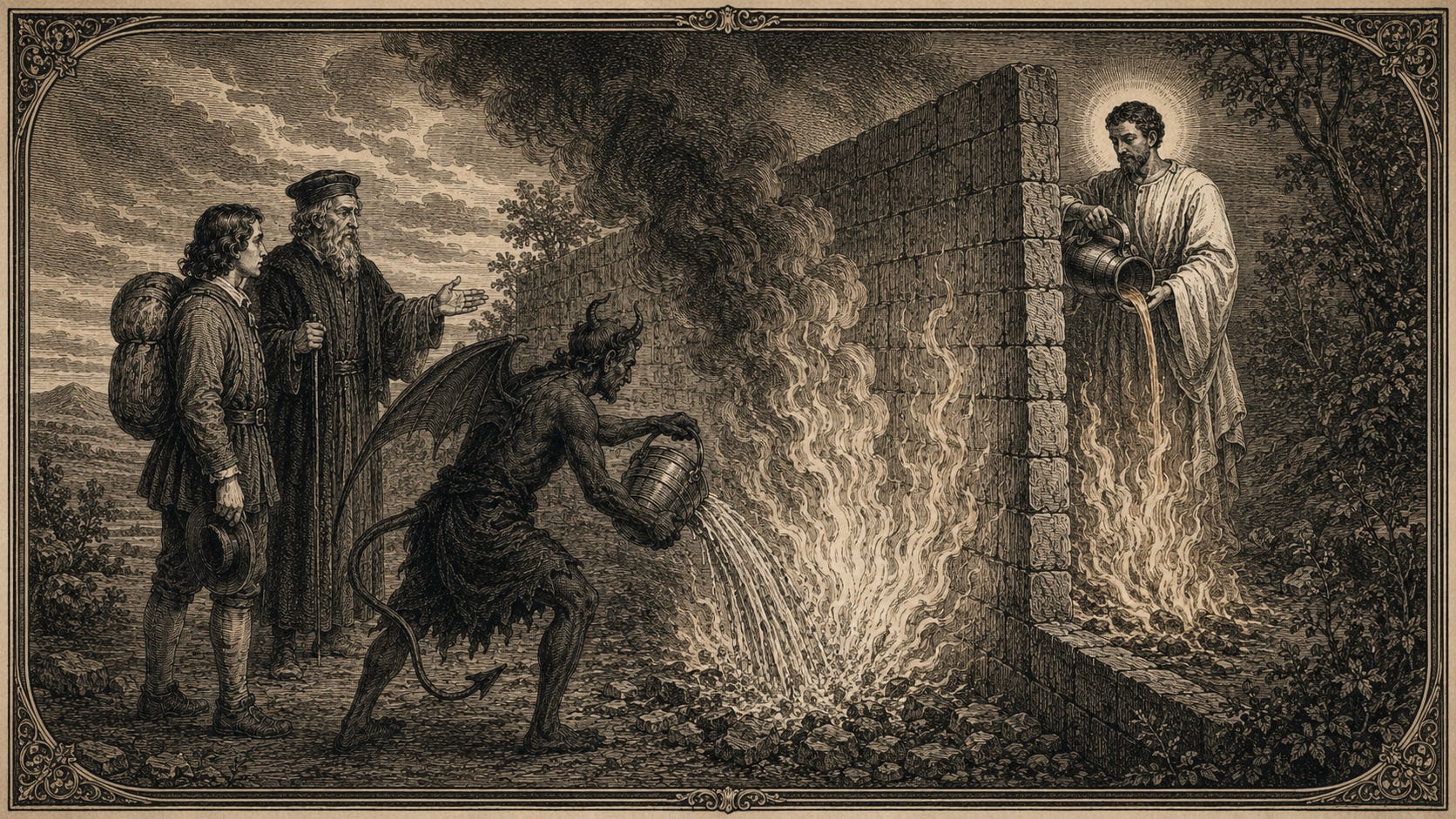
John Bunyan gives us a great illustration of this preserving grace in The Pilgrim’s Progress.
When Christian visits the Interpreter’s house, he sees a fire burning against a wall. A man stands in front of it, throwing water on the flames and trying his best to put it out. Yet the fire keeps burning brighter and brighter.
This does not seem to make much sense until the Interpreter takes Christian behind the wall. There he sees another man secretly pouring oil onto the fire. The Interpreter explains that the fire is the work of grace, the one throwing water on it is the devil, and the man pouring oil is Christ, who will always maintain the work He has begun.
I think Bunyan’s point is that the weakened believer cannot always see how grace is being preserved. He sees the water. He feels the assault. But what he does not see is Christ on the other side of the wall, keeping those flames alive.
What paragraph four of this chapter of the Confession teaches us is that Christ is still pouring that oil. The believer may not feel it, but Christ is pouring.
Assurance Revived in God’s Time
Last but not least, the Confession says:
Out of these graces, through the work of the Spirit, this assurance may at the proper time be revived. In the meantime, they are kept from utter despair through them.
Notice those words: “at the proper time.” Assurance may not return immediately. The believer may confess his sin, return to the means of grace, and continue praying while the darkness remains for a season.
The timing belongs to God, and so does the return of that light. Any renewal, any revival—it is all in God’s timing.
This is why the psalmist speaks to himself in Psalm 42: “Why are you cast down, O my soul, and why are you in turmoil within me?” Then he tells himself, “Hope in God, for I shall again praise Him” (Psalm 42:5, 11).
He does not necessarily know when, but he will. He does not yet possess the comfort he desires, but he knows this darkness will not have the final word. “I shall again praise Him,” he says. And while he waits, God preserves him from utter despair.
Lamentations 3 says, “The Lord will not cast off forever, but, though He cause grief, He will have compassion according to the abundance of His steadfast love” (Lamentations 3:31–32).
And with that, we bring this study to a close.
Assurance is possible. It is founded upon the blood and righteousness of Christ. It is confirmed by the graces of the Spirit. It is witnessed by the Spirit of adoption. It should be diligently pursued, though it may be shaken for a time.
But even then, Christ has not stopped interceding. The Spirit has not abandoned His work. The Father has not ceased to be our heavenly Father.
So, when assurance grows dim, do not surrender to despair. It is unnecessary. Return to Christ. Confess your sins if you have them. Use the means of grace. Trust God even in the darkness. And wait for the day when faith gives way to sight and assurance gives way to glory.


