
What the Cross Reveals About Sin and the Work of Christ
A unified account of the crucifixion shows how the cross exposes the depth of human sin and reveals Christ’s substitutionary work to accomplish redemption.

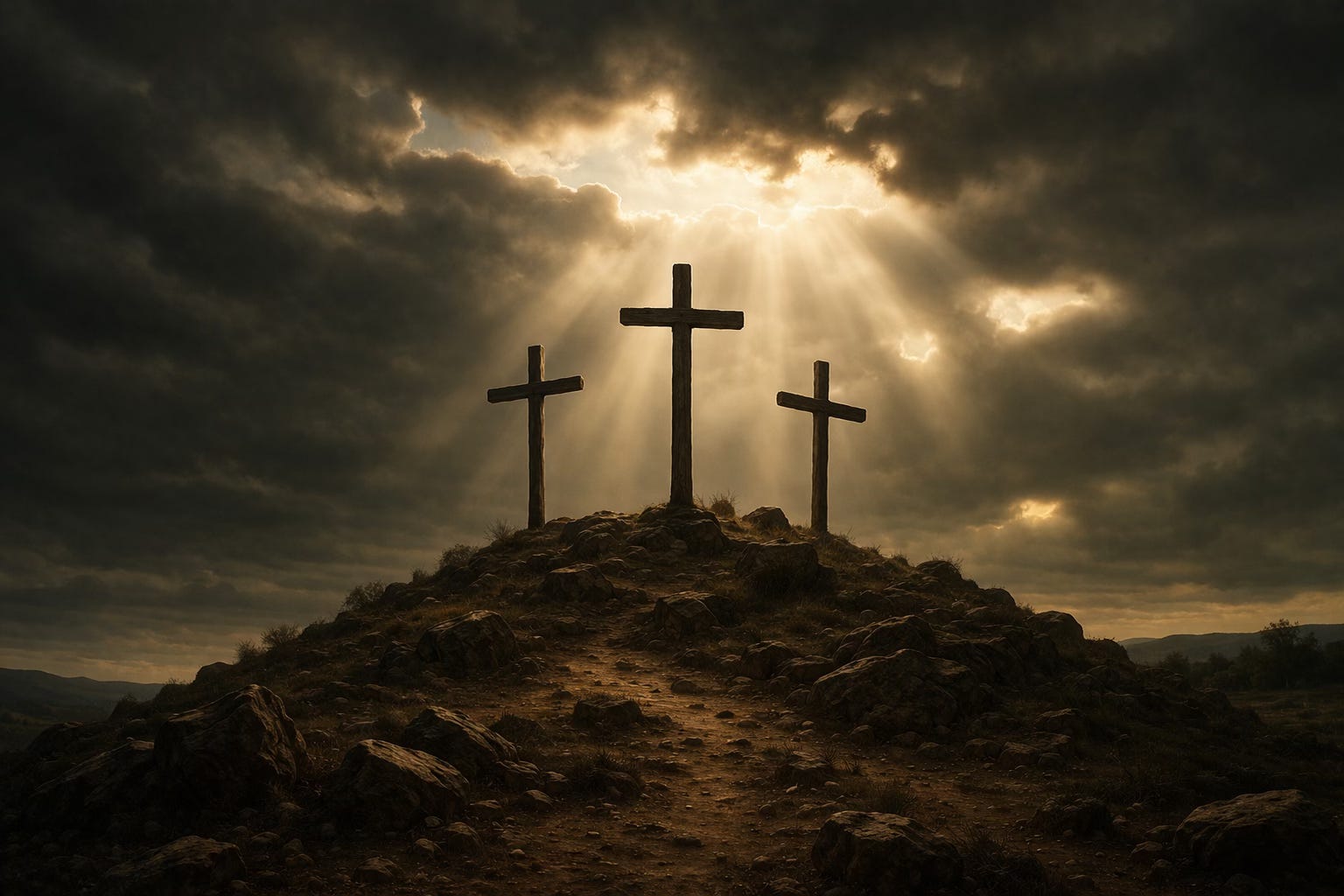
When Jesus instituted the Lord’s Supper the night before his death, he told his disciples, “Do this in remembrance of me,” referring to his broken body and shed blood (Luke 22:19). The apostle Paul later adds, “For as often as you eat this bread and drink the cup, you proclaim the Lord’s death until he comes” (1 Corinthians 11:26). We are to return again and again to that Friday when Jesus was crucified.
As much as we might be inclined to move quickly to the resurrection, Jesus directs our attention first to his suffering and death. We are meant to linger there, to remember it, and to reflect on it often.
What follows, then, is a unified account of the crucifixion1 drawn from all four Gospels—Matthew, Mark, Luke, and John. By bringing these together, we can see the fullest picture of that day that Scripture gives us.
The narrative begins after Jesus’s trials in the early hours of Friday morning, with Governor Pilate’s final decision to hand him over to be crucified.
The Crucifixion of Jesus Christ
Wishing to satisfy the crowd, Pilate decided that [the Jews’] demand should be granted. He released the man who had been thrown into prison for insurrection and murder. But he delivered Jesus over to their will to be crucified. So they took Jesus, stripped him of the purple cloak, and put his own clothes on him. And they led him out to crucify him.
So they took Jesus, bearing his own cross. And as they led him away, they compelled a passerby, Simon of Cyrene, who was coming in from the country, the father of Alexander and Rufus, to carry his cross. [They] laid on him the cross to carry it behind Jesus.
And there followed him a great multitude of the people and of women who were mourning and lamenting for him. But turning to them, Jesus said, “Daughters of Jerusalem, do not weep for me, but weep for yourselves and for your children. For behold, the days are coming when they will say, ‘Blessed are the barren and the wombs that never bore and the breasts that never nursed!’ Then they will begin to say to the mountains, ‘Fall on us,’ and to the hills, ‘Cover us.’ For if they do these things when the wood is green, what will happen when it is dry?”
Two others, who were criminals, were led away to be put to death with him.
And when they came to a place called Golgotha (which means Place of a Skull), they offered him wine to drink, mixed with gall, but when he tasted it, he would not drink it.
And it was the third hour when they crucified him, and the criminals, one on his right and one on his left, and Jesus between them. And Jesus said, “Father, forgive them, for they know not what they do.”
Pilate also wrote an inscription of the charge against him and put it on the cross. It read, “Jesus of Nazareth, the King of the Jews.” Many of the Jews read this inscription, for the place where Jesus was crucified was near the city, and it was written in Aramaic, in Latin, and in Greek. So the chief priests of the Jews said to Pilate, “Do not write, ‘The King of the Jews,’ but rather, ‘This man said, I am King of the Jews.’”
Pilate answered, “What I have written I have written.”
When the soldiers had crucified Jesus, they took his garments and divided them into four parts, one part for each soldier; also his tunic. But the tunic was seamless, woven in one piece from top to bottom, so they said to one another, “Let us not tear it, but cast lots for it to see whose it shall be.” This was to fulfill the Scripture which says, “They divided my garments among them, and for my clothing they cast lots.” So the soldiers did these things, then they sat down and kept watch over him there. And the people stood by, watching.
And those who passed by derided him, wagging their heads and saying, “You who would destroy the temple and rebuild it in three days, save yourself! If you are the Son of God, come down from the cross.”
So also the chief priests with the scribes mocked him to one another, saying, “He saved others; he cannot save himself. Let him save himself, if he is the Christ of God, his Chosen One! Let the Christ, the King of Israel, come down now from the cross that we may see and believe. He trusts in God; let God deliver him now, if he desires him. For he said, ‘I am the Son of God.’”
The soldiers also mocked him, coming up and offering him sour wine and saying, “If you are the King of the Jews, save yourself!”
And the robbers who were crucified with him also reviled him in the same way. One of the criminals who were hanged railed at him, saying, “Are you not the Christ? Save yourself and us!”
But the other rebuked him, saying, “Do you not fear God, since you are under the same sentence of condemnation? And we indeed justly, for we are receiving the due reward of our deeds; but this man has done nothing wrong.” And he said, “Jesus, remember me when you come into your kingdom.”
And [Jesus] said to him, “Truly, I say to you, today you will be with me in paradise.”
Standing by the cross of Jesus were his mother and his mother’s sister, Mary the wife of Clopas, and Mary Magdalene. When Jesus saw his mother and the disciple whom he loved standing nearby, he said to his mother, “Woman, behold, your son!” Then he said to the disciple, “Behold, your mother!” And from that hour, the disciple took her to his own home.
When the sixth hour had come, there was darkness over the whole land until the ninth hour while the sun’s light failed. And at the ninth hour, Jesus cried with a loud voice, “Eloi, Eloi, lema sabachthani?” which means, “My God, my God, why have you forsaken me?”
And some of the bystanders, hearing it, said, “Behold, he is calling Elijah.”
After this, Jesus, knowing that all was now finished, said (to fulfill the Scripture), “I thirst.” A jar full of sour wine stood there, so someone ran and filled a sponge with sour wine, put it on a reed, and held it to his mouth to drink.
But the others said, “Wait, let us see whether Elijah will come to save him.”
When Jesus had received the sour wine, [he] cried out again with a loud voice, “It is finished.” And he bowed his head and, calling out with a loud voice, said, “Father, into your hands I commit my spirit!” And having said this, he breathed his last and gave up his spirit.
And when the centurion, who stood facing him, saw that in this way he breathed his last, he praised God, saying, “Certainly this man was innocent!”
And behold, the curtain of the temple was torn in two, from top to bottom. And the earth shook, and the rocks were split. The tombs also were opened. And many bodies of the saints who had fallen asleep were raised, and coming out of the tombs after his resurrection, they went into the holy city and appeared to many.
When the centurion and those who were with him, keeping watch over Jesus, saw the earthquake and what took place, they were filled with awe and said, “Truly this was the Son of God!”
And all the crowds that had assembled for this spectacle, when they saw what had taken place, returned home beating their breasts. And all his acquaintances and the women who had followed him from Galilee stood at a distance watching these things, among whom were Mary Magdalene, and Mary the mother of James the younger and of Joses, and Salome the mother of the sons of Zebedee. When he was in Galilee, they followed him and ministered to him, and there were also many other women who came up with him to Jerusalem.
Since it was the day of Preparation, and so that the bodies would not remain on the cross on the Sabbath (for that Sabbath was a high day), the Jews asked Pilate that their legs might be broken and that they might be taken away. So the soldiers came and broke the legs of the first, and of the other who had been crucified with him. But when they came to Jesus and saw that he was already dead, they did not break his legs. But one of the soldiers pierced his side with a spear, and at once there came out blood and water. He who saw it has borne witness—his testimony is true, and he knows that he is telling the truth—that you also may believe. For these things took place that the Scripture might be fulfilled: “Not one of his bones will be broken.” And again, another Scripture says, “They will look on him whom they have pierced.”
The Sinfulness of Man
Having considered the full account of our Lord’s crucifixion, we can begin by drawing attention to the sinfulness of man.
I do not merely mean that sinners were present that day. Of course they were. What I mean is that the depravity of the human heart was on full display. Consider the people gathered around Jesus and what they did and said.
First, there were the Roman soldiers. They mocked him, stripped him, nailed him to the cross, and divided his garments among themselves. As Jesus hung there in agony, they gambled for his tunic.
Then there were the religious leaders—the chief priests, scribes, and elders. If anyone should have recognized who Jesus was, it was they. They had the law, the prophets, and the promises concerning the Messiah. Yet they did not weep for the Lord of lords. They demanded his crucifixion and then mocked him, saying, “He saved others; he cannot save himself.”
Do you hear the irony? Subtly, they were proclaiming the truth. “He saved others; he cannot save himself.” That is true, though not in the way they intended. He could not save himself because he was saving others. He had the power to save himself, but he would not, so that he might, as was said at his birth, “save his people from their sins” (Matthew 1:21).
There were also the passersby who had assembled for the spectacle. They were neither soldiers nor religious authorities. They had no reason to be there except curiosity, yet they joined in the scorn, wagging their heads and hurling insults.
Even the criminals crucified beside him joined in. As one of them later confessed, they deserved their punishment, but what had Christ done? “This man has done nothing wrong.”
Look at the scene. Everyone is represented—Gentiles and Jews, rulers and common people, civil and religious authorities, violent men and outwardly respectable citizens. What unites them? They despise Christ.
When some speak of sin, it can sound like little more than a mistake—poor decisions, perhaps, but nothing serious. The cross exposes that lie. These people are not merely indifferent to Christ’s suffering; they celebrate it and add to it. This is what Paul means when he says, “The mind that is set on the flesh is hostile to God” (Romans 8:7). The carnal mind does not simply ignore God; it opposes him.
This sinfulness is universal. We may be tempted to look at those people and ask, How could they do such a thing? Yet what we see in them is what we all are apart from grace. Paul writes, “While we were enemies we were reconciled to God by the death of his Son” (Romans 5:10). In Ephesians 2, he says,
You were dead in the trespasses and sins in which you once walked, following the course of this world, following the prince of the power of the air, the spirit that is now at work in the sons of disobedience— among whom we all once lived in the passions of our flesh, carrying out the desires of the body and the mind, and were by nature children of wrath, like the rest of mankind. (Ephesians 2:1-3)
Apart from God’s grace and Christ’s redemptive work, there is no difference between those who mocked and crucified Jesus and us. We should never treat our sin as a light matter. We opposed God himself. Our sin was so serious, so pervasive, and so offensive that nothing less than the death of his Son could atone for it.
The sinfulness of man is seen not only in the cruelty of the cross but also in the blindness of the people. What did Jesus pray? “Father, forgive them, for they know not what they do.”
They were not innocent, but their sin had blinded them. They looked upon the long-promised Messiah, the Son of God, the Righteous One, and did not recognize him. Where there was divine power, they saw weakness; where there was victory, they saw defeat; where there was glory, they saw shame. This is what sin does. It darkens the mind and hardens the heart, and it was on full display at the cross.
The Substitution of Christ
The second thing the cross reveals is Christ’s substitution. This is the heart of what is happening, so we must not miss it.
The entire narrative emphasizes Christ’s innocence. The repentant criminal says, “This man has done nothing wrong.” Pilate says the same, finding no fault in him and showing reluctance to crucify him. Herod does not condemn him. Even the centurion at the foot of the cross declares, “Certainly this man was innocent.” Jesus does not belong on that cross. He is not a criminal or a sinner. He has done nothing worthy of death. And yet, there he is.
Why? Because he is not there for himself, but for others. He is a substitute.
At the beginning of the narrative, Jesus is led away to Golgotha while Barabbas, a murderer, is set free. The guilty goes free, and the innocent is condemned. Barabbas deserved death, but Jesus took his place.
Then, at the cross, one criminal says to the other, “We are punished justly, for we are getting what our deeds deserve. But this man has done nothing wrong.” Again, the guilty and the innocent stand side by side. What is Jesus doing among the guilty? The prophet Isaiah answers,
He was despised and rejected by men, a man of sorrows, and acquainted with grief; and as one from whom men hide their faces, he was despised, and we esteemed him not. Surely he has borne our griefs and carried our sorrows; yet we esteemed him stricken, smitten by God, and afflicted. But he was pierced for our transgressions; he was crushed for our iniquities; upon him was the chastisement that brought us peace, and with his wounds we are healed. (Isaiah 53:3-5)
A few verses later, he writes, “He poured out his soul to death and was numbered with the transgressors; yet he bore the sin of many, and makes intercession for the transgressors” (Isaiah 53:12).
Or, as Paul says, “For our sake [God] made him to be sin who knew no sin, so that in him we might become the righteousness of God” (2 Corinthians 5:21).
This is what is happening at the cross. Jesus is not suffering for his own sins, but for the sins of many. He can serve as their substitute because he is the sinless God-Man. Having no sins of his own, he steps into our place and bears the wrath we deserved.
Derick Bingham captures this exchange vividly when he writes,
I gave Him a crown of thorns, He gave me a crown of righteousness. I gave Him a cross to carry, He gave me His yoke which is easy, His burden which is light. I gave Him nails through His hands, He gave me safely into His Father’s hands from which no power can pluck me. I gave Him a mock title, ‘This is the King of the Jews.’ He gave me a new name and made me a king and a priest to God. I gave Him no covering, stripping His clothes from Him, He gave me a garment of salvation. I gave Him mockery, casting the same in His teeth, He gave me Paradise. I gave Him vinegar to drink, He gave me Living Water. I crucified and slew Him on a tree, He gave me eternal life. It was my sinfulness that put Him there. It is His sinlessness that puts me here.
This substitution is also seen in the case of the thief on the cross. He moves from reviling Christ to confessing his guilt and pleading, “Jesus, remember me when you come into your kingdom.” Even as Jesus appears to be defeated, the man believes he still reigns, that death will not be the end, and that he can still save.
Jesus answers him, “Truly I tell you, today you will be with me in paradise.”
What could that man do for himself? Nothing. He was at the point of death. There was no opportunity for restitution, no good work to perform. All he could do was cast himself on the mercy of Christ, trusting that Christ’s death was enough to save. And it was because the Righteous One was bearing the penalty of the unrighteous.
The Accomplishment of Redemption
The third thing the cross reveals is the accomplishment of redemption.
From noon until three in the afternoon, darkness covers the land. Throughout Scripture, darkness is often associated with the judgment of God. Think of the plague of darkness in Egypt or the prophetic descriptions of the day of the Lord. Darkness signals judgment; it signals divine wrath. At the end of this darkness, Jesus cries out, “My God, my God, why have you forsaken me?”
Here, the deepest agony of the cross is revealed. The nails were terrible, the scourging was terrible, and the humiliation was terrible. But the greatest suffering was not physical; it was judicial. The Son was bearing the curse of sin. As Paul writes, “Christ redeemed us from the curse of the law by becoming a curse for us” (Galatians 3:13).
That is what is happening in the darkness. Behind that cry of abandonment is the reality that Jesus is enduring the wrath of God for our sin.
Yet at the end of this suffering, Jesus declares, “It is finished.” The work he came to accomplish is complete. The Scriptures are fulfilled, the price is paid, the sacrifice is offered, and the wrath of God has been borne. The debt is canceled. Nothing is left undone.
Immediately, the effects of this finished work become evident. The curtain of the sanctuary is torn from top to bottom, not from bottom to top, as if man were forcing his way into God’s presence, but from top to bottom. God himself opens the way. The barrier between a holy God and sinful man is removed through the death of Christ.
The earth quakes, the rocks split, and tombs are opened. Creation itself responds to the death of its Maker.
Then the centurion, seeing what had taken place, says, “Truly this man was the Son of God.” The irony is striking. Earlier, the mockers said, “If you are the Son of God, come down from the cross.” But the centurion recognizes that Jesus is the Son of God precisely because he does not come down. His remaining on the cross proves that his death accomplished redemption.
The apostle John adds, “He who saw it has borne witness—that you also may believe.” Believe what? That Jesus is the Christ; that he truly died, though he did not deserve it; that the Scriptures were fulfilled in him; that he is the Lamb of God who takes away the sin of the world.
The crucifixion account does not leave us merely with a collection of historical facts. It calls us to believe. If we see ourselves in the mocking crowds, the indifferent soldiers, or the religious leaders who demanded his death, we must look again. See the sinfulness of man. See the substitution of Christ. See the accomplishment of redemption.
Like the thief on the cross, we should confess our sins and turn to Christ. Like the centurion, we should confess, “Truly this man was the Son of God.” Like the crowds, we should walk away, beating our breasts over what we have seen.
And even after we have trusted in Christ as our only hope of salvation, we return to the cross again and again to remember what was accomplished there. Let us say with the apostle Paul, “Far be it from me to boast except in the cross of our Lord Jesus Christ” (Galatians 6:14).
Write to hello@jeremysarber.com for a complete copy of my Gospel harmony of the crucifixion and resurrection (ESV).