
The Sweetness of Intercessory Prayer
Intercessory prayer bears the burdens of others before God, trusts His wisdom when answers differ from our requests, and rests in Jesus Christ, the greater Intercessor.

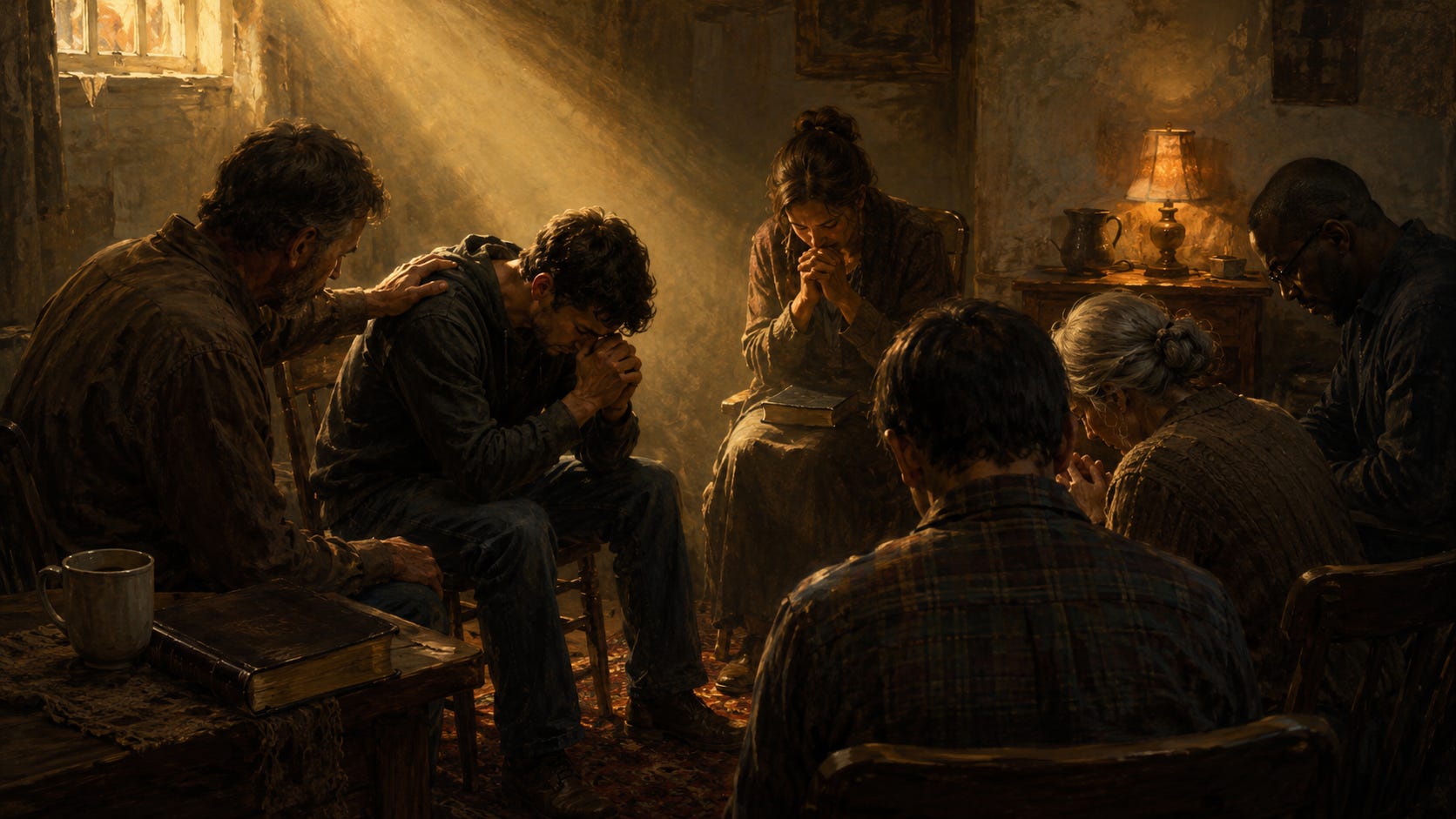
There’s something incredibly sweet about praying for another person, and it’s a sweetness that cannot be found in praying only for ourselves. It’s as though we empty ourselves of our own needs and desires, if only for a moment, and allow someone else’s trouble to become our trouble. We bring their needs before God—their salvation, their healing, their repentance, their endurance, their comfort. We willingly allow their cares to become our cares as we approach the Lord in prayer.
This is what we call intercessory prayer. It’s prayer offered on behalf of someone else. And it’s a beautiful expression of Christian love, if for no other reason than that it most often happens when the one for whom we’re praying isn’t even there to see it or hear it.
That person may never know how often you mention his or her name before God. There’s no praise to be had. No pat on the back. Chances are, the one for whom you pray will not be there to give you a hug or say thank you. But you pray because love has made that person’s burden your burden.
As Paul says in Galatians 6:2, “Bear one another’s burdens, and so fulfill the law of Christ.” And what is the law of Christ? It’s that we love God and love our neighbors as ourselves (Matthew 22:37–39).
Intercession in the Lord’s Prayer
It may not be obvious, but even Jesus, in His model prayer—what we typically call the Lord’s Prayer—taught us to intercede for others. Maybe you ask, “Where is it? I don’t see Jesus teaching us to pray for others in the Lord’s Prayer.”
Well, look again. He doesn’t teach us to pray, “My Father in heaven … Give me this day my daily bread, and forgive my debts.” No, He says, “Our Father in heaven … Give us this day our daily bread, and forgive us our debts” (Matthew 6:9, 11–12).
So while He teaches us how to pray for ourselves, He simultaneously teaches us that we should be praying for others.
Even if that weren’t the case in the Lord’s model prayer, we have many examples throughout Scripture of God’s people praying for others. I’d like to look at a few of those now.
Abraham Intercedes for Sodom
Genesis 18 begins with three strangers paying Abraham a visit. He doesn’t know who they are, but he offers them food and rest. He soon discovers that they are on a divine mission from God Himself. In verses 20 and 21, the Lord says:
Because the outcry against Sodom and Gomorrah is great and their sin is very grave, I will go down to see whether they have done altogether according to the outcry that has come to me. And if not, I will know. (Genesis 18:20–21)
In other words, the cities of Sodom and Gomorrah have become terribly wicked, and the Lord intends to render His judgment against them.
What I want us to notice is Abraham’s response to this news, which begins in verse 23. He begins to plead with God:
Will you indeed sweep away the righteous with the wicked? Suppose there are fifty righteous within the city. Will you then sweep away the place and not spare it for the fifty righteous who are in it? (Genesis 18:23–24)
What if there are forty-five righteous people, or forty, or thirty, or twenty, or ten?
Abraham likely knows how wicked these cities have become, specifically Sodom. He likely knows that God would be just if He were to sweep these cities away. But like God Himself, Abraham does not take pleasure in the destruction of the wicked (Ezekiel 18:23). So he intercedes on their behalf, pleading with God to show mercy.
This truly is a remarkable prayer on the part of Abraham. He could have just as easily thought, Well, they get what they deserve. Let justice be done. God could have pronounced judgment against Sodom and let fire and brimstone rain down right then and there. But instead, Abraham prays for mercy, and God listens. God allows Abraham to draw near to Him, to reason with Him from His own character, and to ask boldly for mercy.
When I say Abraham reasoned from God’s character, we see this in verse 25: “Shall not the Judge of all the earth do what is just?” (Genesis 18:25).
In other words, he prays, “Lord, You are just. Will You let the fate of the righteous be the same as the fate of the wicked?”
Abraham is not asking God to do something outside of His nature or character. He is appealing to what he knows about God. Furthermore, he’s not trying to awaken something in God that doesn’t exist. He’s not trying to convince an unkind God that He should be kind, or an unmerciful God that He should be merciful. He is essentially saying, “Lord, I know who You are, and that’s precisely why I make this request.”
Humble Boldness Before God
We should also notice that, as bold as Abraham was in this prayer, he was also deeply humble. In verse 27, he says, “I have undertaken to speak to the Lord, I who am but dust and ashes” (Genesis 18:27).
And yet, he doesn’t let this humility silence him. He makes a very bold request, over and over again. But even his boldness is reverent.
Sometimes we think of humility and boldness as mutually exclusive, as though we can’t have both at the same time. Because of this, we might imagine that humility means asking for very little when we approach God in prayer. But Abraham shows us otherwise.
His prayer reflects the fact that he knew he deserved nothing, but his faith knew that God is able to give more than we ask or think (Ephesians 3:20). That’s why he keeps lowering the number. That’s why his request gets a little bolder and a little bolder.
To be clear, I don’t believe Abraham is bargaining with God like you would bargain with a salesman at a car dealership. I think it would be more accurate to say that Abraham is exploring the depth of God’s mercy. He knows God is merciful, but he’s seeking to discover just how merciful He really is. At each step, the Lord answers, “I will spare it” (Genesis 18:26, 28–32).
Perhaps the most striking aspect of this prayer is for whom Abraham is praying. This is as far from a selfish prayer as you can get. While I realize that his nephew Lot was in that city, you’ll notice that Abraham never names Lot. I’ll come back to him in a moment, but Abraham is making intercession for Sodom.
This is not a noble city or a noble people. He is pleading for people who have proven themselves guilty, corrupt, and hostile. Their sins are so terrible that those sins have cried out for judgment. We might say that he’s praying for people begging to be punished.
Maybe he has Lot in the back of his mind. Maybe he’s praying for the sake of the righteous, not the wicked. But he’s not asking God to rescue the righteous from that place. He’s asking God to spare the entire city, which tells us something about both Abraham’s heart and what he knows about God’s character.
Trusting God’s Wisdom in the Answer
In the next chapter, we see how God answered Abraham’s prayer. Evidently, ten righteous people were not found, so the city of Sodom was not spared. However, Genesis 19:29 says:
So it was that, when God destroyed the cities of the valley, God remembered Abraham and sent Lot out of the midst of the overthrow when he overthrew the cities in which Lot had lived. (Genesis 19:29)
“God remembered Abraham.”
He may not have answered the prayer just as Abraham had asked, but He did answer it. He rescued Lot and Lot’s daughters from the destruction. Despite the words Abraham actually used, perhaps that is precisely what was on his heart when he prayed. Maybe he was thinking, Lord, spare the city for Lot’s sake.
Regardless, we can learn a couple of valuable lessons about intercessory prayer from this event.
First, we make our intercessions for other people, which is good, but we don’t always know what’s best for them. We don’t always know exactly what the request should be. But we do our best. We let the character of God and His Word inform our prayers, asking God to do this or that, while not always knowing what He will deem best for any given situation.
Second, we learn from Abraham that intercession should trust not only in God’s power—yes, He has the power to answer our prayers—but also in His wisdom. He knows what’s best. His knowledge is infinite, but ours is not.
As Solomon says, “[Man] cannot find out what God has done from the beginning to the end” (Ecclesiastes 3:11). We don’t always understand why God is doing what He is doing or why He answers prayers the way He does, but we’re not called to understand everything. We are called to trust in His wisdom.
James writes:
If any of you lacks wisdom, let him ask God, who gives generously to all without reproach, and it will be given him. But let him ask in faith, with no doubting. (James 1:5–6)
In other words, we may lack wisdom, but we can still approach the Lord in faith, trusting in His wisdom, not to mention His ability and His willingness to answer our prayers.
Moses Intercedes for Israel
Abraham is not the only one to offer an intercessory prayer in the Bible. We see the same sweetness in Moses. After Israel made the golden calf in Exodus 32, the Lord said to Moses, “I have seen this people, and behold, it is a stiff-necked people. Now therefore let me alone, that my wrath may burn hot against them and I may consume them” (Exodus 32:9–10).
Notice how Moses responds. Starting in verse 11, we’re told:
But Moses implored the LORD his God and said, “O LORD, why does your wrath burn hot against your people, whom you have brought out of the land of Egypt with great power and with a mighty hand? Why should the Egyptians say, ‘With evil intent did he bring them out, to kill them in the mountains and to consume them from the face of the earth’? Turn from your burning anger and relent from this disaster against your people. Remember Abraham, Isaac, and Israel, your servants, to whom you swore by your own self, and said to them, ‘I will multiply your offspring as the stars of heaven, and all this land that I have promised I will give to your offspring, and they shall inherit it forever.’” And the LORD relented from the disaster that he had spoken of bringing on his people. (Exodus 32:11–14)
Again, notice how Moses appeals to God’s character and His promises as he makes this intercessory prayer on behalf of Israel.
To be clear, Moses was not asking God to ignore the fact that they had sinned greatly against Him. His prayer continues in verse 31:
Alas, this people has sinned a great sin. They have made for themselves gods of gold. But now, if you will forgive their sin—but if not, please blot me out of your book that you have written. (Exodus 32:31–32)
Moses seems to realize that their sin is so horrendous that he can’t even finish his sentence when he says, “If You will forgive their sin—” He just stops, as though he can’t even imagine a sin so great being forgiven. Instead, he offers to place himself between those guilty people and the judgment they deserve.
Of course, Moses couldn’t actually atone for Israel’s sin, but his willingness reveals the heart of the intercessor. When he offers his prayer for them, he’s not standing aloof at a distance. He’s placing himself right there alongside them.
This comes after the Lord says to him, “My wrath may burn hot against them and I may consume them, in order that I may make a great nation of you” (Exodus 32:10). Moses could have thought, Well, these people deserve judgment, but I’ll be okay, and God will fulfill His promise through me.
But he doesn’t do that. Instead, he intercedes for them. He pleads with the Lord for them, even expressing his willingness to suffer with them, if not in their place.
It reminds me of what the Apostle Paul writes at the start of Romans 9: “I could wish that I myself were accursed and cut off from Christ for the sake of my brothers, my kinsmen according to the flesh” (Romans 9:3).
In the very next chapter, he says, “Brothers, my heart’s desire and prayer to God for them is that they may be saved” (Romans 10:1).
For whom is he praying? He’s making intercession for the very people who crucified his Lord and continued persecuting the church. He not only prays for them, but he also expresses his willingness to trade places with them, if that were possible, just to see them saved.
Samuel Refuses to Stop Praying
When Israel demanded a human king like the other nations, Samuel confronted their sin. They had rejected the Lord’s kingship over them. The people became very afraid, and 1 Samuel 12:19 says:
And all the people said to Samuel, “Pray for your servants to the LORD your God, that we may not die, for we have added to all our sins this evil, to ask for ourselves a king.” (1 Samuel 12:19)
Then, after imploring the people to follow their God and serve Him with all their hearts, Samuel says, “Far be it from me that I should sin against the LORD by ceasing to pray for you” (1 Samuel 12:23).
Even their sin against God did not remove Samuel’s obligation to pray for them. In fact, he says it would be a sin for him to cease praying for them.
Bringing the People in Our Lives Before God
Just think about all the people God has providentially led into our lives—a spouse, children, grandchildren, parents, brothers and sisters in the church, visitors to the church, colleagues, neighbors, the cashier at the grocery store, missionaries serving around the world, and on and on it goes.
You can rarely change their circumstances. You have no power at all to change their hearts. But you can bring them before God.
If you know someone who has cancer, you can’t cure that person, but you can lift him or her up before the Great Physician and plead for healing. If you know someone who has rejected Christ, and maybe that individual won’t even listen to your gospel appeals anymore, that person cannot stop you from taking the case to the Savior Himself and praying, “Lord, save them.”
On more than one occasion, I’ve spoken with someone in a troubled marriage. More than once, I’ve had someone say to me, “I’m trying to do the right things. I’m trying to be a better husband or wife. But my spouse won’t listen anymore. I can’t change him or her. I’m stuck. I don’t know what to do.”
One thing I will always impress upon them is that they shouldn’t stop praying.
Continue praying for the marriage. Continue praying for yourself, but don’t forget to continue praying for your spouse.
And you know what often happens? Even before they see a change in their spouse, they see a change in themselves. It’s pretty difficult to maintain resentment toward someone when you are sincerely pleading with God for that person’s good.
Jesus, the Greater Intercessor
We may sometimes be tempted to think, Who am I to pray for someone else? I’m not Abraham. I’m not Moses. What? You want me to pray for someone who’s struggling? I’m struggling too. You want me to pray for the President of the United States? I’m nobody compared to him. What good could my prayers do?
Well, think about this: you are never praying alone.
When we pray for others, our seemingly small prayers join the much greater prayers of Jesus Christ. We may stumble over our words. We may misunderstand the situation. We may ask for something that is not ultimately best. But Christ receives our weak and imperfect prayers and brings us before the Father on the strength of His perfect righteousness and finished sacrifice.
As Hebrews 7:25 says, “He always lives to make intercession for them.”
Christ is not attempting to persuade an unwilling Father to love us and answer our prayers. The Father sent the Son because He loved us (John 3:16). Christ intercedes by standing before the Father as the One who died for us, rose for us, and now represents us in heaven (Romans 8:34; Hebrews 9:24).
So when you pray for your spouse, your children, your church, those who are suffering, or the lost, you are not throwing helpless words into the darkness. You are coming through a living High Priest.
Abraham interceded for Sodom. Moses interceded for Israel. Samuel interceded for the people. But Jesus is the greater Intercessor, and because He prays for us, we can pray with confidence for one another.