
Andrew Fuller and John Ryland: The Friendship That Helped Spark the Modern Missionary Movement
The friendship of Andrew Fuller and John Ryland Jr. shows how theological conviction, brotherly affection, and spiritual friendship helped revive the Particular Baptists.

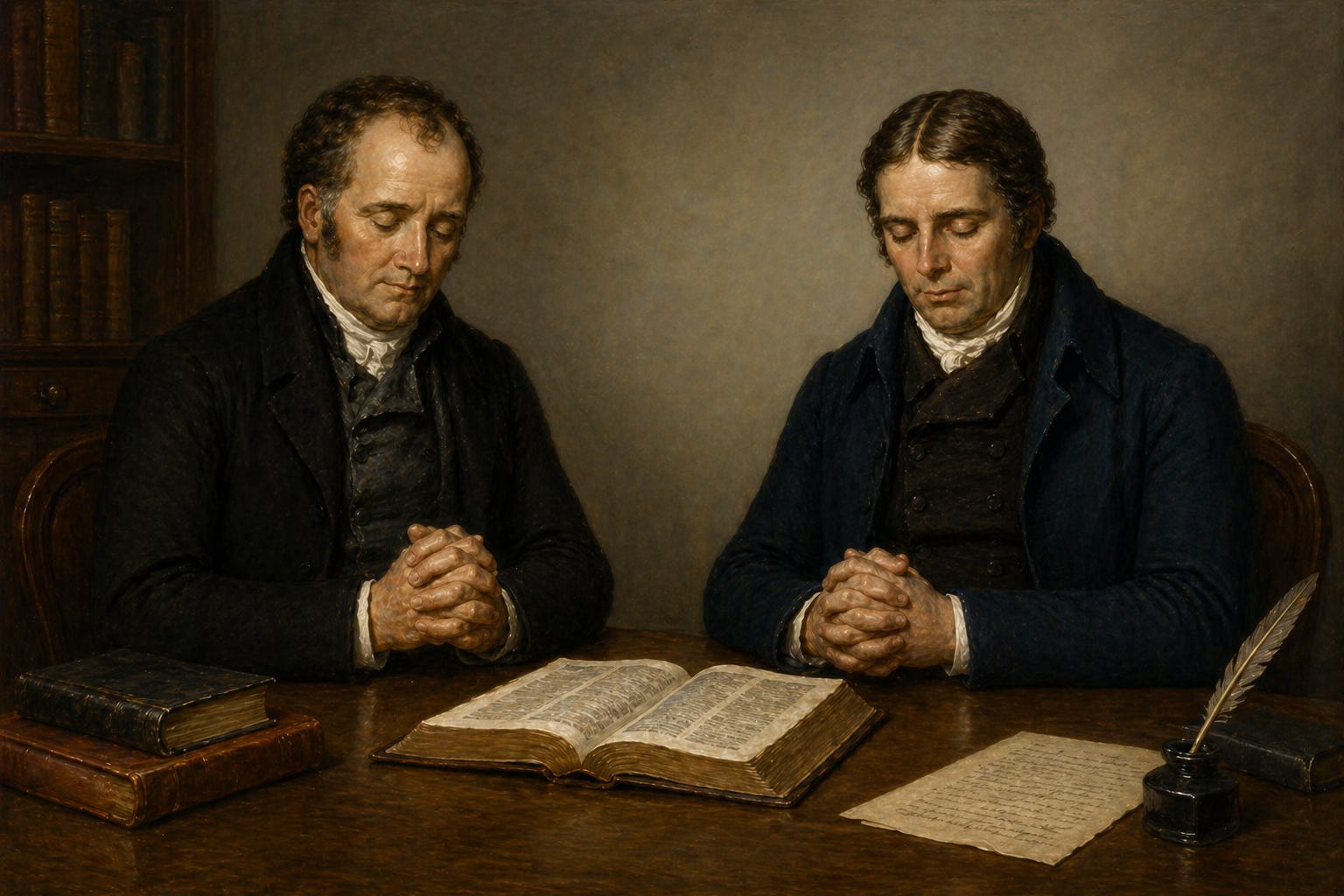
Let’s consider a real historical friendship, one that, without exaggeration, helped change the world. It is the story of Andrew Fuller and John Ryland Jr., two seemingly unlikely friends whose shared convictions and enduring affection became instrumental in the renewal of Baptist life and the expansion of the modern missionary movement.
A Friendship Forged in Theological Decline
To understand their friendship, some historical background is necessary. The Particular Baptists in eighteenth-century England had fallen deeply into hyper-Calvinism. Some trace the beginnings of this decline to the Congregationalist minister Joseph Hussey and his 1707 book, God’s Operations of Grace but No Offers of His Grace. Over time, the theological tendencies represented in that work spread into Particular Baptist churches and came to shape a dominant understanding of salvation. The consequences were devastating. Evangelistic zeal withered, and by 1750, roughly one-third of the 220 Particular Baptist churches had ceased to exist.
Hyper-Calvinism began with something true, but pushed it beyond the bounds of Scripture. It rightly affirmed that fallen sinners are unable to respond to God apart from divine grace. Human beings, dead in sin, cannot repent and believe unless God first works in them. That much was orthodox. But hyper-Calvinism drew a further conclusion. If unconverted sinners lack the natural power to come to Christ, then, it reasoned, ministers have no warrant to call all people indiscriminately to repent and believe the gospel. To issue such invitations, they argued, would be as absurd as commanding a blind man to read a book. Since he cannot do it, the command is meaningless, even cruel.
From that reasoning arose a ministry directed only toward those whom they called “sensible sinners,” those who already appeared to show evidence of awakening. In many Particular Baptist churches, a person sitting unconverted in the congregation would not hear the pastor plead with him to flee to Christ. He would hear no free offer of the gospel extended to all. Instead, he was expected to remain in a state of anxious introspection, waiting for some unmistakable evidence that God was at work in his soul. Only then might he seek pastoral counsel regarding what to do.
It has been described as a spiritual waiting room where no one ever calls your name. Others have referred to it as a theological cage. Both images capture something of its paralysis. It was a system that stifled assurance, suppressed evangelism, and imprisoned both ministers and hearers in uncertainty.
This was the world into which Andrew Fuller and John Ryland Jr. were born. It was the theological atmosphere that shaped their early lives and ministries. Fuller often receives the greater credit for helping Particular Baptists break free from this constriction, and rightly so in many respects. Yet Fuller did not labor alone. His theological courage was strengthened, sharpened, and sustained through friendship. It is no overstatement to say that the cage was not opened by Fuller alone, but by Fuller and Ryland together.
To understand how that happened, we must begin with the men themselves, and first with John Ryland.
An Unlikely Friendship Begins
John Ryland Jr. was born in 1753 in Northampton, the son of a prominent pastor and schoolmaster who pressed his son rigorously in his studies. Ryland proved remarkably gifted. Indeed, he was something of a prodigy. He was reading biblical Hebrew at four years old. By eight, he was translating the Greek New Testament. By eleven, he had become highly proficient in both Latin and French. In 1767, at only twelve years old, he published his first book, a collection of poetry. He achieved in childhood what many men never achieve in a lifetime.
Yet such extraordinary gifting carried spiritual dangers. Ryland became proud, persuaded of his own superiority. His brilliance fed an arrogance that might have ruined him had God not intervened through the counsel of a wiser friend.
That friend was John Newton, the former slave ship captain turned Anglican pastor and author of “Amazing Grace.” Newton had personally known the depths of human depravity and the power of divine grace, and he was a close friend of the Ryland family. More than thirty years older than the young Ryland, Newton perceived something troubling in his character and addressed it directly in a letter. With loving bluntness, he warned that pride would destroy him. He wrote, “Your future comfort and success eminently depend upon your being humble. And if the Lord loves you and has sent you, He will find ways and means to humble you.”
In God’s providence, Newton himself became one of those means. Ryland received the rebuke. He took it so seriously that he ceased publishing for eight years, withdrawing from the spotlight his father had helped create around him. His spirit softened. Decades later, he begged his family to locate and destroy anything he had written before the age of thirty, fearing others might be misled by the arrogance of his youth. The prodigy had been humbled.
On one side, then, stood Ryland, brilliant, polished, academically trained, and now chastened by grace. On the other stood Andrew Fuller, his near opposite.
Andrew Fuller was born in 1754, only a year after Ryland, but his upbringing could scarcely have been more different. He was born into a rural farming family in the village of Wicken. He had virtually no formal academic training. He spoke only one language. Until the age of twenty, he labored as a cattle farmer. Yet he possessed unusual discipline and intellectual hunger. He read and studied on his own, determined to learn despite the absence of formal education.
Fuller’s struggles differed from Ryland’s. He did not identify pride as the dominant sin of his youth. He later wrote that lying and swearing marked his early life. He claimed to have abandoned swearing by age ten, but lying remained a persistent struggle until his conversion to Christ in his late teens.
The contrast between the two men is striking. Ryland was an educated scholar in Northampton, shaped by books, languages, and a cultured society. Fuller was the self-taught farmer-turned-pastor in Soham, shaped by labor, discipline, and personal study. One bore the polish of the academy. The other carried the rough edges of the countryside.
Yet in 1778, these two young men, both in their early twenties, met at a regional gathering of Baptist ministers. Beneath their differences lay profound shared convictions. Both were deeply troubled by the theological paralysis of the Particular Baptists. Both had become persuaded that hyper-Calvinism was a dead end. Both longed to preach the gospel freely and call sinners openly to faith in Christ. Yet both belonged to a church culture that insisted they had no warrant to do so. They felt confined within the same theological cage.
What they shared mattered far more than what distinguished them. They shared Christ. They shared a zeal for the gospel. They shared a burden for evangelism and a growing conviction that the inherited system around them was strangling both. These were not minor commonalities, but the deepest bonds friendship can possess.
What appeared, at first glance, to be an unlikely friendship soon proved providential. Two men from very different worlds discovered in one another a kindred spirit. That bond would endure for the rest of their lives. More than that, it would become one of the great friendships in church history.
Friendship Deepened Through Truth
The decisive turning point in their friendship came in 1782, when Andrew Fuller moved to Kettering to pastor a church only thirteen miles from the ministry of John Ryland Jr. in Northampton. What had once been roughly sixty miles of separation narrowed to a distance close enough for regular personal fellowship. Though thirteen miles was no small matter in the eighteenth century, it made possible what had not previously existed. They could now meet frequently, walk together, converse face to face, and cultivate a friendship that moved beyond correspondence into shared life.
That is precisely what followed. They wrote letters, but they also spent long stretches together in conversation, often on extended walks, discussing theology, Scripture, and virtually every subject that stirred their minds. Their friendship was built merely on intellectual rigor, spiritual seriousness, and mutual refinement.
Their letters offer remarkable insight into the character of that bond. One example comes from a letter Fuller wrote on March 22, 1783. He begins by thanking Ryland for helping him learn Hebrew. Yet after that brief expression of gratitude, there is almost no social preamble. There are no extended pleasantries, no casual inquiries about health or family. Fuller immediately moves into a dense theological discussion of moral inability and the writings of Jonathan Edwards. To modern readers, the transition feels abrupt, but it reveals that their friendship did not depend upon ceremonial small talk before arriving at what mattered most. They moved directly into serious matters because they were the substance of their fellowship.
There is something deeply refreshing in such friendship. To be close enough to another man that one need not spend an hour navigating superficial conversation before speaking of what truly matters is a rare gift. Fuller and Ryland had that gift. Their letters show not only comfort with theological intensity, but delight in it.
More than that, they did not avoid disagreement. They welcomed it. A rigorous and respectful argument was not a threat to their friendship, but a significant part of it. For them, serious debate was itself a form of brotherly affection. They lived out the wisdom of Proverbs 27:17: “Iron sharpens iron, and one man sharpens another.”
They sharpened one another regularly, and they did so through ordinary conversation.
One story in particular captures both their differences and the strength found in those differences. On one occasion, they traveled together to Oxford. Ryland was captivated by the beauty of the city, its architecture, and the accumulated weight of centuries of scholarship. As they walked, he pointed from sight to sight in wonder. “Look at that,” he said. “Oh, look at that.”
Fuller, however, was mostly silent, absorbed in thought. Then suddenly he turned to Ryland and said, “Brother, I think there is one question which, after all that has been written on it, has not yet been well answered.”
Ryland asked what he meant.
Fuller replied, “What is justification? That inquiry is far more to me than all these fine buildings.”
That moment says much about the two men. Ryland possessed breadth, cultural awareness, and a delight in the riches of human learning. Fuller possessed a restless theological mind that continually pressed beneath appearances to first principles. One saw the horizon. The other kept returning to foundations.
Yet these differences did not hinder friendship. They strengthened it. Friendship, like marriage, does not require sameness. It often flourishes precisely where complementary strengths meet. Ryland helped Fuller see a broader world. Fuller repeatedly drew Ryland back to fundamental biblical questions. Together they shaped one another.
This mutual sharpening was not incidental to Fuller’s development. It helped prepare him for the work that would alter Baptist history. In this season of deepening friendship, Fuller labored to write The Gospel Worthy of All Acceptation, the book through which he would challenge hyper-Calvinism at its root and help open the door to evangelical renewal. And it is difficult to understand that achievement apart from the friendship that helped form the man who wrote it.
Friendship in the Service of the Gospel
To appreciate what these men accomplished together, it is necessary to return to the hyper-Calvinist cage they inhabited. The hyper-Calvinist argued that one cannot call sinners indiscriminately to repent and believe because the unconverted lack the ability to respond. To command faith, they reasoned, would be like telling a blind man to see.
But Andrew Fuller came to see the matter differently. The problem, he argued, was not natural inability but moral inability. The sinner is not a creature lacking the faculties necessary to respond to God. He possesses mind, will, and affections. He can understand truth, make choices, and desire what he loves. The issue is not that something essential is missing. The issue is that the heart is corrupt. Sinners do not refuse Christ because they cannot come in a natural sense, but because they will not come. They do not want the light because they love darkness.
That distinction was decisive. It helped explain why Christ, the apostles, and the Bible call men indiscriminately to repent and believe. Such calls are not absurd because repentance and faith are the moral responsibility of every person. Therefore, ministers must proclaim the gospel freely to all and summon all people everywhere to turn to Christ.
Hyper-Calvinism had elevated divine sovereignty to the point of obscuring human responsibility. On the opposite side of the theological spectrum are those who magnify human responsibility to the point of diminishing divine sovereignty. Historic Calvinism, as articulated in the Second London Baptist Confession, held these truths together without sacrificing either. That was what Fuller came to see.
It is difficult to separate this theological breakthrough from the friendship that helped refine it. Fuller receives much of the credit for helping unlock the hyper-Calvinist cage, and rightly so. Yet his friendship with John Ryland Jr. was no mere backdrop. It was part of the means by which those convictions were sharpened and sustained.
Beginning in 1784, Fuller and Ryland, together with John Sutcliff and William Carey, gathered regularly in Ryland’s study for fasting and prayer. For roughly seven years, they sought revival, first in their own souls, then in their churches, and then throughout the Baptist churches of England. These were not casual meetings. They were sustained seasons of spiritual pleading before God, and they helped prepare the ground for what would follow.
In October 1792, they formally organized the Baptist Missionary Society. Carey would soon go to India, declaring that he would go down into the mines if only Fuller would hold the rope.
That image has rightly become famous. Fuller was indeed a chief rope holder. As the Society’s first secretary, he traveled across England, Scotland, and Wales, raising support, defending the mission against critics, and sustaining the work at considerable personal cost. But he did not hold the rope alone. Ryland stood with him as a principal advocate and, in time, became instrumental in training future ministers and missionaries.
His later move, more than a hundred miles away, to serve as president of the Bristol Baptist Academy did not diminish their friendship. Their correspondence continued with remarkable regularity, at least one letter every two weeks. Ryland once said that if more than a fortnight passed without hearing from Fuller, it was to him a “tedious interval.” By tedious, he meant painful. The absence of his friend was felt.
Their friendship was not merely strategic, intellectual, or ministerial. It was deeply personal. This is evident in how they shared one another’s sorrows. When one of Fuller’s children died, he asked Ryland to preach the funeral. When Ryland’s wife died, Fuller was there to comfort him. Their bond extended beyond theological discussion and common labor. They bore grief together.
This is what made their friendship so extraordinary. They were not simply colleagues joined by a cause. They genuinely loved one another. Their affection was personal, deep, and enduring. And that affection, no less than their theological convictions, helped sustain the work to which God had called them.
Friendship Tested and Proven
This friendship, extraordinary as it was, did not exist without serious trials. Indeed, one of the clearest demonstrations of its strength is that it endured profound disagreement without fracture.
In the early nineteenth century, intense debates arose over the Lord’s Supper, particularly among the Particular Baptists. The question was whether those who had not received believer’s baptism should be admitted to the Lord’s Table. Since nearly every other Christian body practiced infant baptism, most non-Baptist Christians had not been baptized as professing believers. The question, therefore, was whether such Christians should be welcomed to commune in a Baptist church, despite not having taken what Baptists regarded as the first act of obedience in the Christian life.
The controversy did not originate in England but in India, among Baptist missionaries, including William Carey and his colleagues. In the practical realities of the mission field, where they were largely isolated and confronted by non-Baptist Christians seeking fellowship at the Lord’s Table, the missionaries adopted a policy of open communion.
When news of this reached Andrew Fuller, he was deeply troubled. He believed the policy undermined the very identity of the missionary movement they had built. These were Baptist missionaries. For Fuller, believer’s baptism was a necessary prerequisite to the Lord’s Supper. If the missionaries no longer maintained that order, he feared the movement’s defining principles were being surrendered. If Baptists did not insist upon baptism before admission to the Table, what distinguished Baptist missions at all?
Yet on this matter, his closest friend stood firmly against him.
John Ryland Jr. disagreed vehemently, bluntly, and publicly. He believed excluding a genuine Christian from the Lord’s Supper violated the law of brotherly love. For Ryland, the issue touched conscience and charity at their deepest level.
The disagreement escalated. Fuller, as secretary of the missionary society, exerted pressure, and by 1811, the missionaries in India returned to a practice of closed communion. This angered Ryland.
For many friendships, this would have been the breaking point. Friendships have ended over far less. This was no peripheral dispute, but a matter each man regarded as bound up with fidelity to Christ. Ryland believed Fuller had pressured the missionaries into violating the law of love. Fuller believed he was defending biblical truth.
Yet they did not conceal their disagreement, nor did they allow disagreement to become estrangement. Ryland later said he had expressed himself “more freely and more strongly” to Fuller on this issue than to any other man in England, yet “without giving him offense.”
That is a remarkable statement. It reveals a friendship sturdy enough to bear the weight of painful disagreement. They continued to love and respect one another and remain friends. They understood that friendship does not require uniformity. True friendship often includes correction, friction, and even wounds. “Faithful are the wounds of a friend” (Proverbs 27:6). They lived that proverb.
Shortly before his death in 1815, Fuller wrote a final letter to Ryland. In it, he reflected, “We have enjoyed much together, which I hope will prove an earnest of greater enjoyment in another world. I trust we shall meet and part no more.” The friendship that had been forged through shared convictions, strengthened through common labor, and tested through disagreement now looked beyond death itself.
In May of that year, Ryland preached at his friend’s funeral, weeping throughout the sermon. There, he made a remarkable declaration, saying their friendship “never met with one minute’s interruption by any one unkind word or thought, of which I have any knowledge.” That statement carries greater weight when heard against the backdrop of their fiercest controversies. It was not the claim of men who had never disagreed. It was the testimony of men whose disagreements never ruptured affection.
The following year, Ryland published the first major biography of Fuller, drawing from more than 330 letters he had preserved over the years. In doing so, he ensured his friend’s legacy would endure.
When Ryland himself died in 1825, Robert Hall preached his funeral sermon and reflected on the friendship between Ryland and Fuller. He said, “He who has acquired a judicious and sympathizing friend may be said to have doubled his mental resources.”
Whatever strengths each man possessed individually, they were stronger together. Their friendship multiplied their gifts. And part of what made it so fruitful was their differences. Their differences, rightly ordered by grace, became instruments of mutual strengthening.